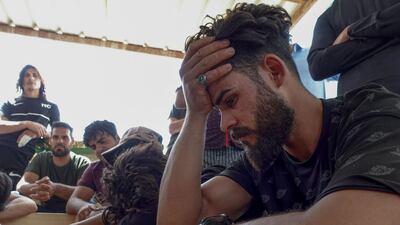
Iraqis transport coffins of relatives killed during a fire in a hospital in the capital, during their funeral in Najaf, April 25. AFP

What does Iraq’s hospital fire say about the regard for human life?


  • English
  • Arabic

Iraqis cannot catch a break. The country has lurched from conflict to conflict since 1980, brought upon by tyrannical leaders, extremists and sectarian militias and hegemonic or occupying powers. Now, instead of air strikes and suicide bombs, they suffer and die because of corruption and negligence – signifiers of a decrepit ruling order that thinks people's lives have no value.

At the weekend, tragedy struck again. At least 82 people died in a fire, most of them Covid-19 patients and their families, and 110 others were injured as the flames consumed parts of Ibn Al Khateeb hospital in a poor suburb of Baghdad.

Iraq is in the midst of another debilitating coronavirus surge. It is one of the hardest hit countries in the region. With over a million total cases, it is registering hundreds of infections every day.

Decades of violence and corruption have left the country of 40 million without the infrastructure to deal with the pandemic or to have enough medical staff at hand to treat the surge of patients, which is why so many families were at the Ibn Al Khateeb Covid-19 wards – they had to take care of their own loved ones.

Media reports indicated that an exploding oxygen tank was the spark that lit the flame which engulfed the hospital, a repurposed structure that was converted into a coronavirus treatment facility.

Remarkably, officials have said that the hospital lacked smoke detectors, sprinklers and working fire extinguishers. Fire escape routes were shut, and even the false ceilings and walls at the ICU were made from flammable materials, turning a centre for recovery into a death trap.

An Iraqi man waits next to oxygen cylinders for his wife, a patient with Covid-19, at the Ibn Al Khateeb Hospital, Baghdad, April 25. AFP

Corruption and mismanagement are responsible for this tragedy, said the Iraqi President Barham Salih. Given the extent of negligence, those responsible have blood on their hands.

No official lifted a finger to prevent the tragedy

The scenes described by doctors at the hospital are gut-wrenching. One said he could hear patients and their families screaming at a higher floor, unreachable, as some 20 explosions ripped through the structure. The Associated Press said one nurse who was on fire jumped to his death from the window.

Reading the reports on the fire, I was struck by the parallels with last year's explosion in Beirut, which rendered 300,000 people homeless because the authorities allowed 2,000 tonnes of ammonium nitrate to languish in the port for years, until it blew up half the city. An investigation pointed to top officials, but the mafia-like top political echelons of the country have stymied it at every turn, even removing the judge leading it, in order to protect their own.

The two events are, of course, hugely different in scale and it saddens me to compare tragedies in this way. Nevertheless, the cause of the suffering is the same: a disregard for the country’s citizens and their well-being and a betrayal of the right to life.

Iraqis mourn relatives killed during a fire in a hospital in the capital, during a funeral procession in Najaf, April 25. AFP

Reports cite doctors and healthcare workers in Iraq saying they knew the hospitals were like ticking time bombs, but no official lifted a finger to prevent the tragedy.

One thing that always struck me as a reporter in the Middle East, and which was instrumental in my decision to emigrate from the region, is how many avoidable tragedies take place because of discounting ordinary lives, and how few of the perpetrators are held to account.

Tragedies like the fire in Iraq, the Beirut explosion, the train and ferry accidents in Egypt, don't happen because people decide to go out of their way to kill and maim. They happen because of negligence, a deadly callousness, with the implication that people's lives don't matter.

But these lives do matter. Each one of them does. They each had names, a place of birth, stories, dreams, loved ones who cared for them, perhaps children they hoped to nurture into adulthood, favourite foods and favourite songs, things that frightened them and moments of joy etched in their memories.

People are not merely statistics, even though the enormity of the suffering tempts us to treat them as such, because it is difficult to comprehend the scale of loss otherwise.

I do not know whether the families of the victims of Iraq’s latest tragedy will see justice. Nor do I know whether the loved ones of those who died in the Beirut blast will see the perpetrators held accountable. Will justice be delivered to other victims of incalculable other tragedies that have befallen the region, from a sheer lack empathy and humanity? It is too early to tell. But history suggests justice will be elusive.

I don’t see a way out of the collective trauma in Iraq, Lebanon, Syria and elsewhere without a real and honest reckoning with crimes of the past, which might afford the survivors of countless victims a sliver of peace.

Kareem Shaheen is a veteran Middle East correspondent in Canada and a columnist for The National

While you're here

EA Sports FC 26

Publisher: EA Sports

Consoles: PC, PlayStation 4/5, Xbox Series X/S

Rating: 3/5

How it works

Each player begins with one of the great empires of history, from Julius Caesar's Rome to Ramses of Egypt, spread over Europe and the Middle East.

Round by round, the player expands their empire. The more land they have, the more money they can take from their coffers for each go.

As unruled land and soldiers are acquired, players must feed them. When a player comes up against land held by another army, they can choose to battle for supremacy.

A dice-based battle system is used and players can get the edge on their enemy with by deploying a renowned hero on the battlefield.

Players that lose battles and land will find their coffers dwindle and troops go hungry. The end goal? Global domination of course.

'The Lost Daughter'

Director: Maggie Gyllenhaal

Starring: Olivia Colman, Jessie Buckley, Dakota Johnson

Rating: 4/5

Company%20Profile
%3Cp%3E%3Cstrong%3ECompany%20name%3A%3C%2Fstrong%3E%20Cargoz%3Cbr%3E%3Cstrong%3EDate%20started%3A%3C%2Fstrong%3E%20January%202022%3Cbr%3E%3Cstrong%3EFounders%3A%3C%2Fstrong%3E%20Premlal%20Pullisserry%20and%20Lijo%20Antony%3Cbr%3E%3Cstrong%3EBased%3A%3C%2Fstrong%3E%20Dubai%3Cbr%3E%3Cstrong%3ENumber%20of%20staff%3A%3C%2Fstrong%3E%2030%3Cbr%3E%3Cstrong%3EInvestment%20stage%3A%3C%2Fstrong%3E%20Seed%3C%2Fp%3E%0A
Tu%20Jhoothi%20Main%20Makkaar%20
%3Cp%3E%3Cstrong%3EDirector%3A%20%3C%2Fstrong%3ELuv%20Ranjan%26nbsp%3B%3C%2Fp%3E%0A%3Cp%3E%3Cstrong%3EStars%3A%20%3C%2Fstrong%3ERanbir%20Kapoor%2C%20Shraddha%20Kapoor%2C%20Anubhav%20Singh%20Bassi%20and%20Dimple%20Kapadia%3C%2Fp%3E%0A%3Cp%3E%3Cstrong%3ERating%3A%3C%2Fstrong%3E%203%2F5%3C%2Fp%3E%0A
UAE currency: the story behind the money in your pockets
The specs

Engine: Four electric motors, one at each wheel

Power: 579hp

Torque: 859Nm

Transmission: Single-speed automatic

Price: From Dh825,900

On sale: Now

TWISTERS

Director: Lee Isaac Chung

Starring: Glen Powell, Daisy Edgar-Jones, Anthony Ramos

Rating: 2.5/5

Ms Yang's top tips for parents new to the UAE
  1. Join parent networks
  2. Look beyond school fees
  3. Keep an open mind
GIANT REVIEW

Starring: Amir El-Masry, Pierce Brosnan

Director: Athale

Rating: 4/5

Nayanthara: Beyond The Fairy Tale

Starring: Nayanthara, Vignesh Shivan, Radhika Sarathkumar, Nagarjuna Akkineni

Director: Amith Krishnan

Rating: 3.5/5

The biog

Fatima Al Darmaki is an Emirati widow with three children

She has received 46 certificates of appreciation and excellence throughout her career

She won the 'ideal mother' category at the Minister of Interior Awards for Excellence

Her favourite food is Harees, a slow-cooked porridge-like dish made from boiled wheat berries mixed with chicken

Cry Macho

Director: Clint Eastwood

Stars: Clint Eastwood, Dwight Yoakam

Rating:**

What is Reform?

Reform is a right-wing, populist party led by Nigel Farage, a former MEP who won a seat in the House of Commons last year at his eighth attempt and a prominent figure in the campaign for the UK to leave the European Union.

It was founded in 2018 and originally called the Brexit Party.

Many of its members previously belonged to UKIP or the mainstream Conservatives.

After Brexit took place, the party focused on the reformation of British democracy.

Former Tory deputy chairman Lee Anderson became its first MP after defecting in March 2024.

The party gained support from Elon Musk, and had hoped the tech billionaire would make a £100m donation. However, Mr Musk changed his mind and called for Mr Farage to step down as leader in a row involving the US tycoon's support for far-right figurehead Tommy Robinson who is in prison for contempt of court.

Mercer, the investment consulting arm of US services company Marsh & McLennan, expects its wealth division to at least double its assets under management (AUM) in the Middle East as wealth in the region continues to grow despite economic headwinds, a company official said.

Mercer Wealth, which globally has $160 billion in AUM, plans to boost its AUM in the region to $2-$3bn in the next 2-3 years from the present $1bn, said Yasir AbuShaban, a Dubai-based principal with Mercer Wealth.

Within the next two to three years, we are looking at reaching $2 to $3 billion as a conservative estimate and we do see an opportunity to do so,” said Mr AbuShaban.

Mercer does not directly make investments, but allocates clients’ money they have discretion to, to professional asset managers. They also provide advice to clients.

“We have buying power. We can negotiate on their (client’s) behalf with asset managers to provide them lower fees than they otherwise would have to get on their own,” he added.

Mercer Wealth’s clients include sovereign wealth funds, family offices, and insurance companies among others.

From its office in Dubai, Mercer also looks after Africa, India and Turkey, where they also see opportunity for growth.

Wealth creation in Middle East and Africa (MEA) grew 8.5 per cent to $8.1 trillion last year from $7.5tn in 2015, higher than last year’s global average of 6 per cent and the second-highest growth in a region after Asia-Pacific which grew 9.9 per cent, according to consultancy Boston Consulting Group (BCG). In the region, where wealth grew just 1.9 per cent in 2015 compared with 2014, a pickup in oil prices has helped in wealth generation.

BCG is forecasting MEA wealth will rise to $12tn by 2021, growing at an annual average of 8 per cent.

Drivers of wealth generation in the region will be split evenly between new wealth creation and growth of performance of existing assets, according to BCG.

Another general trend in the region is clients’ looking for a comprehensive approach to investing, according to Mr AbuShaban.

“Institutional investors or some of the families are seeing a slowdown in the available capital they have to invest and in that sense they are looking at optimizing the way they manage their portfolios and making sure they are not investing haphazardly and different parts of their investment are working together,” said Mr AbuShaban.

Some clients also have a higher appetite for risk, given the low interest-rate environment that does not provide enough yield for some institutional investors. These clients are keen to invest in illiquid assets, such as private equity and infrastructure.

“What we have seen is a desire for higher returns in what has been a low-return environment specifically in various fixed income or bonds,” he said.

“In this environment, we have seen a de facto increase in the risk that clients are taking in things like illiquid investments, private equity investments, infrastructure and private debt, those kind of investments were higher illiquidity results in incrementally higher returns.”

The Abu Dhabi Investment Authority, one of the largest sovereign wealth funds, said in its 2016 report that has gradually increased its exposure in direct private equity and private credit transactions, mainly in Asian markets and especially in China and India. The authority’s private equity department focused on structured equities owing to “their defensive characteristics.”

COMPANY PROFILE
Name: Kumulus Water
 
Started: 2021
 
Founders: Iheb Triki and Mohamed Ali Abid
 
Based: Tunisia 
 
Sector: Water technology 
 
Number of staff: 22 
 
Investment raised: $4 million 
Timeline

2012-2015

The company offers payments/bribes to win key contracts in the Middle East

May 2017

The UK SFO officially opens investigation into Petrofac’s use of agents, corruption, and potential bribery to secure contracts

September 2021

Petrofac pleads guilty to seven counts of failing to prevent bribery under the UK Bribery Act

October 2021

Court fines Petrofac £77 million for bribery. Former executive receives a two-year suspended sentence 

December 2024

Petrofac enters into comprehensive restructuring to strengthen the financial position of the group

May 2025

The High Court of England and Wales approves the company’s restructuring plan

July 2025

The Court of Appeal issues a judgment challenging parts of the restructuring plan

August 2025

Petrofac issues a business update to execute the restructuring and confirms it will appeal the Court of Appeal decision

October 2025

Petrofac loses a major TenneT offshore wind contract worth €13 billion. Holding company files for administration in the UK. Petrofac delisted from the London Stock Exchange

November 2025

180 Petrofac employees laid off in the UAE

Where to donate in the UAE

The Emirates Charity Portal

You can donate to several registered charities through a “donation catalogue”. The use of the donation is quite specific, such as buying a fan for a poor family in Niger for Dh130.

The General Authority of Islamic Affairs & Endowments

The site has an e-donation service accepting debit card, credit card or e-Dirham, an electronic payment tool developed by the Ministry of Finance and First Abu Dhabi Bank.

Al Noor Special Needs Centre

You can donate online or order Smiles n’ Stuff products handcrafted by Al Noor students. The centre publishes a wish list of extras needed, starting at Dh500.

Beit Al Khair Society

Beit Al Khair Society has the motto “From – and to – the UAE,” with donations going towards the neediest in the country. Its website has a list of physical donation sites, but people can also contribute money by SMS, bank transfer and through the hotline 800-22554.

Dar Al Ber Society

Dar Al Ber Society, which has charity projects in 39 countries, accept cash payments, money transfers or SMS donations. Its donation hotline is 800-79.

Dubai Cares

Dubai Cares provides several options for individuals and companies to donate, including online, through banks, at retail outlets, via phone and by purchasing Dubai Cares branded merchandise. It is currently running a campaign called Bookings 2030, which allows people to help change the future of six underprivileged children and young people.

Emirates Airline Foundation

Those who travel on Emirates have undoubtedly seen the little donation envelopes in the seat pockets. But the foundation also accepts donations online and in the form of Skywards Miles. Donated miles are used to sponsor travel for doctors, surgeons, engineers and other professionals volunteering on humanitarian missions around the world.

Emirates Red Crescent

On the Emirates Red Crescent website you can choose between 35 different purposes for your donation, such as providing food for fasters, supporting debtors and contributing to a refugee women fund. It also has a list of bank accounts for each donation type.

Gulf for Good

Gulf for Good raises funds for partner charity projects through challenges, like climbing Kilimanjaro and cycling through Thailand. This year’s projects are in partnership with Street Child Nepal, Larchfield Kids, the Foundation for African Empowerment and SOS Children's Villages. Since 2001, the organisation has raised more than $3.5 million (Dh12.8m) in support of over 50 children’s charities.

Noor Dubai Foundation

Sheikh Mohammed bin Rashid Al Maktoum launched the Noor Dubai Foundation a decade ago with the aim of eliminating all forms of preventable blindness globally. You can donate Dh50 to support mobile eye camps by texting the word “Noor” to 4565 (Etisalat) or 4849 (du).

INVESTMENT PLEDGES

Cartlow: $13.4m

Rabbitmart: $14m

Smileneo: $5.8m

Soum: $4m

imVentures: $100m

Plug and Play: $25m
