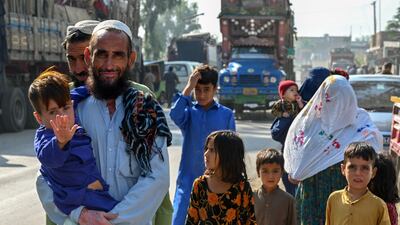
Sarfraz Bugti, Pakistan’s caretaker Interior Minister, announced at the start of October that the country’s caretaker government would begin the expulsion of 1.7 million unregistered Afghan refugees, with the deadline set for November 1. The deportations have already begun, and on Thursday Pakistani officials announced the establishment of deportation centres to hold any undocumented foreigners who have not left by the deadline. The plan represents the largest forced repatriation since the establishment of the UN’s Refugee Convention in 1951, which was created to prevent actions like these.
Although Pakistan is not a signatory to the treaty, the UN’s Refugee and Migration agencies have appealed to Islamabad to reconsider. What has prompted Pakistan to pursue a path that will cause so much human suffering, and is so contrary to established norms?
Caretaker governments are meant to provide non-partisan governance during election campaigns. Given this limited mandate, they rarely take major decisions. Pakistan’s current caretaker government stands out in particular because it is composed of figures selected by the military rather than the major political parties. This has an impact because Pakistan’s Afghan refugee policy has always been weighted towards security interests in Afghanistan. The nature of those interests, however, have sharply changed over time.
The Afghan refugees who began streaming into Pakistan after the Soviet invasion of 1979 were welcomed in large part because Pakistan wanted to ensure that the Afghan resistance had a large and secure social base of support. As Moscow withdrew its forces in the late 1980s, senior Pakistani strategists envisioned and advocated a future where the two countries had fully integrated their economies, or even entered into confederation. The sheer size of the Afghan population in Pakistan and the openness of the border allowed Pakistan to dominate Afghanistan’s economy and politics.
But the emergence of the Pakistani Taliban (the TTP) in 2007 changed all of that. The TTP’s ferocious insurgency was like nothing Pakistani army generals had ever experienced, or even imagined. The scale and reach of the TTP’s violence were certainly shocking, but the depth of the ideological challenge was even more terrifying. Armed forces personnel of every background seemed susceptible to a message that denied legitimate authority to anyone other than a reclusive one-eyed Afghan preacher.
It is no accident that Pakistan stopped granting formal refugee status to new arrivals after 2007. And after the horrific Army Public School massacre that took place in Peshawar in December 2014, the Pakistani government began mass forced repatriations on a scale that had not been seen since Partition. Over 400,000 displaced Afghans were sent back, forcing Kabul to seek some kind of detente with Pakistan.
Afghan refugees, it should be noted, had nothing to do with the TTP and its violence. In fact, the TTP had been largely driven out of its safe havens by a series of army offensives in the semi-autonomous “tribal agencies” along the border. The displaced militants then began to operate from territory vacated by the Kabul government. By 2017, the expulsions of refugees had stopped, but in exchange the Afghan government reluctantly accepted Pakistan’s fencing of the border.
Today it is the Taliban’s Islamic Emirate, rather than the elected and pro-western leadership of the Afghan republic that sits in Kabul, but Pakistan’s choices have not changed for the better. That is because, remarkably, the TTP received support from both of these very different, and very mutually hostile Afghan regimes. Every Afghan government of the past 75 years – royalist, communist, democratic and clerical – has found itself unable to accept the legitimacy of Pakistan’s colonial borders, and this has inevitably led to conflict with Pakistan.
On top of that Pakistan has cracked down on the highly profitable transit trade between Afghanistan and Pakistan, threatening the Taliban’s tax base
Beyond the clash of nationalisms, the Afghan Taliban feels an additional ideological compulsion to support its sister movement, the Pakistani Taliban. The Pakistani government’s on-and-off transactional support to the Afghan Taliban is simply no match for what the Taliban leadership seems to sincerely believe is a matter of faith.
Thanks to the US pullout and the Taliban’s takeover in Kabul in 2021, the TTP has emerged as a reinvigorated force, with an enormous safe haven and no shortage of weapons. The result has been an expanding insurgency in Pakistan’s provinces of Khyber-Pakhtunkhwa and Balochistan, with hundreds of attacks conducted this year alone.
Pakistani forces have not yet been able to turn this tide, despite steadily mounting casualties. After the divisive and bruising battle with Imran Khan, and the near-meltdown of the economy, the failure to maintain peace and security is an extremely serious political problem for the military’s legitimacy.
Although Pakistan has threatened military force against the Afghan Taliban, and even carried out airstrikes on Afghan soil, there is considerable reluctance to get bogged down in the same kind of war that exhausted the Soviets and American superpowers. Especially when Pakistani forces are already stretched between multiple insurgencies. Instead, the goal seems to be to wage an indirect economic war on the Taliban.
A million and a half returnees would put severe pressure on food and housing prices as well as public resources. On top of that Pakistan has cracked down on the highly profitable transit trade between Afghanistan and Pakistan, threatening the Taliban’s tax base. Cumulatively, the hope seems to be that these actions will challenge the Islamic Emirate’s economic stability, and ultimately its domestic legitimacy, without creating a military crisis.
Unfortunately, the Afghan Taliban’s track record does not suggest that they respond to such high visibility external pressure of any sort, whether military or economic. The Taliban’s threshold for pain and its options for escalation remain far higher than that of Pakistan.
Meanwhile, the Pakistani government’s current policies will likely cause immense suffering to refugees and border communities in both countries, which will likely add rather than alleviate its security burden. The radicalisation of Afghan refugees against their adopted country can very easily be transformed from a false stereotype to a self-fulfilling prophecy.
It is clear that Pakistan requires the support of the international community to take on the TTP and to restrain the Taliban. But in turn it must uphold international norms when it comes to the treatment of refugees.

More from Neighbourhood Watch
Haircare resolutions 2021
From Beirut and Amman to London and now Dubai, hairstylist George Massoud has seen the same mistakes made by customers all over the world. In the chair or at-home hair care, here are the resolutions he wishes his customers would make for the year ahead.
1. 'I will seek consultation from professionals'
You may know what you want, but are you sure it’s going to suit you? Haircare professionals can tell you what will work best with your skin tone, hair texture and lifestyle.
2. 'I will tell my hairdresser when I’m not happy'
Massoud says it’s better to offer constructive criticism to work on in the future. Your hairdresser will learn, and you may discover how to communicate exactly what you want more effectively the next time.
3. ‘I will treat my hair better out of the chair’
Damage control is a big part of most hairstylists’ work right now, but it can be avoided. Steer clear of over-colouring at home, try and pursue one hair brand at a time and never, ever use a straightener on still drying hair, pleads Massoud.
Key facilities
- Olympic-size swimming pool with a split bulkhead for multi-use configurations, including water polo and 50m/25m training lanes
- Premier League-standard football pitch
- 400m Olympic running track
- NBA-spec basketball court with auditorium
- 600-seat auditorium
- Spaces for historical and cultural exploration
- An elevated football field that doubles as a helipad
- Specialist robotics and science laboratories
- AR and VR-enabled learning centres
- Disruption Lab and Research Centre for developing entrepreneurial skills
Other ways to buy used products in the UAE
UAE insurance firm Al Wathba National Insurance Company (AWNIC) last year launched an e-commerce website with a facility enabling users to buy car wrecks.
Bidders and potential buyers register on the online salvage car auction portal to view vehicles, review condition reports, or arrange physical surveys, and then start bidding for motors they plan to restore or harvest for parts.
Physical salvage car auctions are a common method for insurers around the world to move on heavily damaged vehicles, but AWNIC is one of the few UAE insurers to offer such services online.
For cars and less sizeable items such as bicycles and furniture, Dubizzle is arguably the best-known marketplace for pre-loved.
Founded in 2005, in recent years it has been joined by a plethora of Facebook community pages for shifting used goods, including Abu Dhabi Marketplace, Flea Market UAE and Arabian Ranches Souq Market while sites such as The Luxury Closet and Riot deal largely in second-hand fashion.
At the high-end of the pre-used spectrum, resellers such as Timepiece360.ae, WatchBox Middle East and Watches Market Dubai deal in authenticated second-hand luxury timepieces from brands such as Rolex, Hublot and Tag Heuer, with a warranty.
MATCH INFO
Uefa Champions League final:
Who: Real Madrid v Liverpool
Where: NSC Olimpiyskiy Stadium, Kiev, Ukraine
When: Saturday, May 26, 10.45pm (UAE)
TV: Match on BeIN Sports
Your rights as an employee
The government has taken an increasingly tough line against companies that fail to pay employees on time. Three years ago, the Cabinet passed a decree allowing the government to halt the granting of work permits to companies with wage backlogs.
The new measures passed by the Cabinet in 2016 were an update to the Wage Protection System, which is in place to track whether a company pays its employees on time or not.
If wages are 10 days late, the new measures kick in and the company is alerted it is in breach of labour rules. If wages remain unpaid for a total of 16 days, the authorities can cancel work permits, effectively shutting off operations. Fines of up to Dh5,000 per unpaid employee follow after 60 days.
Despite those measures, late payments remain an issue, particularly in the construction sector. Smaller contractors, such as electrical, plumbing and fit-out businesses, often blame the bigger companies that hire them for wages being late.
The authorities have urged employees to report their companies at the labour ministry or Tawafuq service centres — there are 15 in Abu Dhabi.
Kill%20Bill%20Volume%201
%3Cp%3E%3Cstrong%3EDirector%3C%2Fstrong%3E%3A%20Quentin%20Tarantino%3Cbr%3E%3Cstrong%3EStars%3C%2Fstrong%3E%3A%20Uma%20Thurman%2C%20David%20Carradine%20and%20Michael%20Madsen%3Cbr%3E%3Cstrong%3ERating%3C%2Fstrong%3E%3A%204.5%2F5%3C%2Fp%3E%0A
The National Archives, Abu Dhabi
Founded over 50 years ago, the National Archives collects valuable historical material relating to the UAE, and is the oldest and richest archive relating to the Arabian Gulf.
Much of the material can be viewed on line at the Arabian Gulf Digital Archive - https://www.agda.ae/en
Jetour T1 specs
Engine: 2-litre turbocharged
Power: 254hp
Torque: 390Nm
Price: From Dh126,000
Available: Now
Desert Warrior
Starring: Anthony Mackie, Aiysha Hart, Ben Kingsley
Director: Rupert Wyatt
Rating: 3/5
Jebel Ali card
1.45pm: Maiden Dh75,000 1,400m
2.15pm: Handicap Dh90,000 1,400m
2.45pm: Maiden Dh75,000 1,000m
3.15pm: Handicap Dh105,000 1,200m
3.45pm: Maiden Dh75,000 1,600m
4.15pm: Handicap Dh105,000 1,600m
4.45pm: Handicap Dh80,000 1,800m
The National selections
1.45pm: Cosmic Glow
2.15pm: Karaginsky
2.45pm: Welcome Surprise
3.15pm: Taamol
3.45pm: Rayig
4.15pm: Chiefdom
4.45pm: California Jumbo
Mercer, the investment consulting arm of US services company Marsh & McLennan, expects its wealth division to at least double its assets under management (AUM) in the Middle East as wealth in the region continues to grow despite economic headwinds, a company official said.
Mercer Wealth, which globally has $160 billion in AUM, plans to boost its AUM in the region to $2-$3bn in the next 2-3 years from the present $1bn, said Yasir AbuShaban, a Dubai-based principal with Mercer Wealth.
“Within the next two to three years, we are looking at reaching $2 to $3 billion as a conservative estimate and we do see an opportunity to do so,” said Mr AbuShaban.
Mercer does not directly make investments, but allocates clients’ money they have discretion to, to professional asset managers. They also provide advice to clients.
“We have buying power. We can negotiate on their (client’s) behalf with asset managers to provide them lower fees than they otherwise would have to get on their own,” he added.
Mercer Wealth’s clients include sovereign wealth funds, family offices, and insurance companies among others.
From its office in Dubai, Mercer also looks after Africa, India and Turkey, where they also see opportunity for growth.
Wealth creation in Middle East and Africa (MEA) grew 8.5 per cent to $8.1 trillion last year from $7.5tn in 2015, higher than last year’s global average of 6 per cent and the second-highest growth in a region after Asia-Pacific which grew 9.9 per cent, according to consultancy Boston Consulting Group (BCG). In the region, where wealth grew just 1.9 per cent in 2015 compared with 2014, a pickup in oil prices has helped in wealth generation.
BCG is forecasting MEA wealth will rise to $12tn by 2021, growing at an annual average of 8 per cent.
Drivers of wealth generation in the region will be split evenly between new wealth creation and growth of performance of existing assets, according to BCG.
Another general trend in the region is clients’ looking for a comprehensive approach to investing, according to Mr AbuShaban.
“Institutional investors or some of the families are seeing a slowdown in the available capital they have to invest and in that sense they are looking at optimizing the way they manage their portfolios and making sure they are not investing haphazardly and different parts of their investment are working together,” said Mr AbuShaban.
Some clients also have a higher appetite for risk, given the low interest-rate environment that does not provide enough yield for some institutional investors. These clients are keen to invest in illiquid assets, such as private equity and infrastructure.
“What we have seen is a desire for higher returns in what has been a low-return environment specifically in various fixed income or bonds,” he said.
“In this environment, we have seen a de facto increase in the risk that clients are taking in things like illiquid investments, private equity investments, infrastructure and private debt, those kind of investments were higher illiquidity results in incrementally higher returns.”
The Abu Dhabi Investment Authority, one of the largest sovereign wealth funds, said in its 2016 report that has gradually increased its exposure in direct private equity and private credit transactions, mainly in Asian markets and especially in China and India. The authority’s private equity department focused on structured equities owing to “their defensive characteristics.”
The specs
Engine: 2.0-litre 4-cyl turbo
Power: 201hp at 5,200rpm
Torque: 320Nm at 1,750-4,000rpm
Transmission: 6-speed auto
Fuel consumption: 8.7L/100km
Price: Dh133,900
On sale: now
Start times
5.55am: Wheelchair Marathon Elites
6am: Marathon Elites
7am: Marathon Masses
9am: 10Km Road Race
11am: 4Km Fun Run
EVIL%20DEAD%20RISE
%3Cp%3E%3Cstrong%3EDirector%3A%20%3C%2Fstrong%3ELee%20Cronin%3Cbr%3E%3Cstrong%3EStars%3A%20%3C%2Fstrong%3EAlyssa%20Sutherland%2C%20Morgan%20Davies%2C%20Lily%20Sullivan%3Cbr%3E%3Cstrong%3ERating%3A%3C%2Fstrong%3E%205%2F5%3C%2Fp%3E%0A
Avatar: Fire and Ash
Director: James Cameron
Starring: Sam Worthington, Sigourney Weaver, Zoe Saldana
Rating: 4.5/5
THE SPECS
Engine: 3-litre V6
Transmission: eight-speed automatic
Power: 424hp
Torque: 580 Nm
Price: From Dh399,000
On sale: Now
Key findings of Jenkins report
- Founder of the Muslim Brotherhood, Hassan al Banna, "accepted the political utility of violence"
- Views of key Muslim Brotherhood ideologue, Sayyid Qutb, have “consistently been understood” as permitting “the use of extreme violence in the pursuit of the perfect Islamic society” and “never been institutionally disowned” by the movement.
- Muslim Brotherhood at all levels has repeatedly defended Hamas attacks against Israel, including the use of suicide bombers and the killing of civilians.
- Laying out the report in the House of Commons, David Cameron told MPs: "The main findings of the review support the conclusion that membership of, association with, or influence by the Muslim Brotherhood should be considered as a possible indicator of extremism."
'Outclassed in Kuwait'
Taleb Alrefai,
HBKU Press
Biography
Her family: She has four sons, aged 29, 27, 25 and 24 and is a grandmother-of-nine
Favourite book: Flashes of Thought by Sheikh Mohammed bin Rashid
Favourite drink: Water
Her hobbies: Reading and volunteer work
Favourite music: Classical music
Her motto: I don't wait, I initiate
Quick facts on cancer
- Cancer is the second-leading cause of death worldwide, after cardiovascular diseases
- About one in five men and one in six women will develop cancer in their lifetime
- By 2040, global cancer cases are on track to reach 30 million
- 70 per cent of cancer deaths occur in low and middle-income countries
- This rate is expected to increase to 75 per cent by 2030
- At least one third of common cancers are preventable
- Genetic mutations play a role in 5 per cent to 10 per cent of cancers
- Up to 3.7 million lives could be saved annually by implementing the right health
strategies
- The total annual economic cost of cancer is $1.16 trillion
THE%20SWIMMERS
%3Cp%3E%3Cstrong%3EDirector%3A%20%3C%2Fstrong%3ESally%20El-Hosaini%3C%2Fp%3E%0A%3Cp%3E%3Cstrong%3EStars%3A%20%3C%2Fstrong%3ENathalie%20Issa%2C%20Manal%20Issa%2C%20Ahmed%20Malek%20and%20Ali%20Suliman%C2%A0%3C%2Fp%3E%0A%3Cp%3E%3Cstrong%3ERating%3A%20%3C%2Fstrong%3E4%2F5%3C%2Fp%3E%0A
UAE currency: the story behind the money in your pockets
What are the influencer academy modules?
- Mastery of audio-visual content creation.
- Cinematography, shots and movement.
- All aspects of post-production.
- Emerging technologies and VFX with AI and CGI.
- Understanding of marketing objectives and audience engagement.
- Tourism industry knowledge.
- Professional ethics.
More coverage from the Future Forum
So what is Spicy Chickenjoy?
Just as McDonald’s has the Big Mac, Jollibee has Spicy Chickenjoy – a piece of fried chicken that’s crispy and spicy on the outside and comes with a side of spaghetti, all covered in tomato sauce and topped with sausage slices and ground beef. It sounds like a recipe that a child would come up with, but perhaps that’s the point – a flavourbomb combination of cheap comfort foods. Chickenjoy is Jollibee’s best-selling product in every country in which it has a presence.
Racecard:
6.30pm: Mazrat Al Ruwayah (PA) | Group 2 | US$55,000 (Dirt) | 1,600 metres
7.05pm: Meydan Sprint (TB) | Group 2 | $250,000 (Turf) | 1,000m
7.40pm: Firebreak Stakes | Group 3 | $200,000 (D) | 1,600m
8.15pm: Meydan Trophy | Conditions (TB) | $100,000 (T) | 1,900m
8.50pm: Balanchine | Group 2 (TB) | $250,000 (T) | 1,800m
9.25pm: Handicap (TB) | $135,000 (D) | 1,200m
10pm: Handicap (TB) | $175,000 (T) | 2,410m.
What is tokenisation?
Tokenisation refers to the issuance of a blockchain token, which represents a virtually tradable real, tangible asset. A tokenised asset is easily transferable, offers good liquidity, returns and is easily traded on the secondary markets.
