


You only miss a quiet and normal life when it is taken away from you.
My mother, Nahid Taghavi, has been a political hostage of the Iranian regime since October 16, 2020.
It was a Friday evening in October 2020 when my mother stopped replying to my messages. “You’re online, why aren’t you replying?” was my last message to her. My family in Iran went looking for her. Two days later, I received a call from my family: “Your mother is in solitary confinement in Evin Prison. We were told it was a national security case. Neither we nor a lawyer are allowed to see her.”
The blood in my veins froze – crisis mode set in.
If you grow up in a political family like I did, Evin Prison and political imprisonment are familiar concepts, having heard of them throughout my childhood. I always knew that in the country where I was born, in the country where my roots lie, bad things happen – people can be arrested and even executed because of their political views and activities. But for me – 5,000 kilometres away in my homeland Germany – it was a different world.
In October 2020, however, my bubble burst and the burden of the Iranian regime’s human rights violations fell on my shoulders. Since my mother is a German citizen, the first thing I did was contact the German Foreign Office. I was promised that they would intervene and was advised not to make the case public, instead to rely on quiet diplomacy. I resisted this recommendation and continue to do so today.
It was as if everything I had learned from my mother had been lying dormant inside me for decades, waiting for the moment to unfold. I researched, created social media accounts and provided information about the latest developments using the hashtag #FreeNahid. The media began to take notice and I started giving my first interviews. Suddenly my mother’s name was in the headlines of major newspapers, and NGOs like Amnesty International took on the case.
Three years later, I continue to use every means at my disposal to ensure that my mother is not forgotten.

Meanwhile, my mother, then 66, spent seven months in solitary confinement in Evin Prison. She was interrogated by the Islamic Revolutionary Guard Corps’ secret service for more than 1,000 hours without access to her lawyer. During this time, she developed diabetes and several herniated discs.
The conditions in solitary confinement are designed to break the prisoner. My mother slept on a stone floor in a small cell, alone, without a bed, mattress or pillow for 194 days. She wore a blindfold for months, was monitored by cameras and had little access to fresh air. The food rations were deliberately kept small; she lost 14 kilograms during this time. Her health deteriorated rapidly, but they failed to break her spirit.
My mother’s trials were a farce. The Iranian regime charged her with “participation in the leadership of an illegal group” and “propaganda activities against the state”. My mother’s reply in court: “If propaganda means talking about the disastrous women’s rights situation, the mismanagement, the poverty, the corruption and the destruction of the environment, then I am guilty.” In August 2021, she was sentenced to 10 years and eight months in prison. The regime criminalised her opinions, her words and her thoughts.
Politically motivated detentions are part of the repressive apparatus of the theocratic rulers in Iran. Since the outbreak of the revolutionary movement in September 2022, following the death of Mahsa Amini in police custody, there have been more than 20,000 new detentions.
What makes my mother’s case different is her German citizenship. The regime runs a lucrative business with its hostage diplomacy. For decades, western nationals have been arrested in order to negotiate the release of Iranian agents, secure political and economic concessions, or blatantly extort money.
Since May of this year, six European and five US citizens have been freed from Iranian hostage custody. Their governments had made their release a priority, established task forces and involved their families in their strategic considerations and actions.
Belgium, Austria and Denmark were able to bring their citizens home in a controversial prisoner exchange; France had previously brought two of its compatriots back safely.
-
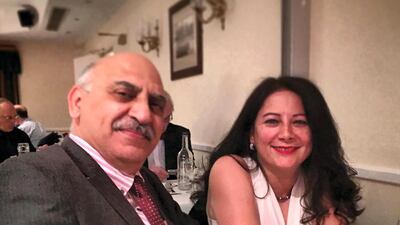
Anoosheh Ashoori with his wife before his arrest in Iran in 2017. Image provided by family -
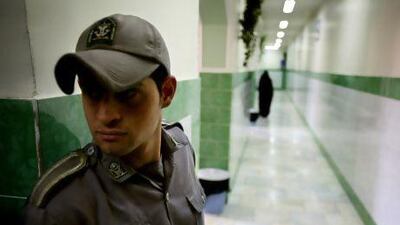
A guard stands along a corridor in Tehran's Evin prison. Reuters -
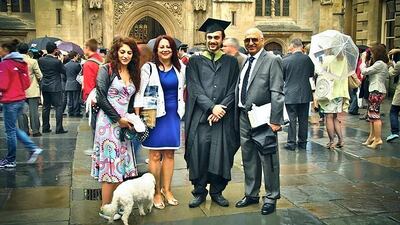
Anoosheh Ashoori (far-right) with his family in the UK before his arrest and detention in Iran. Image provided by family -
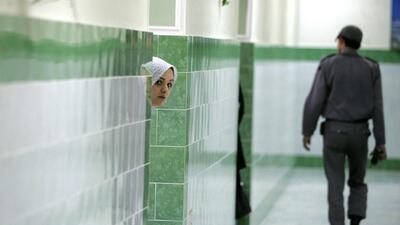
Anoosheh Ashoori told how sick prisoners suspected to have coronavirus have disappeared. AFP -

Nazanin Zaghari-Ratcliffe, a British-Iranian, embraces her daughter Gabriella during a brief period of release from Tehran's Evin jail. AFP


Then on August 10, came the sensational news: five US prisoners of Iranian origin were to be released after years of imprisonment. In return, Washington agreed to release $6 billion in the form of frozen assets of the Iranian regime.
Only in the German Foreign Office does the liberation of a German citizen appear not to be on the agenda.
To date, there has not even been a public demand for my mother’s release. To date, there is no strategy for her safe return to Germany. To date, Foreign Minister Annalena Baerbock has not met me, as the daughter of a German woman detained in Iran. Even when the Nobel Peace Prize winner and fellow inmate of my mother, Narges Mohammadi, wrote an open letter to the public in June, drawing attention to my mother’s catastrophic health condition, no measures were taken in Berlin. They haven’t been to this day.
The German government and companies have maintained close political and economic relations with the regime in Tehran for many years. Germany is Iran’s largest European trading partner. As far as leverage goes, there is certainly plenty.
Current policies and economic interests give the impression that this government, like previous ones, prefers a softer approach towards the Iranian regime. My mother, and ultimately the Iranian population pay the price.
But I will do everything in my power to ensure that my mother doesn’t have to spend her fourth anniversary in Evin Prison. In the hope that the German government will follow up its value-driven words with corresponding actions. Anything else will not be forgotten by history.

