
Sepideh Kashani was an administrator at the now-defunct Persian Wildlife Heritage Foundation, Iran’s premier conservation NGO. She was as well-behaved and unassuming a prisoner as the guards could have asked for. Despite the fact that we were being held in a maximum-security detention facility, the guards sometimes forgot to close the door of her cell, and Sepideh would pull it closed herself.
Both of us spent most of our time in solitary confinement, but for a time we shared a small, cramped cell. Forced to wear blindfolds every time we left it, Sepideh would pull hers firmly over her eyes and stumble around on the arm of the guard, whereas I was forever getting in trouble for wearing mine high on my forehead, my roving eyes registering every detail of the detention site and the shady, nameless individuals who ran it.
However, the day Sepideh found out that her husband, Houman Jokar, had been savagely beaten under the stairs in the interrogation block, something inside her snapped. Quiet, obedient Sepideh, who by this point had spent more than 18 months of her life sleeping on the floor of a cold, windowless cell, simply couldn’t stand that image of her intellectual, softly spoken husband, Iran’s foremost expert on big cat conservation, handcuffed and bleeding, his glasses broken and his ribs kicked in.
Houman was an employee of both the Iranian Department of Environment and the UN office in Iran when he and Sepideh were arrested along with seven other colleagues and charged with security offences by Iran’s Islamic Revolutionary Guard Corps.
“Do whatever you want to me,” she had screamed at the manager of the facility, “but don’t touch him. You can kill me if you want, but if you people touch him again, I will kill you!”
Following a meeting with her husband, Sepideh had entered the Afsar Negahbani reception area of the infamous 2A detention facility within Tehran’s Evin prison, run by the IRGC’s intelligence branch. The duty officer’s desk featured a glass barrier and wood panelling, and prisoners would regularly approach it to fill out forms stating that they had returned from a family meeting or had been granted a phone call. Ripping off her blindfold, Sepideh launched herself at this desk, smashing her bare fist through the glass and scattering shards all over the room like shrapnel.
Screaming incoherently about Houman’s unprovoked beating, she grabbed a large splinter of glass in her hand. What she intended to do with it not even she herself knew, because at this moment several burly interrogators jumped on her and held her down. One dug the heel of his shoe into her wrist to force her to drop the sharp piece of glass she was holding.
In conservative Iran, physical contact between female prisoners and their male captors was strictly forbidden and tightly policed. One of my cell mates had even been censured for hugging her own male cousin in a family meeting because cousins are considered potential suitors. However, Sepideh had completely “lost it”, and desperate times called for desperate measures. Knowing the perverse and sadistic way in which these interrogators operate, they may have even enjoyed it.

When innocent people are subjected to systemic injustice, there is almost always a moment in which the individual makes the decision to write-off the entire system itself. To stop hoping that justice will somehow miraculously be restored, to stop wondering whether your own case is an anomaly and to expect that someone will realise that you are innocent and will come to set things right.
As humans, we have a deeply programmed, almost instinctive sense of justice and of right and wrong. People who spend their entire lives living under authoritarianism, in the absence of a free and unbiased judiciary, without procedural fairness and the rule of law, experience the same outrage as those who have been more fortunate when suddenly deprived of their rights and their liberty.
Iranian prisoners again and again told me that while they might not be shocked that innocent men and women are jailed in their country for political or ideological reasons, when it happened to them they were still caught unawares. Somehow, no matter how pragmatic they were, some part of them still expected justice. Some part of them still thought, “I haven’t done anything wrong, so it will never happen to me.”
There are many cycles of coping when thrown into a highly restrictive detention facility like 2A, which weaponises solitary confinement as a form of psychological torture designed to pressure inmates into making false confessions. After the initial disbelief and denial, one eventually comes to accept the system and its strange internal logic.
The prisoner still hopes that their lawyer could make a difference, that they might be released during the court process, that a foreign government may intervene, that public pressure might be brought to bear on their captors. Bitter experience in the courtroom and in engagement with prison and judiciary officials usually puts such naive hopes to rest.
By this point, the lies of the interrogators, the duplicity of their puppet-judges and the predetermined nature of the verdict hits home and the prisoner usually takes one of two paths.
The first is to resign themselves to their fate. The prisoner either falls into a deep, helpless despondency or sells their soul to the devil and collaborates with the IRGC in exchange for assurances about freedom. They are then forced into doing all manner of terrible things to both themselves and others to escape prison.
The second is resistance. After that moment of breaking, of giving up on the entire rotten system itself, some prisoners decide to wage war on it. After all, they have nothing to lose. The first path, which involves losing one’s dignity and self-respect, is, for these prisoners, not an option.
These brave fighters, innocent political hostages or regular everyday people unwillingly trapped in disputes involving the government, the IRGC and/or foreign nations, line the dusty corridors of Iran’s prisons. Most of their names you have probably never heard.
-
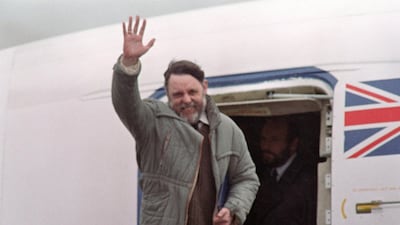
Last of the captured British hostages Terry Waite waves at his arrival in Lyneham, on November 19, 1991, following their release in Lebanon. Iran resorted to hostage-taking during the latter stages of the Lebanese civil war in the 1980s, when scores of foreign nationals, including British hostages John McCarthy and Terry Waite, were seized as part of Tehran’s campaign to end Western intervention in the conflict. AFP -

A freed British hostage John McCarthy (L), 34, addresses the media on August 8, 1991 at the Syrian Foreign Ministry in Damascus, after being released in Beirut after more than five years in captivity. McCarthy was kidnapped in Beirut in 1986. At left, then British Ambassador to Syria, Andrew Flemming-Green. AFP -
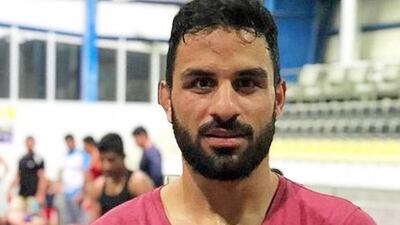
Iranian champion wrestler Navid Afkari was executed this year for his role in the 2018 protests. EPA -
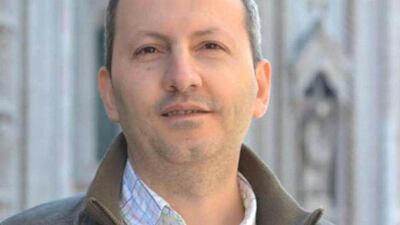
Ahmadreza Djalali, an Iranian-Swedish professor, who has been sentenced to death on spying charges, has been linked to the assassination of a number of high-ranking Iranian scientists said to be working on Iran’s controversial nuclear programme. -
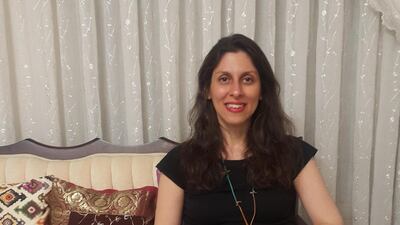
A handout picture released by the Free Nazanin campaign on March 17, 2020 shows Nazanin Zaghari-Ratcliffe wearing an ankle tag as she poses for a photograph in West Tehran, Iran following her release from prison for two weeks. Free Nazanin campaign / AFP -
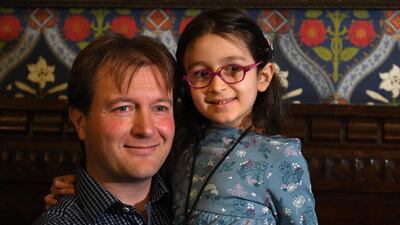
Richard Ratcliffe, husband of British-Iranian aid worker Nazanin Zaghari-Ratcliffe jailed in Tehran since 2016, holds his daughter Gabriella during a news conference in London, on October 11, 2019. The five-year-old daughter of a British-Iranian woman jailed in Tehran since 2016 has arrived back in Britain, her father said Friday, after making the "bittersweet" decision to bring her home. AFP


Many were scooped up and incarcerated by a dragnet of amateurish intelligence-gathering by brainwashed and paranoid operatives who see the hand of the US or Israel behind every anti-regime gathering or online discussion, in a country crippled economically by sanctions and periodically roiled by the protests of the disaffected.
Many are in prison as “payback” – Iran’s intelligence ministry has imprisoned an innocent family member of someone they want to extort or blackmail, or the IRGC have arrested someone in order to get their hands on their assets and eliminate a competitor to their extensive business interests. In many ways, these groups operate like a mafia, and the state-run prison system is their dumping ground.
Sepideh and Houman’s case is a classic example. Following an internal investigation, the Iranian government had determined that the Persian Wildlife Heritage Foundation conservationists are innocent.
Nonetheless, Sepideh and Houman received prison sentences of six and eight years respectively. They continue to languish in Evin prison more than three years later.
I have seen acts of exceptional bravery, even foolhardiness, from fellow inmates like Sepideh Kashani. Regular, everyday people who have been forced to choose between selling out others to escape sometimes decades behind bars, and upholding their principles and calling out the injustices they have been subjected to, even at great personal cost.
They are not famous political prisoners protected from the cruel excesses of prison life by name recognition and vast international campaigns for their freedom.
These brave, ordinary Iranians who refuse to accept a corrupt and biased judiciary, and pit themselves, sometimes alone, against the systemic injustice which has deprived them of even their most basic rights – they are the true heroes.
Dr Kylie Moore-Gilbert is a lecturer in Islamic studies at the University of Melbourne. She was held prisoner in Iran for more than two years before being released in November 2020

