


The UN observes dozens of commemorative days throughout the year, most of which are intended to shine a spotlight on to problems so that we can try to fix them. One such day is World Drowning Prevention Day, on July 25.
Different from World Water Day in March – widely covered and popular with environmentalists, or Tsunami Awareness Day, in November – it is a relatively new addition to the roster of days, having only been introduced in 2021, and perhaps not a year too soon.
Every year, nearly a quarter of a million people die from drowning – 90 per cent from low and middle-income countries and most of them young children.
There were a few unfortunate cases in the UAE that led to a change in regulations in recent years. In May 2021, a 32-year-old woman drowned off the coast of a beach in Umm Al Quwain. Her husband and twin children were also in peril but were saved.
In January of last year, a toddler died at a hotel pool in Ras Al Khaimah. His anguished mother, despite not knowing how to swim, dived into the pool to save him. A hotel guest had to jump in to save the mother. These are rare tragedies in this country, but after this spate of cases, the UAE last August said that children under the age of five would not be allowed in the adult swimming pools in hotels.

Why should it be the case that globally so many people drown? Some of these incidents can be prevented. One straightforward solution is to teach more people to swim. More parents ought to take children to swimming classes and remove the fear of water from young psychs. Apart from the umpteen benefits of pure physical exercise, these classes give children a useful – sometimes life-saving – skill.
It's easier said than done, of course, considering the sheer number of people in the world who have not or cannot take swimming lessons.
The 76th UN World Health Assembly, which took place in Geneva this May, adopted its first resolution on drowning prevention that suggests six low-cost measures for countries and organisations to put into practice.
These include: training bystanders in safe rescue and resuscitation; setting and enforcing safe boating and shipping and ferry regulations; improving flood management locally and nationally; installing barriers to control access to water; providing safe places away from water for preschool children, with capable childcare, and teaching school-age children basic swimming, water safety and safe rescue skills.

Anywhere in the world, those guidelines are as good as any. In the UAE, which has spectacular swimming pools unlike other parts of the developing world where people have little choice but to contend with poor infrastructure, there is ample opportunity for parents and the wider community to boost their skills. Besides the quality, hygiene and sheer number of pools (and perfect weather much of the year to swim), there are professional swimmers in the UAE who've competed on the international circuit and taken on coaching. These are all part of the many opportunities here to pick up a sport and fine-tune inelegant swim strokes while learning valuable breathing techniques.
Schools could do their bit for those who want to learn to swim to tie up with sports facilities and make it relatively easy and inexpensive for all families to have their children attend swimming lessons. Often what comes in the way of learning to swim is access to a pool, perhaps a parent's limited skill in the water, or affordability.
Most children don’t go to schools that have in-house pools. Not every family in the UAE lives in an apartment block or a villa with such amenities, and coaching lessons can stretch the household budget. Generally speaking, though, there is no lack of swimming pools in the UAE, whether at public sports facilities, in residential apartments or in the vast majority of hotels, if not in every hotel.
While the relatively well-off can afford “day passes” to access hotel pools, countless people could benefit from swimming classes at the beach – much like open-air gyms installed in parks. It could be an inclusive community programme that would ideally welcome people across nationalities, genders, income and age groups. In this way, the UAE could really take the lead in training children and adults in a life skill and making sure people are as well-equipped in their freestyle strokes as in practising safety drills.
While this may be a bit optimistic, the more the number of confident, good swimmers who are trained in safety and rescue skills, the more people can benefit, pass on the skill to others who may want to learn and create a chain of actions that could, eventually, help lower that bleak statistic of 2.5 million people a decade who drown. That improved outcome, however, will not materialise overnight – nor will it happen by just staying away from the water.
-
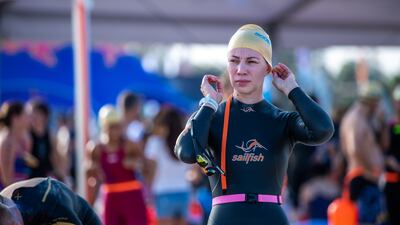
People prepare to take part in the Oceanman Dubai, in Umm Suqeim. All photos: Victor Besa / The National -
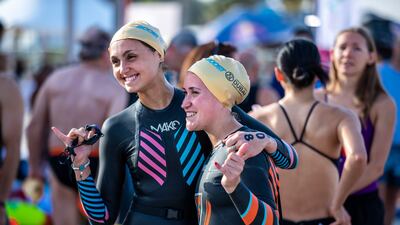
Oceanman open water swimming events give participants the opportunity to achieve their personal goals in unique locations. -
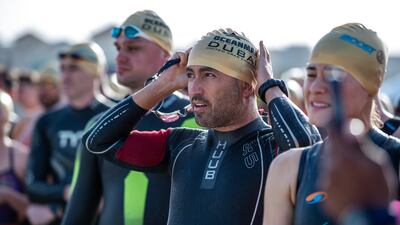
Oceanman has 24 races in 17 different countries around the world. -
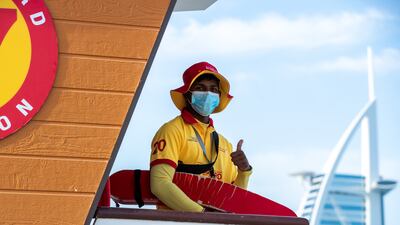
Oceanman Dubai is organised under the aegis of Dubai Sports Council. -
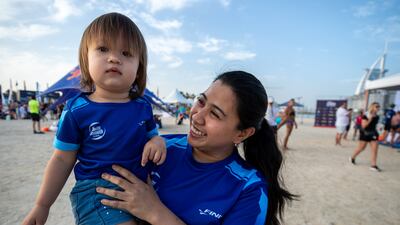
The event in Dubai had five different categories, for people of all ages – the 10-kilometre Oceanman, the 5km Half Oceanman, the 1.5km Spring, the 3x500m Oceanteam and the 500m Oceankids. -
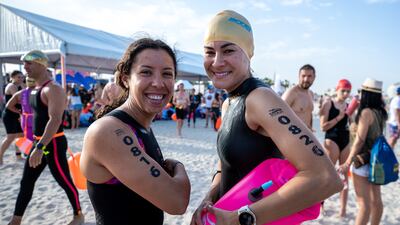
Deema Saidi and Mediha Diyaboglu before the race. -
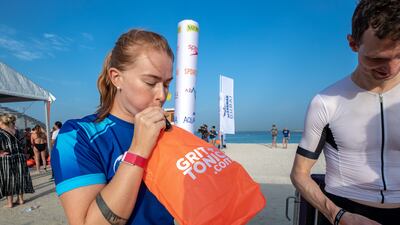
Josie Seidel inflates a flotation device before the race. -

People study the course of the race. -
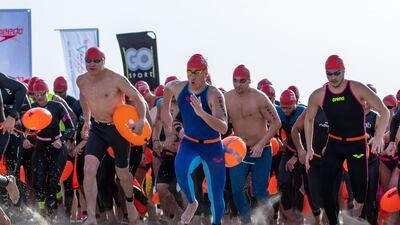
Participants at the start of the 5km race. -
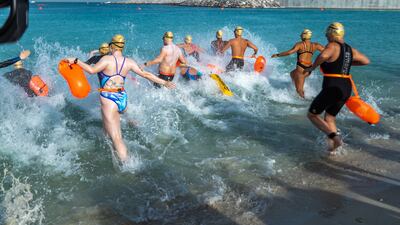
Swimmers enter the water for the 10km race .



