


The voting is done for now and summer beckons, which means it is tourist season across the Aegean and time again for Turkey and Greece to trade accusations and rattle sabres.
In a strange quirk of political scheduling, Turkey’s recent elections – the May 14 parliamentary and presidential contests and the May 28 run-off – perfectly sandwiched Greece’s May 21 vote. In both countries, the leader defied expectations and proved his staying power.
In Turkey, President Recep Tayyip Erdogan won another term on Sunday, two weeks after his ruling Justice and Development Party alliance upset the opposition to maintain its parliamentary majority. In Greece, the New Democracy party of Prime Minister Kyriakos Mitsotakis crushed its main opponent, Syriza, by more than 20 points, the best performance by a Greek incumbent in half a century.
A confident Mr Mitsotakis decided against forming a coalition government and instead called for a new election, perhaps as early as late June, hoping to obtain a parliamentary majority thanks to a new voting law that hands the victor bonus seats.
As I’ve previously detailed, Turks and Greeks have been in regular conflict almost since ancient times. A period of relative amity followed Turkey’s war of independence and the 1923 population exchange, but the two neighbours have since been at loggerheads: anti-Greek violence in Turkey in 1955; Turkey’s invasion of Cyprus in 1974 and the island’s ensuing division; and finally, inching close to war in 1987, 1996 and 2020.

Now, in their links to the West, these two re-elected leaders are expected to continue on divergent paths. Mr Mitsotakis is likely to further deepen ties with Nato and the US, which has beefed up its military presence in Greece since Russia’s invasion of Ukraine early last year. In May 2022, Athens extended by five years a military agreement that grants the US military continued access to three bases on the Greek mainland and its naval presence on Crete.
Two weeks ago, the EU agreed to invest $26 million in Greece’s Alexandroupolis port, which welcomes US and Nato ships and could become an energy entry point for the bloc. That Eastern Mediterranean port town, the capital of Greece’s Evros province, has emerged as a geopolitical hub in the past year as Nato-country diplomats, investors and military shipments have poured in, mainly to support Ukraine in its conflict with Russia.
Turkey, meanwhile, has kept its distance from its western allies. Despite approving the accession of Finland, Ankara continues to block Nato membership for Sweden. Turkish officials said last week they had sent Stockholm a list of 120 alleged terrorists it would like handed over; Sweden says it has received no such list.
In mid-May, Turkey denounced the presence of an American naval vessel, the USS Arleigh Burke, at Limassol port in southern Cyprus, saying it disrupts the regional balance at the expense of Turkish Cypriots. This comes less than a year after the US lifted an arms embargo on Cyprus that had been in place since 1987, enabling Washington to ship weapons to EU member Republic of Cyprus to aid its defence against the Turkish Republic of Northern Cyprus, recognised only by Turkey.
As if Turks and Greeks did not already have enough to argue about – maritime borders, Cyprus, sovereignty, airspace violations, Hagia Sophia, history, migrant response, western ties – we can add another file to the list: the name of the sea that separates them.
Turkey’s tourism authority fired the initial shot across the bow last year with an ad campaign welcoming visitors to the “Turkaegean”. Greece pushed back, but the EU and the US both cleared the term for marketing use.
-

Turkish President Recep Tayyip Erdogan acknowledges supporters in Ankara after winning re-election in a run-off vote. EPA -
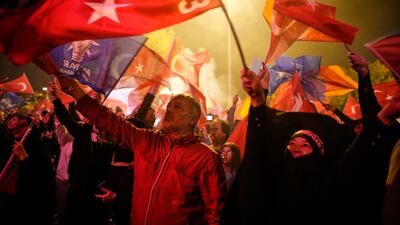
Mr Erdogan's supporters celebrate in Istanbul. AP -
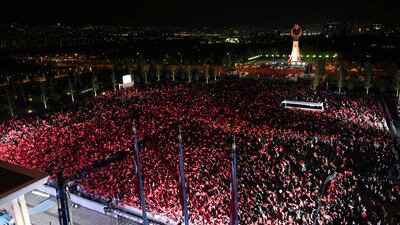
Mr Erdogan's supporters wave Turkish flags as they wait for him to make a speech at the Presidential Palace in Ankara. Reuters -
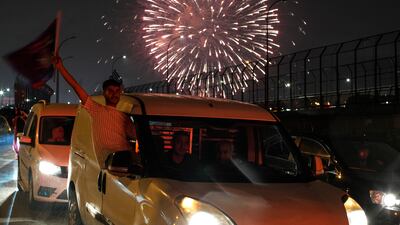
The Turkish President won 52.14 per cent of the vote. AP -
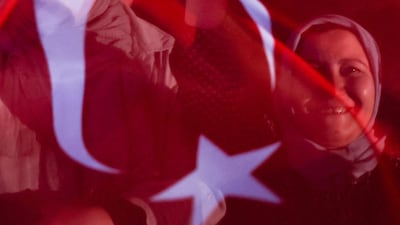
Turkey's lira weakened to 20.05 against the dollar on Sunday after Mr Erdogan claimed victory. Reuters -

Mr Erdogan said the election was Turkey's 'most important' of the modern era. Reuters -
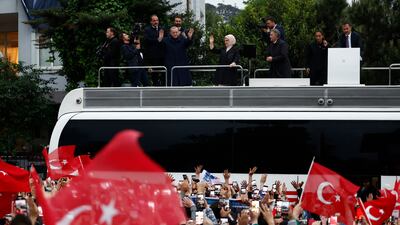
The Turkish leader acknowledged that inflation was the most urgent issue for the country, but said it would also fall. Getty -

Mr Erdogan was congratulated by world leaders, including President Sheikh Mohamed, US President Joe Biden, Russian leader Vladimir Putin and Ukrainian President Volodymyr Zelenskyy. Reuters -
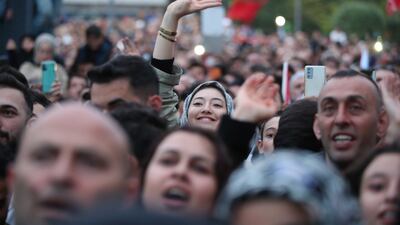
Mr Erdogan's supporters cheer in Istanbul. EPA -
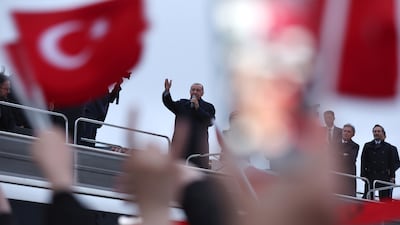
Mr Erdogan speaks to Turkish flag-waving supporters. EPA -
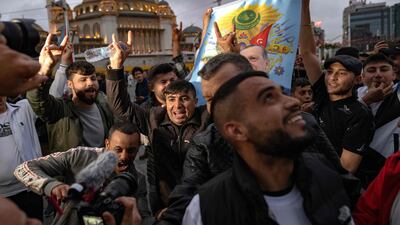
Mr Erdogan's supporters celebrate near Taksim Mosque in Istanbul. AFP -

Mr Erdogan's supporters celebrate outside the offices of his Justice and Development Party (AKP) in Istanbul. AP -
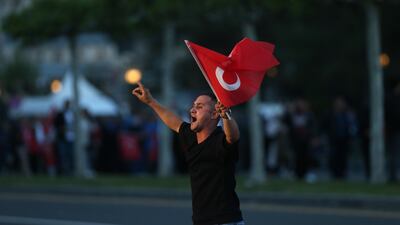
A man waves a Turkish flag outside the presidential palace in Ankara. EPA -
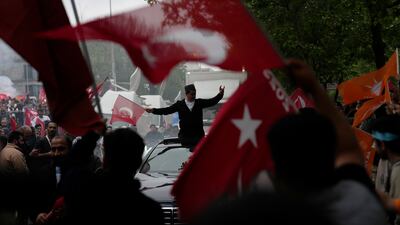
Mr Erdogan's supporters gather outside the AKP's offices in Istanbul. AP -
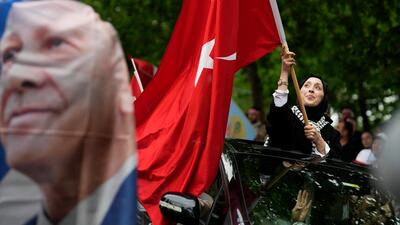
Investors are now looking for any signs that Mr Erdogan will start to relax the state’s tight grip over markets. AP -

Total foreign holdings of Turkish stocks and bonds are down by about 85 per cent, or $130 billion, since 2013. Getty -
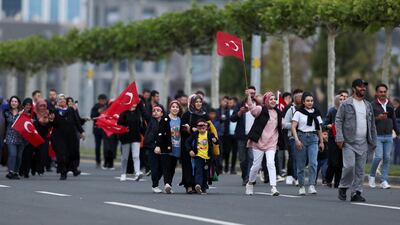
AKP supporters walk to the Presidential Palace in Ankara to attend his victory speech. Reuters -

Electoral officials empty a ballot box in Diyarbakir. AFP -
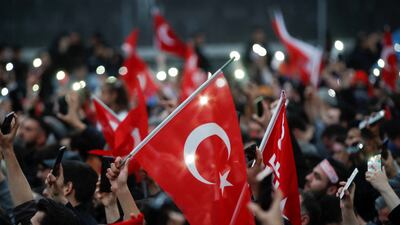
There was a gap of more than two million votes between Mr Erdogan and his rival Kemal Kilicdaroglu. Reuters -
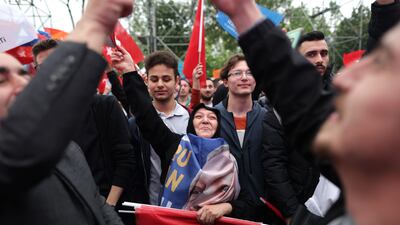
AKP supporters after early election results were announced. EPA -
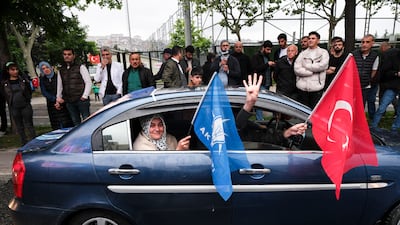
AKP supporters wave flags and chant slogans. Getty -

People react after the early election result. EPA


In April, Ankara seemed to throw down the gauntlet as the term appeared in full-page ads in The New York Times and French daily Le Monde and on Bloomberg TV, in addition to the social media accounts of GoTurkiye. Considering that Turkey has repeatedly questioned Greek sovereignty over a number of Aegean islands, Athens’s displeasure came as little surprise.
Former Greek foreign minister George Katrougalos said the term implies that the Aegean is Turkish, putting Greek maritime boundaries and sovereignty into question. Greece has since been working to revoke Turkey’s trademarking of the term in the US and EU.
Greek officials have urged the EU Commission to annul the term’s validity and Athens has hired a major Washington legal firm to make its US case. Turkey is also preparing its side of the story, though a decision on the matter is not expected soon. At least for now, Ankara is free to promote holidays to the Turkaegean. Might we soon hear of a Greekaegean?
Verbally asserting ownership over an international body of water is, on its surface, somewhat ridiculous, and nobody questions the origin of the name. It is derived from the ancient Greek king Aegeus, probably the father of Theseus, founder of Athens.
This is merely a tourist ad campaign, not the assertion of a top Turkish official, but that does not make Greek concerns any less grave. A Turkish official recently called it “pure paranoia on the part of Athens”. But as history shows, paranoia between these two tends to be a reasonable approach.
One wonders if Mr Erdogan and Mr Mitsotakis, buoyed by their somewhat surprising electoral victories and looking ahead to a fresh start, might be able to find common ground and calm these troubled waters before a real storm hits.

