


On June 8, German police detained a 29-year-old after he drove his Renault Clio into a group of pedestrians in western Berlin, killing a teacher and injuring 14 children. German Chancellor Olaf Scholz described the incident as a "cruel rampage". Interior Affairs Minister Iris Spranger said: "The latest evidence suggests this is a case of a mentally ill person running amok."
The driver did indeed turn out to have a history of mental health problems, including a diagnosis of schizophrenia. But what exactly does it mean to "run amok" in an industrialised 21st-century nation?
The expression was popularised more than 200 years ago by the British explorer James Cook after he claimed to have observed it among Malay tribesmen. Mengamok, as it is known in the Malay language, refers to a disordered mental state characterised by a murderous frenzy. Traditional beliefs attributed the state to possession by "Hantu Belian", an evil tiger spirit. Afflicted individuals would run through the village, indiscriminately killing and maiming men, women, children and even animals. The manic killing spree would typically end when the amok runner – almost always a lone male – was killed by the authorities or bereaved and outraged onlookers.
For a long time, western psychiatry considered amok a culture-bound syndrome, a psychiatric condition limited to a particular society or cultural group – in this case, South-East Asian nations such as Malaysia, Indonesia, the Philippines and Papua New Guinea. One theory suggests that, in these societies, amok represents a way of "ending it all" while allowing the distressed individual to get around the cultural or religious taboos against suicide.
More recently, however, the notion that amok is restricted to South-East Asia has unravelled. The rising rates of indiscriminate slayings at the hands of lone individuals – almost always men – suggest that 21st-century amok is perhaps a global phenomenon. In some nations, such as the US, for example, the issue is greatly exacerbated by easy access to military-style assault weapons and ammunition. Imagine the outcome of the Berlin incident if the driver also had a couple of AR-15 assault rifles and 1,000 rounds of ammo in the backseat.
Mental health professionals are rightly concerned about the increasing prevalence of such incidents. In 1999, an article was published in the Journal of Clinical Psychiatry titled "Running Amok: A Modern Perspective on a Culture-Bound Syndrome". This compelling article argues that amok should be considered the possible outcome of an undiagnosed or untreated psychiatric illness regardless of cultural context. In other words, if people can't get or don't get appropriate help for specific mental health complaints, then "running amok" is a possible consequence anywhere.
Predicting who might be at risk of running amok is difficult, but it is the first step toward prevention. Preventative efforts, however, require that individuals experiencing mental health problems feel okay about seeking help in the first place.
-
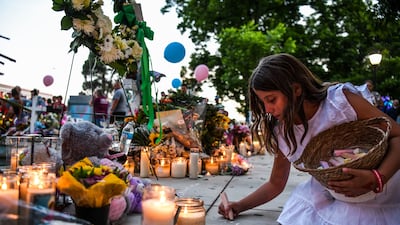
Alanna De Leon writes the name of her friend, Annabelle Rodriguez, who died in the shooting. AFP -
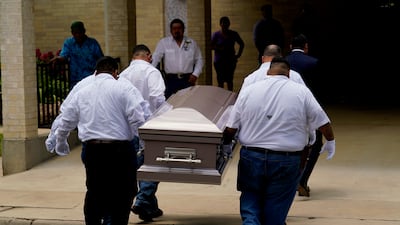
Pallbearers carry the coffin of Amerie Jo Garza into Sacred Heart Catholic Church. AP -
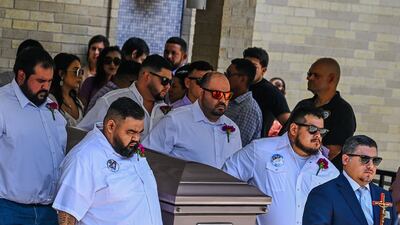
Pallbearers carry the coffin of Amerie Jo Garza, who died in the mass shooting at Robb Elementary School. AFP -

A memorial in Town Square, Uvalde, Texas, for victims of the Robb Elementary school shooting. Reuters -
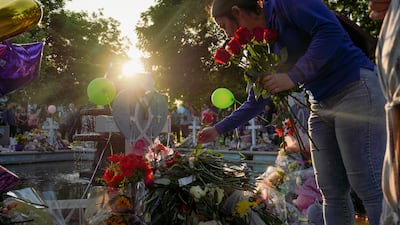
A woman places a rose on Layla Salazar’s memorial cross, who was one of the victims that died in the shooting. Reuters -

Bags with brisket sandwiches and a snack that will be sold at a fundraiser for families of the victims. Reuters -
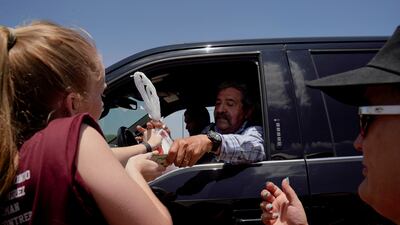
Ashtyn Leigh, 18, hands a man a brisket meal. Reuters -

A choir sings in front of the memorial. Reuters -
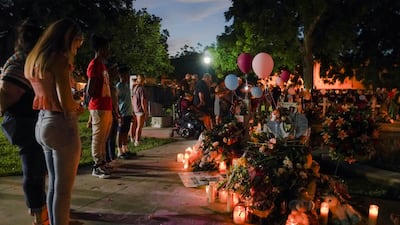
People pray in front of memorial crosses. Reuters -
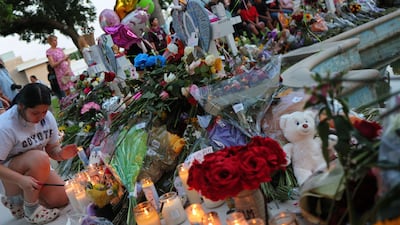
Nineteen children and two adults were killed in the shooting. AFP -
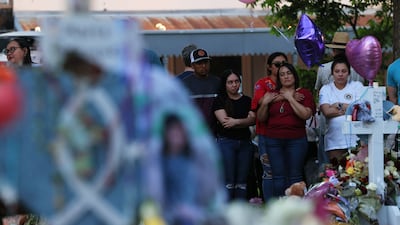
People visit a memorial for the victims. AFP -
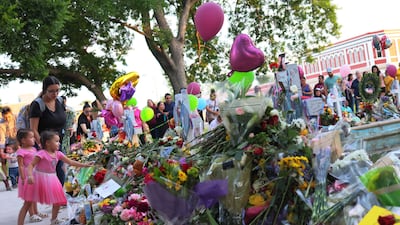
Flowers are left outside the school. AFP -

Twenty-one empty chairs are seen outside of a daycare center as a memorial for the victims. AP Photo -
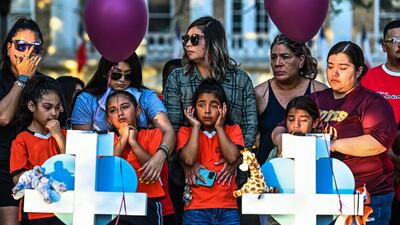
Football teammates of Tess Mata, who died in the Texas school shooting, cry as they visit a makeshift memorial outside the Uvalde County Courthouse. AFP -

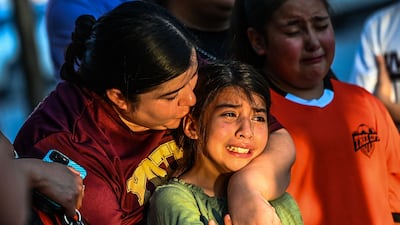
A football teammate of shooting victim Tess Mata cries, supported by her mother. AFP -
Texas police faced angry questions over why it took an hour to stop the gunman who murdered 19 children and two teachers in Uvalde, as video emerged of desperate parents begging officers to storm the school. AFP -

Activists join Senate Democrats outside the Capitol, in Washington, to demand action on gun control legislation after the killings at the Texas elementary school this week. AP -

The George R Brown Convention Centre, site of the National Rifle Association annual convention. Days after the deadliest mass school shooting in Texas history, the gun lobbyist group is meeting in Houston, from Friday until Sunday. Reuters -
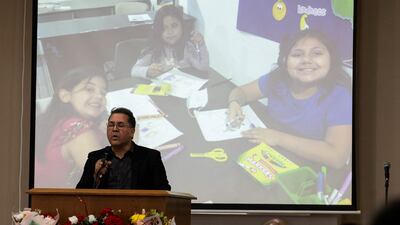
Pastor Carlos Contreras preaches to his congregation as photos of some of the children killed in the mass shooting at Robb Elementary flash on the screen at Primera Iglesia Bautista, in Uvalde. Reuters -

People march after a vigil held to stand with the Uvalde families and demand an end to gun violence in Newtown, Connecticut. AP -
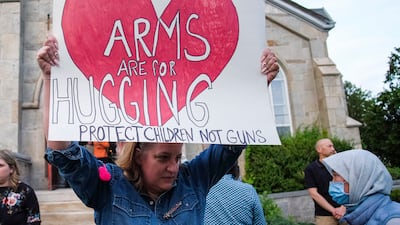
A woman holds up a banner at the end of the vigil in Newtown, Connecticut. AP -
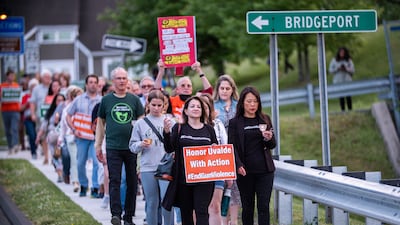
Newtown was the scene of the 2012 attack at Sandy Hook Elementary School, when 20 pupils and six teachers were killed by a gunman. AP -

Candles are lit for each victim as people pray at St Philip's Episcopal Church. EPA -
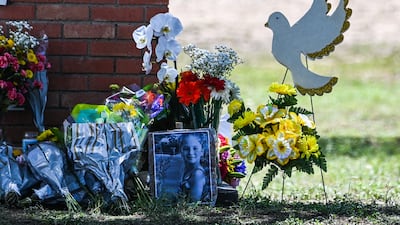
A makeshift memorial in front of Robb Elementary School. AFP -

Omahar Padillo with his son Omahar Jr, 12, during a community prayer, in Pharr, Texas, for the shooting victims at Robb Elementary School. AP -
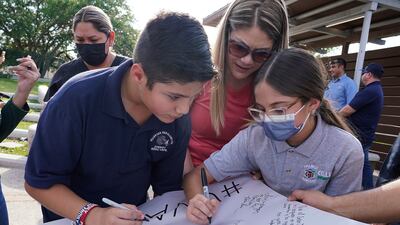
Omahar Padillo Jr, 12, and his sister Samantha, 9, with their mother, Silvia Padillo, write messages in support of the victims at Robb Elementary School. AP -

A vigil for the victims of the mass shooting at Robb Elementary School. AFP -

A young mourner at the vigil in Uvalde, Texas. AFP -
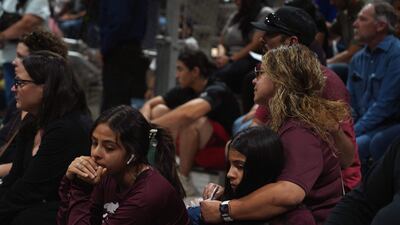
Families at the vigil. AFP -
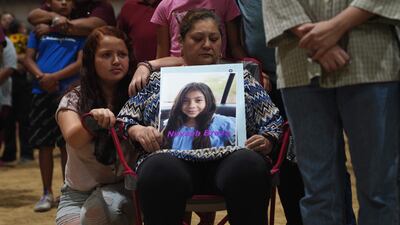
A woman holds a photo of Nevaeh Bravo, who was killed in the mass shooting, during a vigil for the victims of the massacre in Uvalde, Texas. AFP -
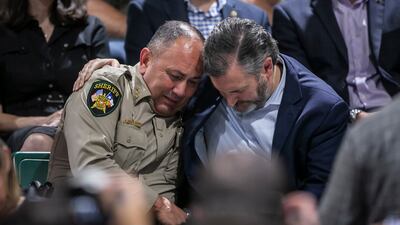
Uvalde County Sheriff Ruben Nolasco is comforted by Senator Ted Cruz during a vigil at the Uvalde County Fairplex Arena. AP -

Diana Karau of Uvalde with a therapy dog named Tritan before a vigil to honour those killed at Robb Elementary. AP -

Gun-control advocates Dana Cibulski, left, and Judi Giannini attend a vigil outside the National Rifle Association headquarters in Fairfax, Virginia after the mass shooting in Uvalde, Texas. AFP -

Uziyah Garcia, 8, was among those killed in the shooting at Robb Elementary School in Uvalde, Texas. AP -
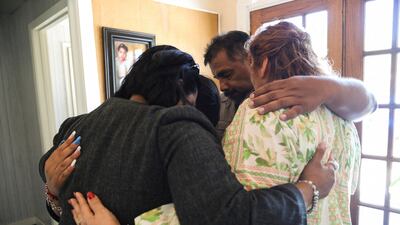
Pastor Jaime Cabralez, the uncle of shooting victim 10-year-old Eliahana Cruz Torres, is surrounded in prayer at his church in Uvalde, Texas on Wednesday. Reuters -

A woman embraces a child outside Willie de Leon Civic Centre, in Uvalde, where pupils were taken after the school shooting. Bloomberg -

Gun-control advocates hold a vigil outside the National Rifle Association (NRA) headquarters in Fairfax, Virginia. AFP -
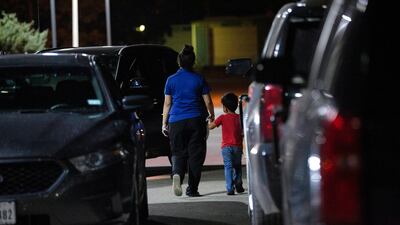
A woman and child leave the Civic Centre. Reuters


Unlike the vast majority of physical health problems, mental health issues are still frequently stigmatised. An article published in the American Journal of Men's Health in 2020 argues that mental health stigma is magnified when the potential help-seeker is a male. Men and boys are generally reluctant to discuss emotional hurt for fear of appearing "weak". A tragic consequence of this persisting social norm is that men often don't seek help until it's too late.
For example, In western nations, death by suicide is three to four times more common among men than women. In the UK, suicide is the biggest killer of men under 45. It is also responsible for a quarter of deaths among males under 35. Males are also far more likely to attempt self-medicating with drugs and alcohol, leading to higher rates of addiction and substance-related disorders. Drug and alcohol problems are, in turn, risk factors for suicide and other impulsive behaviours. Of course, the stigma around help-seeking for mental health is not the only factor at play here, but it is a major one.
Thankfully, incidents of people running amok are still relatively rare. But mental health problems are "pathoplastic"; they are shaped and re-shaped by socio-cultural change. Anorexia nervosa, for example, was once extremely rare – considered a clinical oddity. Today, it is relatively common. So we need to guard against modern-day amok following a similar trajectory.
Redoubling our efforts to destigmatise all mental health problems – not just depression and anxiety – is a must. However, reducing stigma and promoting help-seeking is only half the equation. We also need to ensure that quality help is available and easily accessible for all. Notably, we must design services and mental health promotion initiatives with men and boys in mind. The next person to run amok will almost certainly be a male.

