

In addition to the many trade and business deals, and the significant political announcements made during Donald Trump’s visit to the Gulf, the trip itself marks an important shift in the geopolitical landscape.
First, for a US president to undertake a multi-day trip to the Middle East – especially as his first official overseas visit of this term – and not to include Israel, is largely unprecedented and indicates that the President sees the Gulf countries as America’s main centre of interest and partnership in the region. Israel remains, of course, a close US ally and partner, but its Prime Minister, Benjamin Netanyahu, must be left questioning where Israel lies in Mr Trump’s mind-map of interests and priorities.
Second, it’s no secret that Mr Trump does not have many warm relationships in Western Europe and has complained about US economic and security partnerships there. For Mr Trump to make the Gulf his first official foreign visit again in his second term also indicates that he sees the Gulf countries and economies as main geopolitical and geoeconomic players in many ways surpassing the states and economies of Western Europe. The leaders of Saudi Arabia, Qatar and the UAE now appear to hold more influence with the US President than do some of the leaders of America’s traditional Nato allies.
Third, Mr Trump in his second term is confirming the shift that he is leading in the principles of US foreign policy: from a foreign policy built on Cold War-style political and power alliances built in seemingly permanent confrontation or counterbalancing against semi-permanent adversaries, to a non-ideological, business-friendly, long-war-hostile, transactional foreign policy that shuns large alliance and confrontation systems, and looks after strictly defined US interests – primarily of the economic kind.
This should be read clearly in Tehran and Moscow – neither capital can claim that Mr Trump has a deep-seated ideological or long-term hostility to their governments. It also enables him to be close to Mr Netanyahu while also embracing President Ahmad Al Shara of Syria and hurling olive branches at the supreme leader in Iran.
At the geoeconomic level, the main shift that this visit underlines is the deep alignment of GCC states alongside the US in the latter’s bid to build out its AI capacities ahead of China over the coming years and decades. AI will define the global power landscape of the 21st century, and AI processing centres require huge amounts of energy. The US does not have the capacity to ramp up its energy resources enough to meet the escalating demands of an ambitious US AI sector; the Gulf countries have the available energy and the ample cash reserves to meet a significant portion of this need.
At the geopolitical level, the most striking outcome of the visit is the US decision to lift sanctions on Syria. This decision, followed by a warm meeting between Mr Trump and Mr Al Shara, marks a sea change in the Levant. For the past six decades, Syria had been an adversary of the US and most of the Gulf states, first as a long-time ally of the Soviet Union, then as an ally – and eventually a client – of Iran. If Mr Al Shara can leverage this newfound support to lift his country from civil war and economic collapse, he will be realigning it alongside the Gulf and the US and reversing decades of recent Middle Eastern history.
-
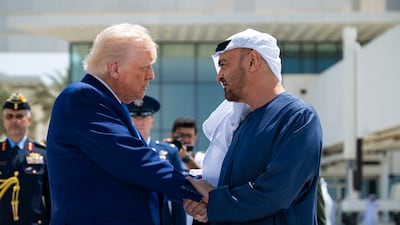
President Sheikh Mohamed bids farewell to US President Donald Trump. Abdulla Al Neyadi / UAE Presidential Court -
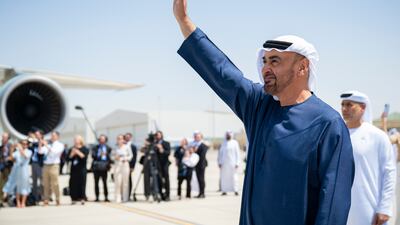
Sheikh Mohamed waves as Mr Trump's aircraft leaves the Presidential Airport. Abdulla Al Neyadi / UAE Presidential -
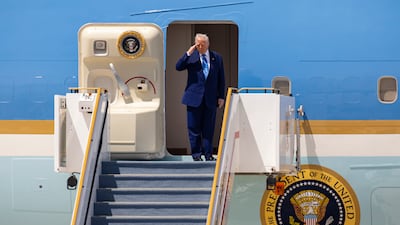
Mr Trump aboard Air Force One. Ismaeel Al Zaher / UAE Presidential Court -
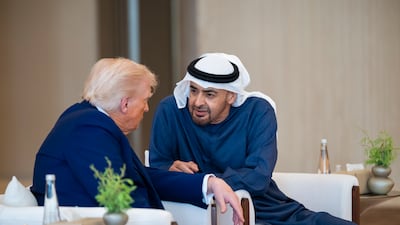
Sheikh Mohamed and Mr Trump. Abdulla Al Neyadi / UAE Presidential Court -
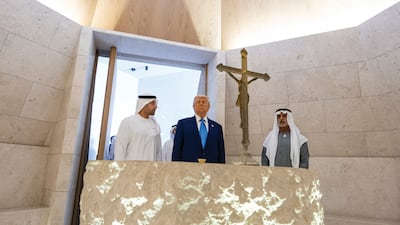
Mr Trump and senior officials visit the Abrahamic Family House in Abu Dhabi. Photo: Abu Dhabi Media Office -
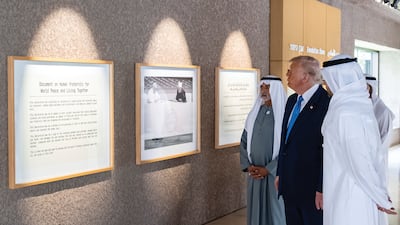
Mr Trump at the Abrahamic Family House. Photo: Abu Dhabi Media Office -
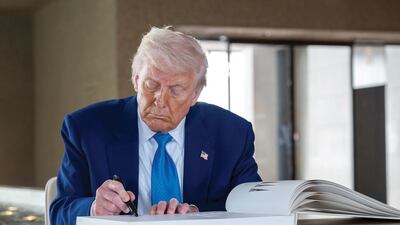
Mr Trump at the Abrahamic Family House. Photo: Abu Dhabi Media Office -
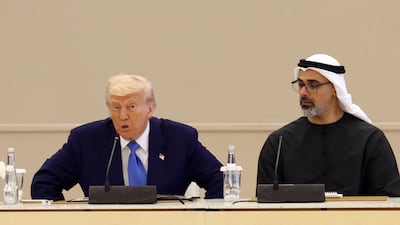
Mr Trump attends the UAE-US Business Dialogue alongside Sheikh Khaled bin Mohamed, Crown Prince of Abu Dhabi, at Qasr Al Watan. Chris Whiteoak / The National -
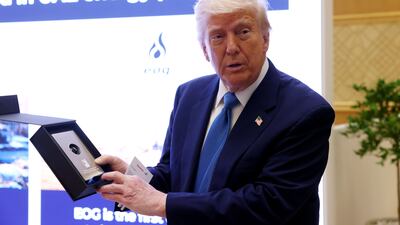
Mr Trump receives a small bottle of the UAE's Murban crude oil at Qasr Al Watan in Abu Dhabi. Chris Whiteoak / The National -
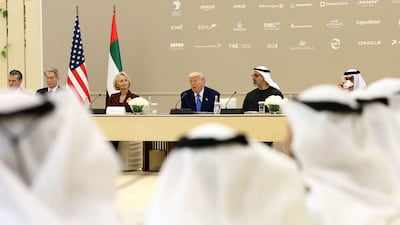
Mr Trump and Sheikh Khaled at the UAE-US Business Dialogue. Chris Whiteoak / The National -
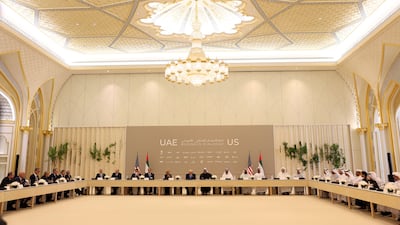
The UAE-US Business Dialogue. Chris Whiteoak / The National -
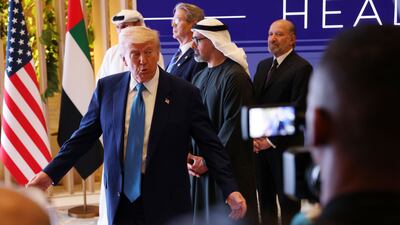
Mr Trump at the UAE-US Business Dialogue. Chris Whiteoak / The National -

Mr Trump and Sheikh Khaled at Qasr Al Watan. Chris Whiteoak / The National -
President of the United States of America Donald Trump attends the UAE-US Business Dialogue at Qasr Al Watan in Abu Dhabi during his tour of the Middle East. Chris Whiteoak / The National -
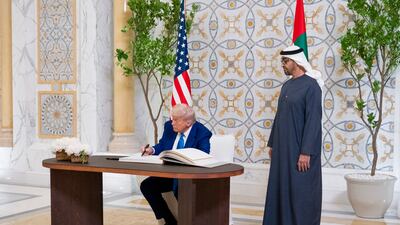
UAE President Sheikh Mohamed watches as US President Donald Trump signs the guest book at Qasr Al Watan, in Abu Dhabi. UAE Presidential Court -
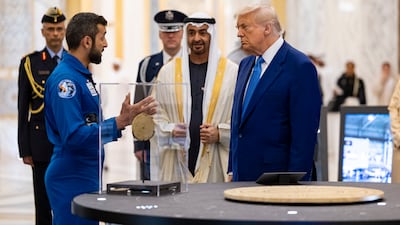
Sheikh Mohamed and Mr Trump are given a tour by Sultan Al Neyadi, UAE astronaut and Minister of State for Youth Affairs, of an exhibition titled Guided by the Stars at the presidential palace. UAE Presidential Court -
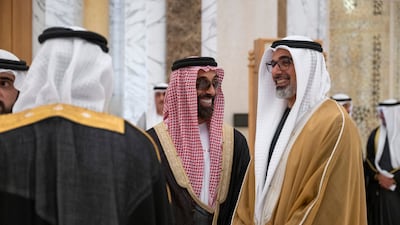
Sheikh Khaled and Sheikh Tahnoon bin Zayed, Deputy Ruler of Abu Dhabi and UAE National Security Adviser, attend the reception for Mr Trump at Qasr Al Watan. UAE Presidential Court -
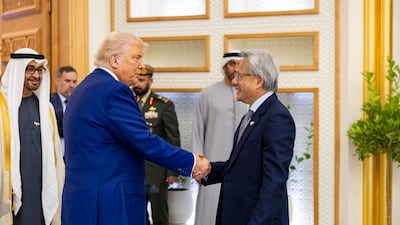
Mr Trump greets Jensen Huang, president and chief executive of Nvidia, at Qasr Al Watan as Sheikh Mohamed watches. Photo: UAE Presidential Court -
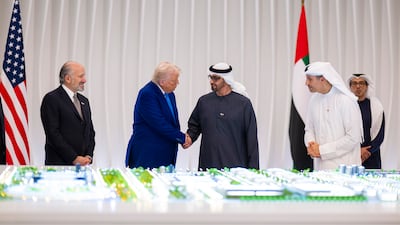
Sheikh Mohamed and Mr Trump view a model of the UAE-US AI Cluster, during the launch ceremony at Qasr Al Watan. Photo: UAE Presidential Court -

Sheikh Mohamed presents the Order of Zayed to Mr Trump during the state reception at Qasr Al Watan. Hamad Al Kaabi / UAE Presidential Court -
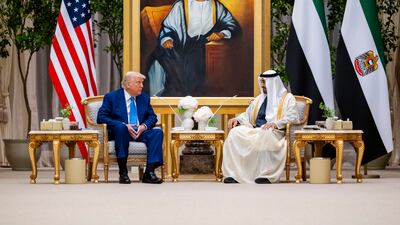
Sheikh Mohamed speaks with Mr Trump at Qasr Al Watan. Hamad Al Kaabi / UAE Presidential Court -
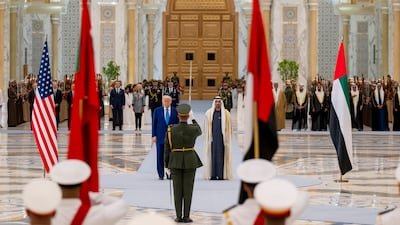
Sheikh Mohamed and Mr Trump stand for the national anthems at Qasr Al Watan. Abdulla Al Neyadi / UAE Presidential Court -
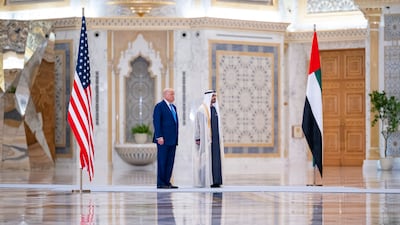
Sheikh Mohamed and Mr Trump stand for the national anthems. Hamad Al Kaabi / UAE Presidential Court -
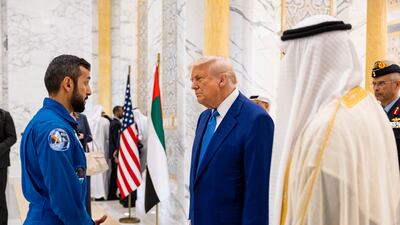
Sheikh Mohamed and Mr Trump view an exhibition titled ‘Guided By the Stars’ at Qasr Al Watan, and speak with UAE astronaut and Minister of State for Youth Affairs, Dr Sultan Al Neyadi. Ryan Carter / UAE Presidential Court -
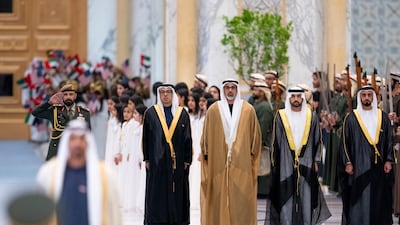
The ceremony at Qasr Al Watan is attended by Sheikh Mansour bin Zayed, Vice President, Deputy Prime Minister and Chairman of the Presidential Court; Sheikh Khaled bin Mohamed, Crown Prince of Abu Dhabi; Sheikh Hamdan bin Mohammed, Crown Prince of Dubai, Deputy Prime Minister and Minister of Defence; and Sheikh Saif bin Zayed, Deputy Prime Minister and Minister of Interior. Abdulla Al Neyadi / UAE Presidential Court -
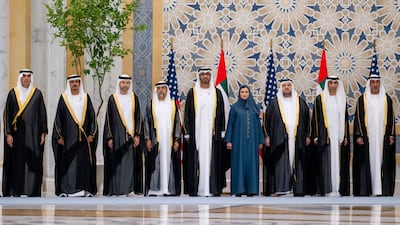
Also standing for the national anthems at Qasr Al Watan are Mohamed Al Mazrouei, Minister of State for Defence Affairs; Dr Thani Al Zeyoudi, Minister of State for Foreign Trade; Mohamed Al Suwaidi, Minister of Investment; Sarah Al Amiri, Minister of Education; Dr Sultan Al Jaber, Minister of Industry and Advanced Technology, and managing director and group chief executive of Adnoc; Suhail Al Mazrouei, Minister of Energy and Infrastructure; Mohamed Al Hussaini, Minister of State for Financial Affairs; Ali Al Shamsi, Secretary General of the Supreme Council for National Security; and Khaldoon Al Mubarak, chairman of the Executive Affairs Authority and managing director and group chief executive of Mubadala Investment Company. Abdulla Al Neyadi / UAE Presidential Court -
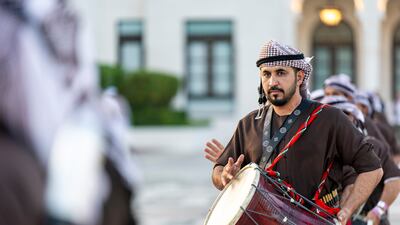
Heritage band musicians perform as Mr Trump arrives at Qasr Al Watan. Ryan Carter / UAE Presidential Court -
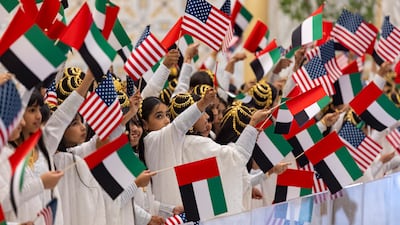
Children wave UAE and US flags at Qasr Al Watan. Ryan Carter / UAE Presidential Court -

President Sheikh Mohamed and Mr Trump arrive at Qasr Al Watan. Chris Whiteoak / The National -
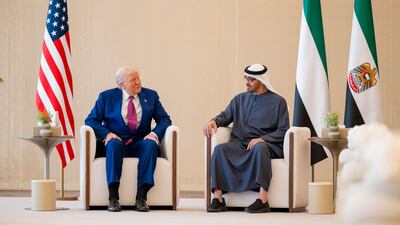
Sheikh Mohamed meets Mr Trump after his arrival at the Presidential Airport in Abu Dhabi. Abdulla Al Neyadi / UAE Presidential Court -
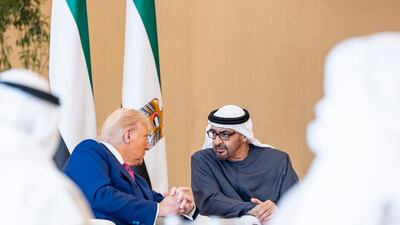
Sheikh Mohamed and Mr Trump in discussion at the Presidential Airport. Ryan Carter / UAE Presidential Court -
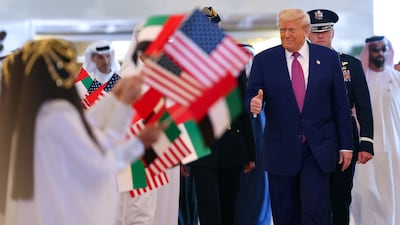
Mr Trump arrives in Abu Dhabi. Chris Whiteoak / The National -

Mr Trump arrives in Abu Dhabi. Chris Whiteoak / The National -

Traditional drummers greet the US President on his arrival. Chris Whiteoak / The National -
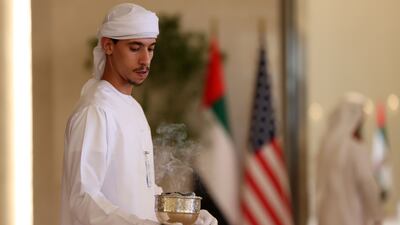
A participant in the ceremony welcoming Mr Trump to Abu Dhabi. Chris Whiteoak / The National -
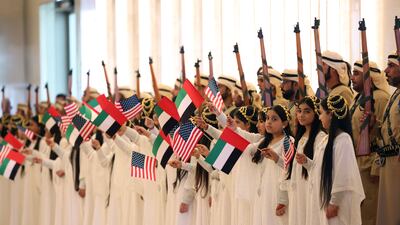
Participants in the welcoming ceremony for Mr Trump. Chris Whiteoak / The National -
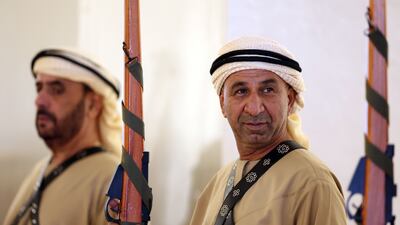
Participants help to welcome Mr Trump to Abu Dhabi. Chris Whiteoak / The National -
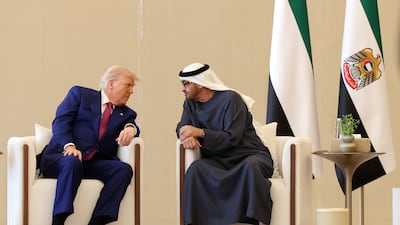
Sheikh Mohamed with Mr Trump. Chris Whiteoak / The National -
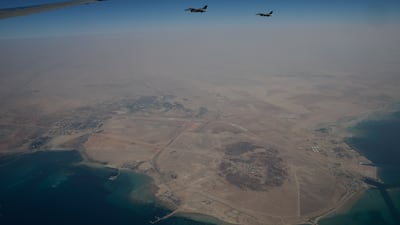
UAE Air Force fighter jets accompany Air Force One, carrying Mr Trump, as it approaches Abu Dhabi. Reuters


The decision on Syria also has major and positive implications for Lebanon. Lebanon has paid the price of a hostile – and problematically aligned – Syria ever since the Baath Party took over Damascus in 1963. If Mr Al Shara succeeds in building a more inclusive and stable Syrian state and economy, and one that is not ideologically hostile to an independent Lebanon and aligned with the main Arab countries and the West, Lebanon’s path to regaining sovereignty and building a vibrant economy – already under way with a new president, prime minister and government – will have a solid and sustainable path forward.
The geopolitical move that is closest to Mr Trump’s heart and key to his vision of the region – the expansion of the Abraham Accords – did not make visible progress during this visit. He talked about it during his address in Riyadh and mentioned it as a desired end goal of the opening to Syria, but he is also aware that the conditions for moving forward are not currently available.
Saudi Arabia is the key country in any expansion of the Abraham Accords to other Arab or Muslim-majority countries, and Riyadh made clear once again that it requires an end to the war in Gaza and a solid pathway to a Palestinian state. Mr Trump is increasingly aware that Mr Netanyahu is neither willing nor able to move in that direction. The rift between Mr Trump and Mr Netanyahu is growing; whether it will boil over into the open and lead to public clashes like Mr Trump has had with other formerly friendly world leaders is – like everything with Mr Trump – impossible to predict.
Although the visit was not about the US-Iran talks, it did provide positive momentum for them. The US President spent several days with Gulf leaders, all of whom now have cordial relations with Tehran and are counselling a negotiated solution over any talk of war. And Mr Trump has made clear that he is looking for a win-win solution and is not an ideological foe. Of course, it helps that Iran’s proxy network has been devastated by Israeli and American military action, and that its economy is on its knees, made even more desperate by the recent decline in oil prices.
Mr Trump’s two geopolitical ambitions for the region – expanding the Abraham Accords and striking a lasting deal between the US and Iran – would be truly transformative if he can achieve them. A nuclear deal between the US and Iran is looking increasingly likely; expanding the Abraham Accords is ripe for the picking, but requires new leadership in Israel. In the meantime, Mr Trump has cemented globally significant political and economic ties with the key states of the Gulf. The region’s leaders can be effective partners with the US in achieving the breakthroughs that are still needed to create a truly peaceful, integrated and prosperous Middle East.

