
China on Monday announced it is suspending export controls on some critical minerals for two months, preserving a broader trade deal struck between Washington and Beijing before an expected meeting between presidents Donald Trump and Xi Jinping in Asia next week.
The announcement from China's Ministry of Commerce formalises an agreement to extend a bilateral trade truce that was set to expire on Tuesday. The extension runs to January 10, according to the ministry. China's finance ministry also said a 24 per cent tariff on US goods would be suspended for two months, although it will still charge a 10 per cent fee, according to a statement.
A filing from the Office of the US Trade Representative posted in the Federal Register also said it was suspending action from a Section 301 investigation into China's maritime and logistic sectors. The US is also extending 178 current Section 301 tariff exclusions for Chinese goods, according to a second filing.

China announced a package of export controls on seven heavy rare earth elements last April, before expanding that list in October. It had earlier announced export curbs on battery supply chain chokepoints, including cathode materials, cathode precursors and graphite anode materials, widening a trade rift with Washington and stoking fears of a potential global supply chain crisis.
China accounted for 60 per cent of global mined production of magnet rare earths in 2024 and 91 per cent of global refined output, according to the International Energy Agency. It holds an even higher share for permanent magnet production.
The US and China entered into a one-year trade truce last October during their summit in Busan, South Korea, that paused tit-for-tat tariff measures, deferred rare earth curbs and included a pledge from China to resume importing US soybeans.
However, Treasury Secretary Scott Bessent last week urged Chinese Vice Premier He Lifeng to “fully and immediately” implement its commitments in Busan, while also raising concerns about “recent Chinese actions”, his department said in a statement.
In a separate statement, US Trade Representative Jamieson Greer said it remained important for China to fully implement its commitments, particularly in relation to agricultural purchases, rare earths and other critical minerals.
“There is an effort that has been co-ordinated between Treasury and the White House to track various commitments made by China since they first met in Busan,” said a former senior US official. “It's not just critical minerals; it is purchases of various agricultural products, where they stand on GE engines and Boeing,”
“And I think there are people … inside the US government that believe that China has overpromised and underdelivered, and they are making a consistent case that the issue that Bessent and Greer went out on was on critical minerals.”
Meanwhile, China said it “expressed serious concern” over recent US restrictions after Washington placed sanctions on two Chinese companies over their alleged ties to the Cuban regime's oil shipping networks supporting the Cuban military.
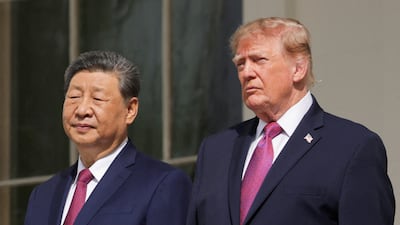
Mr Trump and Mr Xi are expected to hold a meeting on the sidelines of the Asia-Pacific Economic Cooperation (Apec) summit held in Shenzhen next week. It would be the leaders' third meeting this year.

