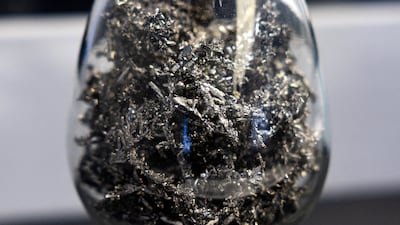

The last time presidents Donald Trump and Xi Jinping met, they emerged optimistic, even without a formal deal. Their reunion on Thursday comes with much more at stake: China’s grip on the rare earths needed to keep US factories, advanced technology and defence production running.
The leaders of the world’s two largest economies reconvene at the White House with trade, artificial intelligence and the war in Iran on the agenda. But looming over the talks is Beijing’s dominance of critical minerals and its willingness to restrict their supply as economic leverage.
in April last year, China enforced strict controls on certain types of rare earths and magnets, then added more curbs. It also cut rare-earth exports to Japan, a move that in turn ruffled supply chains tapped by the US.
“A significant amount rides on the meeting where the rare-earths story is concerned,” says Cauvery Ganapathy, a fellow for climate and energy at Dubai-based Observer Research Foundation Middle East.
“[This is] especially considering the disruptions we have seen in the previous iterations of the Chinese deciding to wield their rare-earths card as an economic tool of leverage in response to something not going their way, or as a response to a real or perceived sleight,” she tells The National.
'Supply chain weapon'
Critical minerals are the building blocks of modern technology, used across industries from electric vehicles and power grids to advanced manufacturing and defence. Rare earths are a subset of these minerals.
China, the world's second-largest economy, has been the dominant player in the rare-earth industry for nearly five decades.
It holds about 44 million tonnes of reserves, more than double second-placed Brazil's 21 million tonnes, according to the Energy Institute.
“China has significant leverage in this space given its integrated and dominant role, but the more it throttles production, the more it will encourage alternate supply chains,” says Rachel Ziemba, a geopolitical analyst and founder of New York-based advisory Ziemba Insights.
“The problem is that it's not easy to develop supply chains; they take many years, cost a lot of money and labour.”
The International Energy Agency, meanwhile, in an analysis of 20 critical minerals, pegs China's refining market share for 19 of them at about 70 per cent.
“Even when minerals are mined elsewhere, they may still need to pass through Chinese facilities before manufacturers can use them,” Umud Shokri, an energy strategist and geopolitical analyst in Washington, tells The National.
“The US can respond with tariffs, technology controls, investment in its own industry and closer work with allies. Those steps matter but they can’t replace Chinese supply quickly. That gives Beijing more leverage in the short term.”
The Council on Foreign Relations this month described rare earths as China's “supply chain weapon”.
Alessandro Rebucci, a professor of economics and finance at Johns Hopkins University, says the US has long had leverage over China through its control of advanced technology and global finance.
“But China learnt from the US playbook. Its near monopoly on rare-earth processing now gives it leverage over the US,” he says, noting that this includes input needed to rebuild the munitions spent in the Iran war. “If China choked the flow of rare earths, large parts of western advanced manufacturing and defence production could stall.”
Mr Trump's threat of further tariffs is another bargaining point. However, US Treasury Secretary Scott Bessent said on Wednesday that Washington and Beijing would extend their trade truce until January.
Previously due to expire on November 10, it includes lower US levies on some Chinese products in return for Beijing easing restrictions on US access to rare earths.

“It is not an exaggeration to say the Chinese hold all the cards … the vertical integration that China has built over the decades is nearly impossible to replicate at the speed and scale that industrial production needs today,” Ms Ganapathy says.
As for other countries that plan to tap into their own critical mineral wealth, an acceptable US-China deal might ease the pressure for a while but is unlikely to stop nations from building alternative supply options.
Saudi Arabia, for instance, is accelerating its minerals strategy. In August, Saudi Aramco and Maaden formed a venture to tap into the kingdom's $2.5 trillion mineral wealth with plans to explore a 182,000-square-kilometre zone for copper, zinc, lead and rare-earth deposits.
“Recent restrictions [on rare earths] have shown how disruptive it can be when so much processing is concentrated in one place. Saudi Arabia is one country looking to play a bigger role,” Mr Shokri says.
The UAE and other Gulf states are also expanding their ambitions in rare earths through targeted acquisitions and international partnerships, hoping to bolster related industries at home, challenge China’s dominance and present themselves as alternative partners to western nations, the London-based International Institute for Strategic Studies says.
The Emirates “may focus more attention on developing foreign processing channels”, Ms Ziemba adds.
Where it's headed
The US isn't out of cards to play, with technology restrictions, sanctions and Taiwan among Washington's potential sources of leverage.
Even Mr Trump's threats of punishing buyers of Russian oil might not seem credible to the Chinese, Ms Ziemba says, and countries such as India are more likely at risk if Mr Trump chooses to use this policy lever.
“China could [just] react asymmetrically such as by reducing critical mineral exports,” she adds.
Mr Shokri, meanwhile, says that while the Russia angle is a separate issue from rare earths, both countries may weigh up the risk of escalation.
“Washington has tools to pressure Beijing, while Beijing can disrupt supply. That creates room for bargaining but also gives both sides reasons to be cautious.”
But Ms Ganapathy argues there is “very little” that could force China’s hand on rare earths, primarily because while each of those options will matter to the Chinese and hurt their interests in various measures, these could largely be circumvented or absorbed in the short term.
“Mr Trump’s use of any of these levers of leverage and the Chinese response and retaliation to it, however, will come with broader macroeconomic and security implications that the US itself will not be insulated from,” she says.
Ms Ganapathy says the worst-case scenario would be another extension of rare-earth export restrictions, causing significant market disruption. She is “deeply sceptical” Beijing would agree to surrender such an important source of leverage altogether.
“The most plausible outcome … would be a truncated kind of arrangement leading to sequenced extension of the export licence suspension in return for bargains in the tech sector, and a potential ‘re-look’ at [US] investigations indicated to be considered against Chinese companies,” she says.

