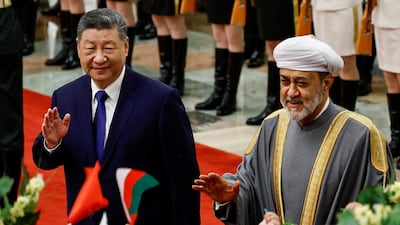
Chinese President Xi Jinping said that the Middle East and the Gulf region should not become an arena for great-power rivalry, as he met Oman's Sultan Haitham in Beijing on Monday, with the two countries calling for the resumption of safe navigation through the Strait of Hormuz.
“The Middle East Gulf region should not become an arena for great-power rivalry and geopolitical conflict. Peace and stability in the region require joint nurturing and protection by all parties,” Mr Xi was quoted as saying by China’s Foreign Ministry.
He added that China remained committed to helping to end the US-Iran war, and was willing to work with Arab countries including Gulf Co-operation Council states, with the aiming of achieving lasting regional stability and security.
In a 20-point joint statement, China and Oman called for normal and safe navigation to resume in the Strait of Hormuz and urged the US and Iran to pursue peaceful options, to return to the agreement reached in June aimed at ending the conflict and to restart dialogue.
Mr Xi also said China was ready to deepen the alignment of its development strategies with Oman, according to Xinhua news agency. He described the two countries as stable and reliable energy partners, investment partners with significant potential, and partners in high-tech innovation.
The talks came during Sultan Haitham’s two-day state visit to China, the first by an Omani head of state since the establishment of diplomatic relations between the two countries in 1978.
Sultan Haitham said Oman appreciated China’s positions on key regional issues, stressing that development and stability were closely linked and required security, respect for state sovereignty, adherence to international law and the peaceful resolution of disputes. He also said Oman was open to a preferential bilateral trade and investment agreement with China, saying it could create new opportunities for commercial and investment exchanges.
The joint statement said the two countries would deepen co-operation in oil and natural gas and expand partnerships in renewable energy, including solar power, wind energy, electricity transmission and transformation, and energy storage.
China is Oman’s largest trading partner. The two countries have also sought to expand co-operation in energy supply chains, investment and digital commerce.

During the visit, Oman’s Foreign Minister Badr Al Busaidi and Transport, Communications and Information Technology Minister Said Al Maawali met representatives of Chinese companies.
They discussed potential partnerships in priority sectors, including transport, logistics, communications and information technology, as well as artificial intelligence, advanced technologies and drone-based air transport, the Omani Foreign Ministry said.
The two sides also explored how Chinese companies can invest their expertise and capabilities in Oman, including by leveraging the sultanate’s strategic location, infrastructure and economic potential.
The proposed co-operation aims to support Oman’s economic diversification, enable the transfer of knowledge and technology, and advance the objectives of Oman Vision 2040 and the National Digital Economy Programme, the ministry said.
Separately, China’s Foreign Ministry said its special envoy to the Middle East, Zhai Jun, would visit Iran, Oman and Saudi Arabia this month.

