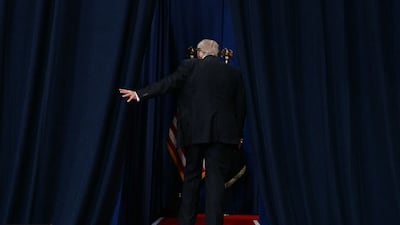

US President Donald Trump is famous for his seemingly off-the-cuff policy changes and governing via social media, but his subversion of traditional diplomacy during the Iran war is alienating allies at a challenging moment.
This week, Mr Trump lashed out at South Korea and ordered the Pentagon to “substantially reduce” joint military exercises, after accusing Seoul of declining the contribute to the conflict.
“I recently asked the President of South Korea if they would like to join us in the Denuclearisation of the Islamic Republic of Iran, and they said, 'No thanks!'” Mr Trump wrote on Truth Social, calling the drills “costly” and essentially a show of aggression against an “unthreatening” North Korea.
He later expanded on that, saying at the Oval Office on Monday that he had told South Korean President Lee Jae Myung: “We have 39,000 soldiers over there, guarding you from Kim Jong-un, your next-door neighbour, and you’re not going to help us on a very easy military operation in Iran. That’s strange.”

Following Mr Trump's comments, Mr Lee said that while maintaining peace was of the “utmost importance”, preparation for the “worst-case scenario” was also necessary.
South Korea has long been one of the strongest US allies in East Asia. US troops have helped Seoul to keep the peace along the border with North Korea for more than 70 years.
The South Korean leadership signalled that it was exploring the deployment of naval vessels to the Strait of Hormuz, through which it receives about 70 per cent of its crude oil supplies, Korea JoongAng Daily reported last month. But Seoul probably needs to balance this against the perceived threat from North Korea, which fired ballistic missiles towards the East Sea earlier this month in protest against the planned US-South Korea military drills.
Also this week, Mr Trump threatened to bomb Oman “if they get in the way” of US efforts against Iran.
Speaking to Fox News on Monday, the US President urged Iran to surrender and said his administration was involved in back-channel negotiations with the Islamic Revolutionary Guard Corps.
Mr Trump then said on Tuesday that no direct talks were taking place.
His comments come amid discussions between Oman and Iran over the future of the Strait of Hormuz, the primary focus of contention between the US and Tehran. Iran effectively closed the crucial waterway at the start of the war and the US ultimately responded with a blockade of Iranian ports.
Oman has yet to respond to Mr Trump's threat, but it is not the first time he has threatened Muscat.
In late May, asked whether he would accept a deal that would give Oman and Iran control of the strait, Mr Trump said: “Nobody is going to control it. It’s international waters, and Oman will behave just like everybody else, or we will have to blow them up.”
These most recent incidents build on previous fractures with traditional allies over the war.
Throughout the conflict, Mr Trump has blasted Nato countries for failing to come the aid of the US, calling the world’s largest military alliance a “paper tiger”.

Mr Trump has urged Nato members to send naval support to reopen the Strait of Hormuz, arguing that Europe relies heavily on regional energy supplies. No such help materialised, with allies concerned over unilateral US actions without wider consultations followed by demands for assistance.
“Nato wasn’t there when we needed them, and they won’t be there if we need them again,” Mr Trump wrote on Truth Social in April.
Italy grew markedly closer to the US under far-right Prime Minister Giorgia Meloni, but this bond was shaken after Rome refused to allow Washington to use Nato airbases to strike Iran and over differences over defence spending. The feud escalated further when Mr Trump insisted Ms Meloni had begged him for a photo at a recent G7 summit, which she denied.
Weeks into the conflict, Spain, another Nato member, also denied the US the ability to use airbases in the country for the war. During the Nato summit in July, Mr Trump lashed out at Madrid, calling Spain a “terrible partner” and a “wasted cause”.
The US is in a complicated position as, while the bombings have stopped, so apparently have direct negotiations, meaning Washington is no closer to achieving its goals in Iran than it was months ago.
There are reports that US munitions are running low and the Pentagon has placed multibillion-dollar orders with leading defence firms to shore them up. The Trump administration is facing increased scrutiny from Congress over the billions of dollars that have been allocated towards the conflict and is growing concerned the war may have a major effect on the midterm elections in November.
Direct contributions from allies, militarily or otherwise, towards reopening the Strait of Hormuz would probably help draw the war to a close sooner. But Mr Trump's public criticisms of traditional partners over the course of the war are likely to have had a corrosive effect on relationships already damaged by issues such as tariffs.

