


When the US and Israel partnered late last month to launch strikes on Iran, their goal of toppling the regime appeared aligned.
US President Donald Trump called on the Iranian people “to take back” their country. Israel’s Prime Minister Benjamin Netanyahu told Iranians they were facing a “once-in-a-lifetime opportunity” to end the regime of Ayatollah Ali Khamenei and secure their freedom.
But after three weeks of conflict, the two leaders’ aims appear to be diverging.
Mr Trump had been hoping for a swift military victory with limited economic fallout, experts say, and he has described the war as a “little excursion”. Mr Netanyahu, who has spent decades positioning himself against Iran’s leadership, is meanwhile preparing for what could be a prolonged campaign.
Israel’s strike on Iran’s South Pars gasfield on Wednesday underscored the growing tension between the two leaders and their differing objectives.
Experts say Mr Trump had envisioned a quick, in-and-out operation like the military pulled off when they snatched Venezuela's then-president from Caracas in January.
"The bottom line for Netanyahu is regime change or at least devastating Iran as a country," said Alex Vatanka a senior fellow at the Middle East Institute in Washington.
"Trump agrees with that and supports that, he just pretends it's not what he wants."
Mr Trump sought to distance himself from the strike on the world’s largest natural gasfield, which Iran shares with Qatar, a US ally that hosts the region’s largest American military base.
He also finds himself scrambling for a Plan B as the world faces an energy crisis over the Strait of Hormuz shutdown.
He said Israel had “violently lashed out” at Iran.
“The United States knew nothing about this particular attack, and the country of Qatar was in no way, shape, or form, involved with it,” Mr Trump wrote on Truth Social.
-
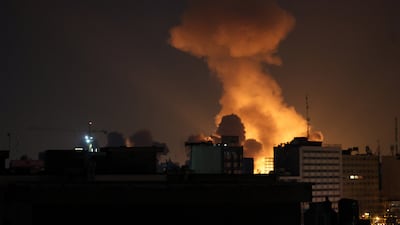
Smoke rises after an air strike in central Tehran. A joint Israeli and US military operation continues to target multiple locations across Iran. EPA -

Projectiles fly through the sky. Reuters -

Smoke rises during air strikes in Tehran. AFP -
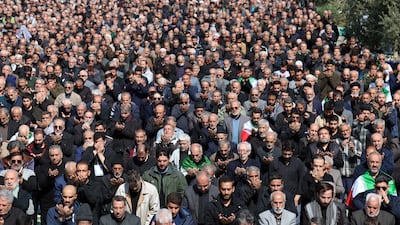
Iranians attend Friday prayers at Mosallah mosque in Tehran. EPA -
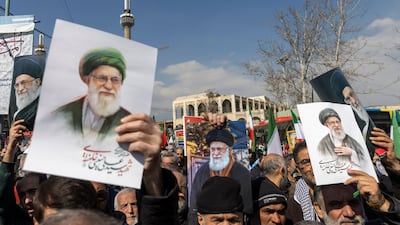
Iranians hold images of Ayatollah Ali Khamenei as they take part in a demonstration against the US and Israel in Tehran. Getty Images -
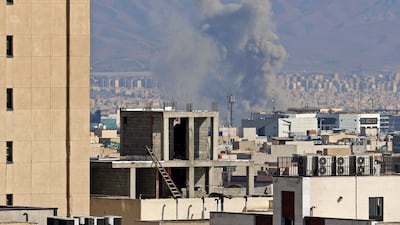
Smoke rises from the site of air strikes in Tehran. AFP -
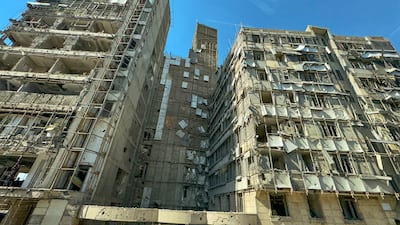
A view of the damaged Gandi Hospital in Tehran. AFP -
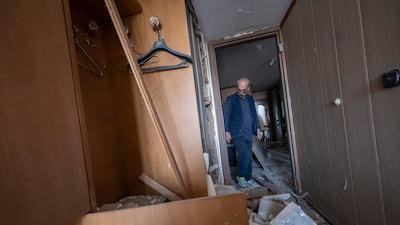
An Iranian man attends his damaged office in Tehran. AFP -
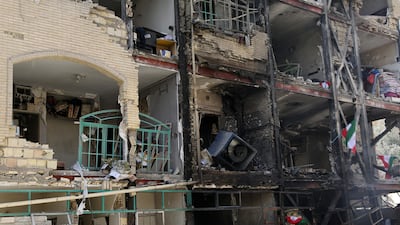
A residential complex in Tehran damaged by intense bombardment. AFP -
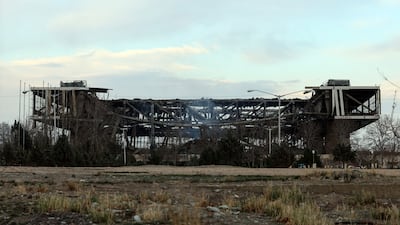
A damaged building at Tehran's Azadi Sport Complex. AFP


The strike prompted Iranian retaliation against Gulf states and contributed to a surge in fuel prices – a critical issue before US midterm elections in November, ahead of which Mr Trump had hoped to highlight economic achievements, including lower petrol costs.
“I told him: ‘Don’t do that,’” Mr Trump said on Thursday, referring to a conversation with Mr Netanyahu. “We’re independent. We get along great. It’s co-ordinated, but on occasion, if I don’t like it, we’re not doing that.”
Mohammed Abu-Nimer, a professor in the International Peace and Conflict Resolution programme at American University in Washington, said Mr Trump’s approach could backfire.
“It sends a clear message that the US has a partnership with Israel, but is unable to control it or influence its actions,” Mr Abu-Nimer said. “Trump is essentially saying: ‘I have a partner, but they’re not listening to me.’”
Mr Netanyahu, however, has maintained that co-ordination remains strong.
“I don’t think any two leaders have been as co-ordinated,” he said. “He’s the leader. I’m his ally. America is the leader.”
Voices within the Trump administration have so far been mixed.
Director of National Intelligence Tulsi Gabbard said on Thursday that the US and Israel have different objectives in the war. Testifying before the House Intelligence Committee, she said Israel is focused on targeting Iran’s leadership, while the Trump administration is aiming to degrade the country’s military capabilities.
Pentagon chief Peter Hegseth described Israel as an “incredible and capable partner” while noting it was pursuing its own objectives in the South Pars strike.
Meanwhile, senior counter-terrorism official Joe Kent resigned on Tuesday over the war, saying Iran “posed no imminent threat” to the US.
Mr Trump’s position is a departure from his messaging just 10 months ago.
Speaking in Saudi Arabia during his first trip abroad in May, Mr Trump hailed a “bright new day” for the Middle East and denounced decades of US nation-building efforts.
“In the end, the so-called nation builders wrecked far more nations than they built, and the interventionalists were intervening in complex societies that they did not even understand themselves,” he said.

