The exiled son of Iran's last monarch on Friday urged the international community to intensify pressure on Tehran to help protesters overthrow clerical rule, even as a sweeping crackdown appeared to have largely suppressed street demonstrations.
“The people have not retreated,” Reza Pahlavi told a news conference in Washington. “The slaughter has not stopped.”
The Iranian opposition figure insisted momentum remained on the protesters’ side.
“That’s not my opinion,” he said. “That’s the verdict delivered loudly and clearly by the people in the face of bullets.”
-

Anti-government demonstrators and supporters of exiled Iranian crown prince Reza Pahlavi outside the Houses of Parliament in London. EPA -

Iranians during a protest in Tehran on January 9. AFP -
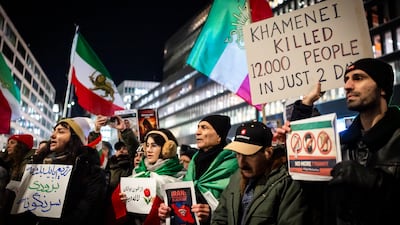
Protesters attend a rally in Zurich on January 13 in support of the nationwide mass demonstrations in Iran. EPA -

A screengrab shows body bags lying outside Kahrizak Forensic Medical Centre in Tehran, after deadly protests across Iran. Reuters -

Activists attend a rally in support of the protesters, in Los Angeles, California. AFP -

Protesters burn a picture of Iran's supreme leader Ayatollah Ali Khamenei outside Downing Street, in London. AFP -

Demonstrators gather in Paris to support the Iranian people amid the anti-government protests in Iran. AFP -
Smoke rises from a mosque as protesters gather amid evolving anti-government unrest in Tehran, Iran, on Friday. Reuters -
Protesters gather amid evolving anti-government unrest in Tehran, Tehran Province, Iran, on Friday. Reuters -
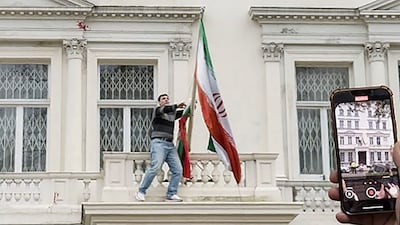
A protester pulls down the Iranian flag from the balcony of Iran's embassy in central London on Saturday. AFP -
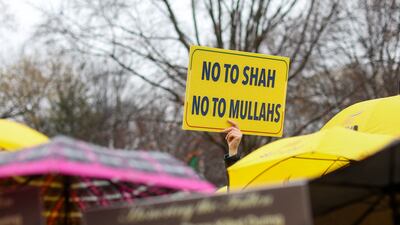
A person holds a placard, as demonstrators and activists rally in support of nationwide protests in Iran, outside the White House in Washington. Reuters -
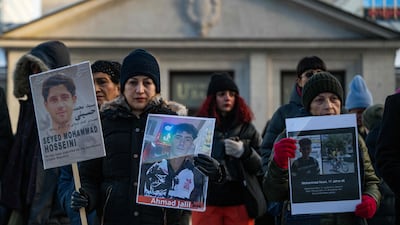
Protesters display placards featuring portraits of Iranians executed by the Iranian regime, during a rally in Berlin on Saturday. AFP -
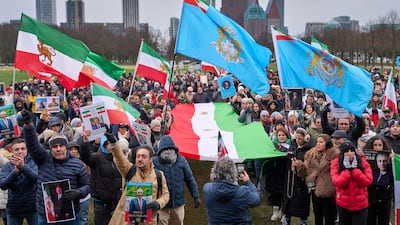
People protest in solidarity with demonstrations in Iran at Malieveld Square, Netherlands on Saturday. AFP


Widespread protests have rocked Iran for weeks, and activists say thousands of civilians have been killed amid the government crackdown.
Mr Pahlavi added that Iranians were taking "decisive action on the ground".
“It is now time for the international community to join them fully," he said, adding it should target the "Islamic Revolutionary Guard leadership and its command-and-control infrastructure".
Mr Pahlavi claimed that “large sections” of Iran’s military and security forces had quietly pledged loyalty to him, positioning himself as a central figure in any transition.
“They have called for me to lead,” he said. “The bond between me and the Iranian people is not new. It’s been with me since birth, and it cannot be broken.”
He portrayed the fall of the regime as a turning point, not only politically, but historically.
“The end of the regime will mark the rebirth of one of the most accomplished civilisations in history,” Mr Pahlavi said.
“Our people are highly educated, producing one of the highest numbers of engineers in the world, around 70 per cent of them women, today. The regime wastes these gifts.”
Mr Pahlavi drew a stark comparison with East Asia, saying Iran's human capital and natural resources should have made it into the next South Korea. Instead, it became North Korea, he said.
He accused Tehran’s leadership of impoverishing the nation while diverting wealth to fund extremist groups and regional proxies. International pressure could “expedite” collapse, he said, as he called for co-ordinated political, economic and military pressure on Tehran.
“The Iranian people’s boots are already on the ground,” he told reporters. “They are the ones marching, sacrificing and fighting for their freedom every single day. What they need from the world is resolute, targeted support to protect lives, amplify their voices and hasten the collapse that is already on the way.”

Esfandyar Batmanghelidj, an adjunct professor at the School of Advanced International Studies Europe, questioned Mr Pahlavi’s claims of support, saying he was speaking about leading a caretaker government “before he has even formed a political party, committee or congress".
Any US intelligence assessment of his leadership capacity, he added, would likely note this failing.
“If [Venezuelan opposition figure Maria Corina] Machado, with her deep organising experience, couldn’t win the trust of the Trump administration,” Mr Batmanghelidj said, “how can Pahlavi?”
Born in Tehran, Mr Pahlavi is the eldest son of the late shah of Iran, Mohammad Reza Pahlavi, and empress Farah Pahlavi. He was officially named crown prince in 1967.
Mr Pahlavi has lived in exile in the US since the 1979 Islamic Revolution ousted his pro-western father. The last shah of Iran, characterised by the leaders of the revolution as a corrupt autocrat who terrorised his opponents through the use of secret police, died in Egypt in 1980.
In April 2023, Mr Pahlavi visited Israel in "an effort to rebuild the historic relations between Iran and Israel". He attended a Holocaust Remembrance Day ceremony, visited the Western Wall, and met with President Isaac Herzog and Prime Minister Benjamin Netanyahu.
He has been criticised for his support of Israel, especially after the 12-day war between Israel and Iran in June last year. He was labelled a "traitor" by many Iranian opposition figures, including several high-profile political prisoners in Iran.

