
President Donald Trump has threatened to deploy US military forces to Minnesota to quell protests in response to violent encounters involving federal immigration agents.
Protesters and federal agents have been engaged in increasingly tense stand-offs in the northern US state over the past few days. Video footage has shown officers using tear gas and stun grenades, while the Minneapolis police chief said some demonstrators threw fireworks and other projectiles at security personnel.
Mr Trump said on social media on Thursday: “If the corrupt politicians of Minnesota don’t obey the law and stop the professional agitators and insurrectionists from attacking the patriots of ICE, who are only trying to do their job, I will institute the Insurrection Act, which many presidents have done before me, and quickly put an end to the travesty that is taking place in that once great state.”
-
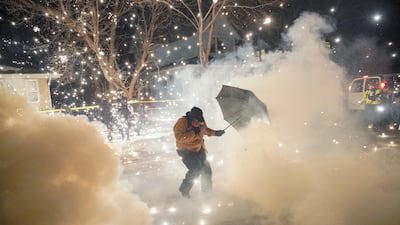
A protester uses an umbrella for cover from projectiles fired by federal agents, in north Minneapolis, Minnesota. Reuters -
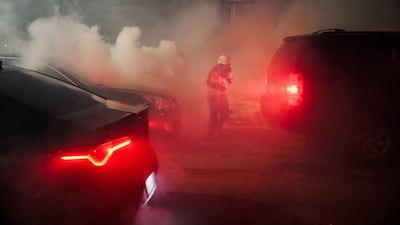
A protester walks through tear gas smoke in Minneapolis. Reuters -
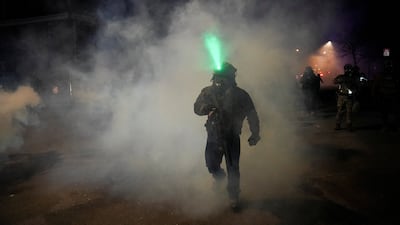
A federal agent walks through tear gas smoke. Reuters -
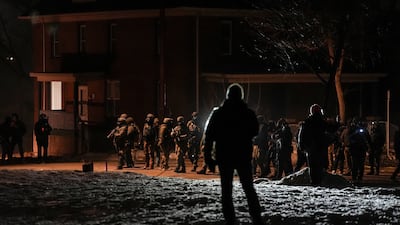
Federal law enforcement personnel stand guard in Minneapolis, as tension rises after agents were involved in a shooting incident in the city. Reuters -
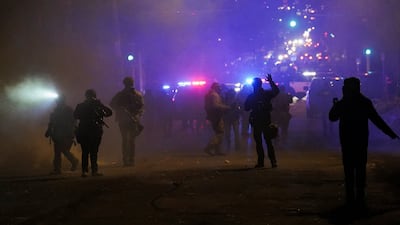
Federal agents fire projectiles at demonstrators. Reuters -
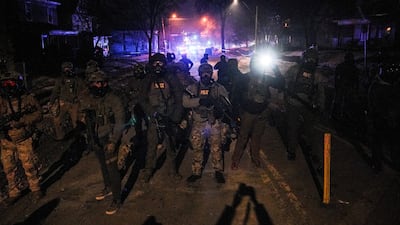
Federal agents in Minneapolis. Reuters


The escalation comes after a US Immigration and Customs Enforcement (ICE) agent shot and killed Renee Good, 37, last week. Video footage of the incident shows ICE agents attempt to enter Ms Good's car after demanding she move. When she does move, an agent can be seen firing into the car three times as it is being driven away.
The Trump administration has said the agent feared Ms Good was attempting to ram him with her car. Critics say the agent killed her as she was merely following law enforcement instructions.
What is the Insurrection Act?
The Insurrection Act is a federal law that gives the President the power to deploy the military or federalise National Guard troops inside the US to quell domestic uprisings.
The law is commonly referred to as the Insurrection Act of 1807 – the year Thomas Jefferson signed it into law. But the modern-day Insurrection Act is an amalgamation of statutes passed between 1792 and 1871 outlining the role of the US military in domestic law enforcement.
It enables troops to take part in domestic law enforcement activities such as making arrests and carrying out searches, functions they are otherwise largely prohibited from conducting.

The Insurrection Act can be invoked when there are “unlawful obstructions, combinations or assemblages or rebellion” against the US government's authority. When a president deems one of those conditions has been met, the law gives them the power to deploy the armed force to take actions “to enforce those laws or suppress the rebellion”.
The last time a US president invoked this was in 1992, when George HW Bush sent 4,000 federal troops to Los Angeles to calm violent protests that arose after the acquittal of four police officers accused of brutally beating Rodney King.
Mr Trump previously threatened to invoke the Insurrection Act in Los Angeles in June, though he used other executive authorities to deploy about 4,000 members of the National Guard and 700 Marines to the city to quell immigration-related protests.
Section 12406 of Title 10 of the US Code allows a president to bring the National Guard into federal service but prohibits guardsmen from carrying out civilian law enforcement activities.
What do Minnesota leaders say?
Minnesota leaders have denounced Mr Trump's threats of invoking the Insurrection Act.
Governor Tim Walz, who was Democratic presidential candidate Kamala Harris's running mate in the 2024 elections, said on X: “I am making a direct appeal to the President: let’s turn the temperature down. Stop this campaign of retribution. This is not who we are.
“And an appeal to Minnesotans: I know this is scary. We can – we must – speak out loudly, urgently, but also peacefully. We cannot fan the flames of chaos. That’s what he [Mr Trump] wants.”
After the shooting of Ms Good, Mr Walz ordered the Minnesota National Guard to prepare for potential deployment.
Minnesota Representative Ilhan Omar called Mr Trump's threats “a blatant act of authoritarianism”.
“This is the playbook of a wannabe dictator to rationalise even more extreme abuses of power,” she said.
Minneapolis Mayor Jacob Frey has become a major voice during the protests, telling immigration agents in an expletive-ridden rant after the shooting to leave his city.
“Minnesota needs ICE to leave, not an escalation that brings additional federal troops beyond the 3,000 already here,” he said on X. “My priority is keeping local law enforcement focused on public safety, not diverted by federal overreach.”

