

The US envoy to the UN warned on Thursday that, for Washington, all options were on the table to “stop the slaughter” in Iran.
“The level of violence, the level of repression that the Iranian regime has unleashed on its own citizens, its own people, has repercussions for international peace and security," Mike Waltz told Security Council members at an emergency meeting to address Iran’s deadly crackdown on protests. "You're going to hear today that it's an internal matter – absolutely wrong and false."
At least 2,615 people have been killed since the unrest began, according to the US-based Human Rights Activists News Agency – a death toll that exceeds any previous round of protests in Iran in decades.

“The regime is solely … responsible for the economic misery of the Iranian people and the repression of their freedom," Mr Waltz said. "They will be held accountable."
He described US President Donald Trump as a "man of action, not endless talk", as is often seen at the council. “He has made it clear, all options are on the table" Mr Waltz said. "And no one should know that better than the leadership of the Iranian regime."
Iran's deputy UN ambassador Gholam Hossein Darzi said Tehran does not seek escalation or confrontation. He accused Mr Waltz of resorting "to lies, distortion of facts and a deliberate misinformation campaign to conceal his country’s direct involvement in steering unrest in Iran to violence."
"However, any act of aggression – direct or indirect – will be met with a decisive, proportionate and lawful response," he said. "This is not a threat; it is a statement of legal reality."
Masih Alinejad, an Iranian-American activist who was invited by the US to address the council, sharply criticised the UN and Secretary General Antonio Guterres, accusing them of failing to respond with what she called “the urgency this moment demands".
Ms Alinejad said “all Iranians are united” against the regime. “The Secretary General himself has not spoken publicly against the massacre unfolding in Iran, only a written statement through his spokesperson,” she said.
-

Anti-government demonstrators and supporters of exiled Iranian crown prince Reza Pahlavi outside the Houses of Parliament in London. EPA -

Iranians during a protest in Tehran on January 9. AFP -
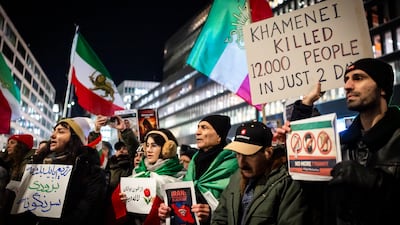
Protesters attend a rally in Zurich on January 13 in support of the nationwide mass demonstrations in Iran. EPA -

A screengrab shows body bags lying outside Kahrizak Forensic Medical Centre in Tehran, after deadly protests across Iran. Reuters -

Activists attend a rally in support of the protesters, in Los Angeles, California. AFP -

Protesters burn a picture of Iran's supreme leader Ayatollah Ali Khamenei outside Downing Street, in London. AFP -

Demonstrators gather in Paris to support the Iranian people amid the anti-government protests in Iran. AFP -
Smoke rises from a mosque as protesters gather amid evolving anti-government unrest in Tehran, Iran, on Friday. Reuters -
Protesters gather amid evolving anti-government unrest in Tehran, Tehran Province, Iran, on Friday. Reuters -
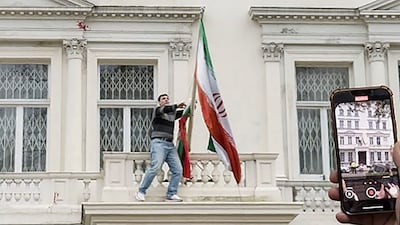
A protester pulls down the Iranian flag from the balcony of Iran's embassy in central London on Saturday. AFP -
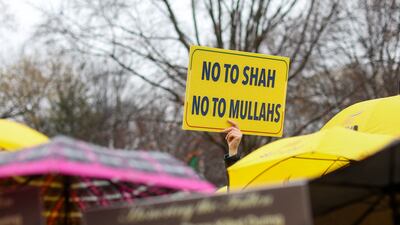
A person holds a placard, as demonstrators and activists rally in support of nationwide protests in Iran, outside the White House in Washington. Reuters -
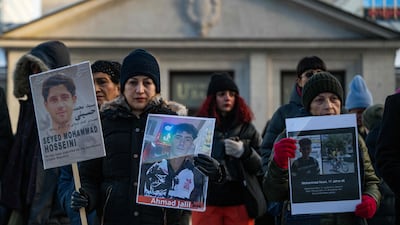
Protesters display placards featuring portraits of Iranians executed by the Iranian regime, during a rally in Berlin on Saturday. AFP -
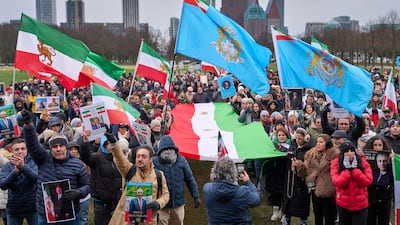
People protest in solidarity with demonstrations in Iran at Malieveld Square, Netherlands on Saturday. AFP


“Silence at this moment sends a signal; it sends a message to the killers of young protesters and their family members."
She warned that accountability would require more than diplomatic language.
In a dramatic exchange, Ms Alinejad turned directly to Iran’s representative as she spoke. “You have tried to kill me three times. I saw the man sent to assassinate me with my own eyes, standing outside my home in Brooklyn,” she said, as the Iranian diplomat stared straight ahead, offering no reaction.
Before the emergency Security Council meeting, Iranian Foreign Minister Abbas Araghchi spoke by phone with Mr Guterres to discuss the protests, according to state media. Tehran urged the UN to do more to condemn what it described as foreign interference in Iran.
Speculation has been rife that the US is preparing to strike government positions in Iran in support of protesters. Mr Trump has said in recent days that Iran would be "hit very hard" if it continued to kill demonstrators.
UN assistant secretary general Martha Pobee warned that threats of military action against Iran, like those made by Mr Trump, increased “volatility” in the protest-torn country.
“We note with alarm various public statements suggesting possible military strikes on Iran. This external dimension adds volatility to an already combustible situation,” she said.
Russia’s ambassador to the UN, Vasily Nebenzya, also criticised Washington, urging the US to “stop making themselves out to be a global judge” and to end what he described as “escalatory actions”.
“Your actions risk plunging the region into even bloodier chaos, chaos that could easily spill beyond its borders,” Mr Nebenzya warned.

