


The UN has been marked by unease and quiet division following the dramatic US operation in Venezuela, with UN diplomats questioning both the legality of the action and the relevance of the multilateral system in restraining such a force.
In the corridors of the UN's New York headquarters, envoys speak of a sense of paralysis after US forces seized Venezuelan President Nicolas Maduro in Caracas and transferred him to New York to face charges including drug trafficking.
US special forces seized Mr Maduro at the weekend, marking the most dramatic US intervention in Latin America since the 1989 invasion of Panama.

An emergency Security Council meeting was requested by Venezuela and formally conveyed to the council by Colombia, whose UN ambassador, Leonor Zalabata Torres, argued that the capture of Mr Maduro risked allowing “the law and the interests of the strongest” to prevail over multilateralism.
Russia also launched a blistering attack on Washington. Mr Maduro, like his predecessor, forged a close relationship with Russia, while China became the main destination for most Venezuelan oil.
“There is no and can be no justification for the crime cynically perpetrated by the United States in Caracas,” Russia's UN envoy Vasily Nebenzya told the council, describing the operation as a breach of international law.
Mr Nebenzya said the episode stripped away any remaining pretence about Washington’s aims, accusing the US of seeking to seize control of Venezuela’s natural resources and reassert its hegemonic dominance across Latin America.
China, for its part, demanded that the US “change its course, cease its bullying and coercive practices”. “No country can act as the world's police, nor can any state presume to be the international judge,” said China’s UN representative, Sun Lei.
Denmark, a close US ally and Nato member, also issued a carefully worded rebuke, stopping short of naming Washington directly. Copenhagen has jurisdiction over the mineral-rich island of Greenland, where officials in President Donald Trump's administration have previously floated the prospect of expanded American control. “The inviolability of borders is not up for negotiation,” warned Christina Markus Lassen, Denmark’s ambassador to the UN.
-
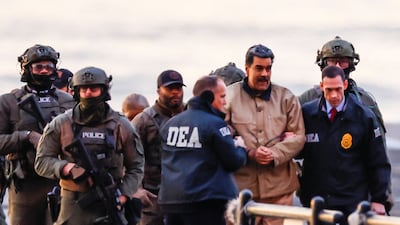
Captured Venezuelan President Nicolas Maduro arrives at the Downtown Manhattan Heliport. Reuters -
Mr Maduro is in the US after being captured by US forces during a military operation in Venezuela. Reuters -
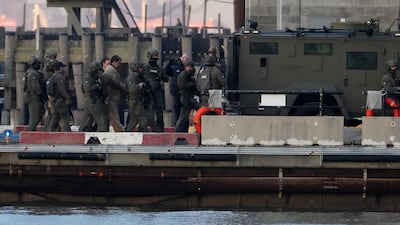
US security troops lead Mr Maduro from the heliport. He has been president of Venezuela since 2013. Reuters -
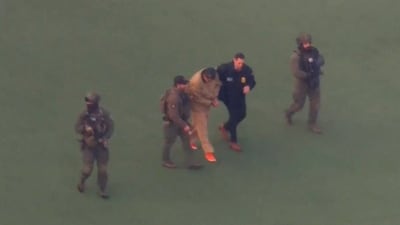
Mr Maduro being moved from a vehicle to a helicopter. Reuters -
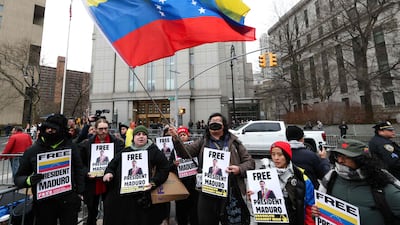
Demonstrators hold signs in support of Mr Maduro outside the Daniel Patrick Moynihan United States Courthouse in New York. AFP -
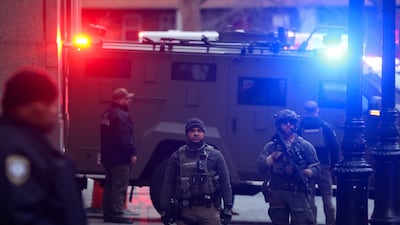
US security forces patrol near the Daniel Patrick Moynihan United States Courthouse, where Mr Maduro was due to appear. Reuters -
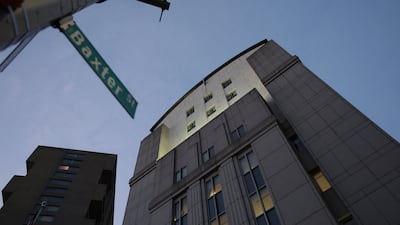
The courthouse in New York City. The US has long accused the Venezuelan government of crimes including drug trafficking. Reuters -
A motorcade thought to be carrying Mr Maduro departs from the Metropolitan Detention Centre in Brooklyn. Bloomberg


But the US pushed back, with Washington's UN envoy Mike Waltz defending his country's “surgical law enforcement operation".
“If the United Nations in this body confers legitimacy on an illegitimate narco-terrorist with the same treatment in this charter of a democratically elected president or head of state, what kind of organisation is this?” asked Mr Waltz.
Publicly, most UN member states have limited themselves to cautious statements calling for respect for international law. Privately, however, diplomats say the episode has deepened concerns that the Security Council is increasingly sidelined when major powers act unilaterally, and that the US operation sets a precedent for cross-border arrests of political leaders that could have ramifications for international law.
Eloy Alfaro de Alba, Panama’s ambassador to the UN, told The National before the emergency meeting that the focus must now be on Venezuela’s future rather than the legality of the US actions alone.
“We’re very concerned about the future in Venezuela and how to get a democratic strength and institutional democratic regime in Venezuela,” he said. “We’re worried about the effects this is having on the entire region and in all other countries, for obvious reasons.”
Analysts say the tension between concern and caution reflects deeper divisions inside the UN. Daniel Forti, head of UN affairs at the International Crisis Group, said most member states were nervous about the implications of the US operation.
“Countries in the Latin American region are particularly worried about the risks of new waves of regional instability and appear open to the UN’s good offices to help de-escalate the crisis,” Mr Forti told The National.
He added that those states probably have the backing of a broad group of developing countries. At the same time, the US's partners on the Security Council face a delicate balancing act.
“They have to defend the UN Charter and international law without openly confronting the Trump administration,” Mr Forti said, noting that countries such as Denmark and Panama are keen to avoid further straining ties with the US.
Mr Forti said Russia and China are expected to seize on the episode to denounce the US military operation and portray it as part of a new wave of American imperial action.
However, he added that they have little to diplomatically offer the Venezuelan government, with whom they have already worked closely at the UN.

