
Though countries around the world breathed a sigh of relief after US President Donald Trump paused his “reciprocal” tariffs for 90 days on Wednesday, some of the world's most underprivileged nations could still be hit with steep charges if the levies are ultimately enforced, as they also grapple with the challenge of Washington cutting off foreign aid through its dismantling of USAID.
The developments come as part of a radical change in international policy under Mr Trump, who, during his first months in office, has ruptured the norms of global trade and US soft power.
“You're basically saying, we're taking away our money, we're taking away your ability to raise money,” said Charles Kenny, a senior fellow at the Centre for Global Development think tank in Washington. “So, it's a double hit, and it's a very unfair double hit.
Mr Trump has framed the levies as a means to reduce the $1.2 trillion US trade deficit. The least developed and small island countries affected by the economic measures represent 1.6 per cent and 0.4 per cent of the deficit, respectively, according to UN Trade and Development.
Centre for Global Development
Low-income countries typically have higher tariffs to generate government revenue and protect their domestic industries.
But the President has argued these countries have ripped off the US. He alleges that Cambodia “made a fortune with the United States of America” by charging a 97 per cent tariff – which Phnom Penh disputes – and has issued a 40 per cent levy on the country. The average monthly salary in Cambodia will be $905.38 this year, according to Independent Property Services, a real estate company in the South-east Asian nation, and the new US tariffs could push many Cambodians deeper into poverty.
Dozens of the world's poorest countries have been hit with some of the steepest penalties: a 46 per cent duty has been placed on goods from Vietnam, 50 per cent on Lesotho in Africa, 41 per cent on Syria and 37 per cent on Bangladesh. At the same time, a shift in US foreign policy is stripping away foreign aid to the same countries.
Among them is Myanmar, which is recovering from a devastating earthquake that resulted in more than 3,500 deaths and razed critical infrastructure. As Myanmar began the early stages of its recovery efforts, Mr Trump hit Naypyidaw with a 44 per cent tariff.
-

A rescuer and earthmovers at work on the ruin of a building brought down by an earthquake in Bangkok, Thailand. Reuters -

A survivor of the earthquake in Bangkok asks rescuers about a relative believed to be trapped in their building. Reuters -

A bridge that connects two high-rise buildings in the aftermath of Bangkok earthquake. Reuters -
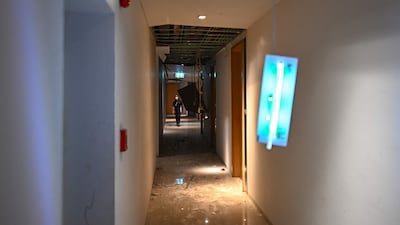
A security guard patrols a high-rise residential building in Bangkok after the March 28 earthquake that hit central Myanmar and Thailand. More than 150 people are feared to have been killed. AFP -
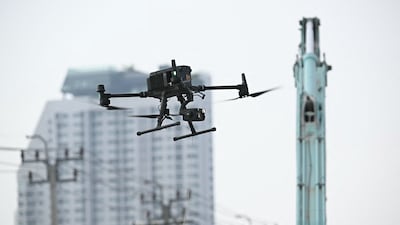
A drone with thermal imaging equipment is used to search for survivors at an under-construction building collapse in Bangkok on March 29, 2025, a day after an earthquake struck central Myanmar and Thailand. AFP -
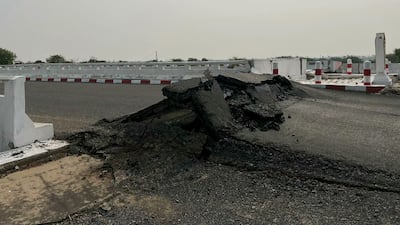
Earthquake damage to a road in Kyaukse district, central Myanmar. AFP -
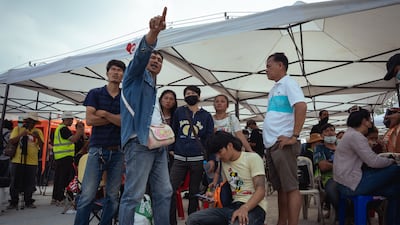
Members of the public await news of rescue operations at the site of the Chatuchak skyscraper collapse in Bangkok, Thailand, in the aftermath of the 7.3 magnitude earthquake. Getty Images -
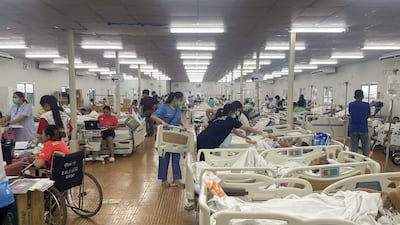
A makeshift medical treatment area is set up in the canteen of a hospital in Bangkok on March 29, a day after an earthquake struck central Myanmar and Thailand. AFP -

The Maha Myat Muni Pagoda collapsed in the earthquake that shook Mandalay, Myanmar, on Friday March. The shock there reached 7.7-magnitude, according to state media. EPA -
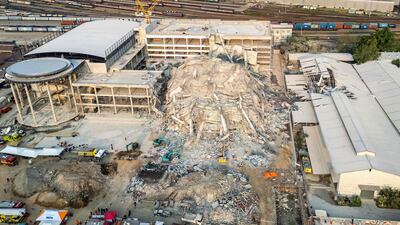
Part of a building site in Bangkok, Thailand, was reduced to rubble. AFP -
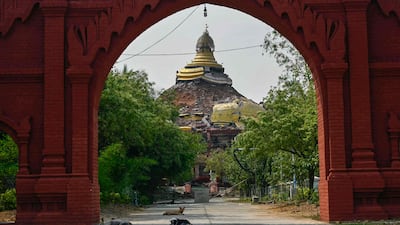
A damaged pagoda in Mandalay, central Myanmar, on March 29, 2025, a day after the earthquake. AFP


“Myanmar is in sort of no state to be responding to that kind of thing right now,” Mr Kenny told The National.
Washington has been criticised for its response to the earthquake, sending a team of three to help, as opposed to the more robust US reactions to previous global emergencies.
The State Department said it had made $9 million in assistance available to Myanmar. Secretary of State Marco Rubio, who has presided over the dismantling of USAID, has defended Washington's response to the earthquake, citing Myanmar's unfriendly junta as a partial reason for the approach.
But Jeremy Konyndyk, president of Refugees International and a former political appointee to USAID under presidents Barack Obama and Joe Biden, said Washington's response sends a “terrible message”.
“That's a terrible reason to say, we're just going to let people in Myanmar die – the fact that we have a political dispute with their government means that their people should be consigned to die crushed under buildings,” he told The National.
Mr Konyndyk, who led USAID's office of Foreign Disaster Assistance from 2013 to 2017, said the agency's dismantling has dramatically reduced Washington's ability to respond to disasters.
“They have fired all the people,” Mr Konyndyk said. “They have cancelled the contracts that would get a Dart [Disaster Assistance Response Team] off the ground.”
Mr Trump's tariffs also represent a change in US policy towards Africa, which used to benefit from congressional legislation enabling sub-Saharan countries to boost economic co-operation and trade with the US. Washington was a significant donor to Lesotho, where gross domestic product reached $2.1 billion in 2023 and which received $44 million from USAID last year.
“The reason these countries need this aid so badly is that they're terribly poor,” Mr Kenny told The National. “The way you make them richer is by them growing through manufacturing and seeing their economies undergo structural transformation. The tariffs are ruining the possibility.”
This comes as the wealth gap between rich and poor nations has widened since the Covid-19 pandemic. A report by the World Bank last year found one in three countries eligible for grants and loans under its International Development Association are now poorer than they were before the pandemic.
“Having this global economic disruption coming right on the heels of the Covid economic disruptions is a really, really, historically damaging double whammy for some of the poorest economies in the world,” said Mr Konyndyk.
Now, the world's poorest countries are at risk of a potential global downturn because of the latest trade wars. Economists at Goldman Sachs this week raised the probability of a US recession from 35 per cent to 45 per cent, warning the economy could weaken further if the tariffs take effect.
“That's going to further undermine the availability of aid because for a lot of countries, they tie their level of aid to share of their overall gross domestic product,” Mr Konyndyk said. “So if their GDP goes down because it's a recession, their aid will also go down, and we're seeing that pressure emerging even before a potential recession hits.”

