


Anti-war protesters calling for Columbia University's divestment from Israel and its actions in Palestine began demonstrations on the first day of classes in New York on Tuesday. This follows the protest movement that began in the spring.
“It's back to school season in both Gaza and New York – but while we are privileged enough to move into our dorms ready for the new school year, 715,000 Gazan children receive their US-backed education in the form of air strikes,” the CU Apartheid Divest organisation said. “We're not going anywhere. All day long, we will #Picket4Palestine."
Live video on social media showed a small group of protesters picketing outside an entrance of the Upper West Side campus in Manhattan, chanting pro-Palestinian slogans and attempting to block entry to the main grounds.
"The university welcomed new and returning students for a productive first day of classes on Morningside Campus," a Columbia representative told The National in an email. "As we begin the new semester, we are focused on our mission of teaching, creating and advancing knowledge, and ensuring a safe, respectful campus environment for our community."
The picket did not disrupt the start of classes and dispersed on its own in the early afternoon.
Red paint was also thrown on the Alma Mater statue on campus — allegedly as part of a protest — and it was cleaned up shortly after the incident.
Tuesday's actions mark the start of an academic term that could be disrupted by student protests and increased campus security in the run-up to the US election and as the Israel-Gaza war rages on.
Elsewhere, the University of Michigan saw a police crackdown on an anti-war protest last week, while The New York Times reported pro-Palestine activists shut down the student government, demanding that the administration divest from companies connected to Israel.

“As long as Columbia continues to invest and to benefit from Israeli apartheid, the students will continue to resist,” graduate student Mahmoud Khalil told AP. “Not only protests and encampments, the limit is the sky.”
The Ivy League university was the centre of anti-war student protests, with demonstrators angered over the rising civilian death toll due to Israel's military operations in Gaza after a deadly Hamas-led attack on Israel on October 7.
The first student camp in the middle of Columbia's Morningside campus and the initial arrests of more than 100 people inspired thousands of university students nationally and internationally to start their own anti-war protests.
Some academic programmes agreed to divest from finances connected to Israel, while others told student protesters that they would take their demands into consideration, along with other requests. Columbia has refused to consider divesting.
Columbia is also starting its term weeks after its president, Minouche Shafik, resigned. She faced criticism over calling New York police twice: once to evict a tent camp and again to clear the occupation of an academic building.
Universities try to curb protests
Colleges and universities have changed codes of conduct and blocked parts of campuses over the summer in moves to curb student protests. Changes include limiting when and where demonstrations could take place, restrictions on amplified sound and guidelines about protest signs, educators with the American Association for University Professors organisation said last week.
New York University, another site of student demonstrations in the city, updated its student code of conduct to include anti-Zionist speech as a form of discriminatory behaviour that could result in punishment.
The Intercept and The Hill reported that NYU was the first US university to view Zionism as an identity in need of protection. “With harsh sanctions for violations, the policies broadly chill students and faculty from engaging in protests and demonstrations,” the AAUP added.
New York University had Gould Plaza, the location of a student occupation, boarded up as of last week, and NYU professor Jacob Remes posted a photo on X showing campus benches barricaded off with a suggestion that it was because of protest concerns.
AP reported that Columbia has hired private security guards to patrol and require students or faculty to present identification to enter the campus, a part of the city that used to be open to the public.
The university's safety division also introduced a colour-coded campus status level system, with each level mandating different measures of security and entry requirements.
It is currently set at orange, the second-highest level under red, which means there is a limited amount of entrances open and only those with Columbia IDs or pre-registered guests can pass through
“Our colleges and universities should encourage, not suppress, open and vigorous dialogue and debate even on the most deeply held beliefs,” the AAUP said.
-
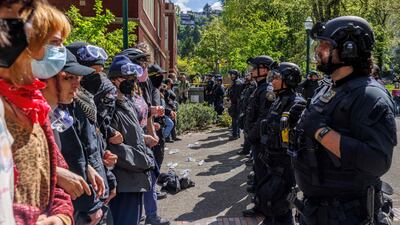
Students and activists protesting against the Gaza war face police after demonstrators were evicted from the library at Portland State University in Oregon. AFP -

A car is damaged after it was driven towards protesters at Portland State University. AFP -
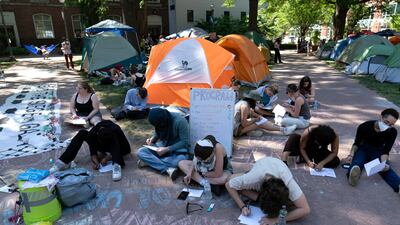
Students write letters in support of Palestinians in Gaza at an encampment at George Washington University, in Washington. AP -
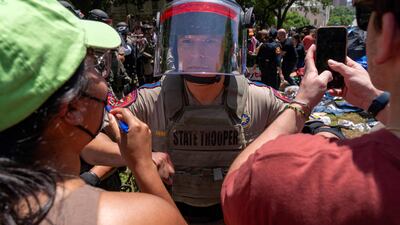
Pro-Palestinian protesters confront a state trooper at the University of Texas in Austin. AFP -
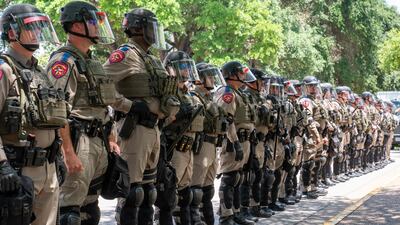
Texas State troopers stand guard at the University of Texas. AFP -
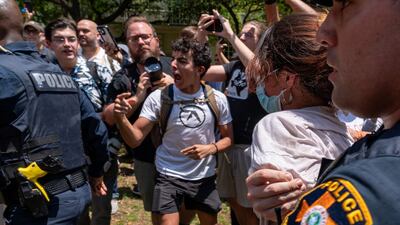
A protester confronts University of Texas police. AFP -

A demonstrator protests outside the encampment established in support of Palestinians in Gaza at Columbia University, in New York City. AFP -
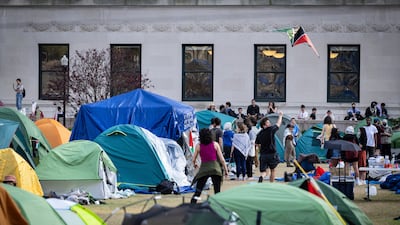
A student protester flies a kite inside the protest encampment at Columbia University. AP -
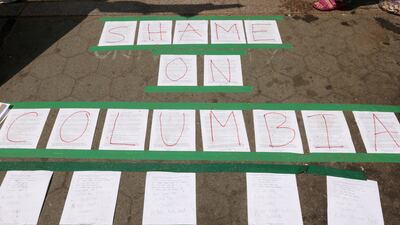
Students at Columbia University write a message as the conflict between Israel and Hamas continues. Reuters -
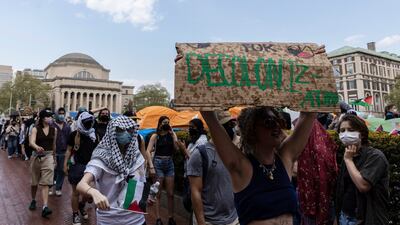
Student protesters march round their encampment at Columbia University. AP -
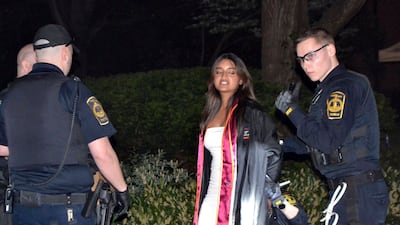
A student is arrested at a protest encampment on the Virginia Tech campus in Blacksburg. AP -
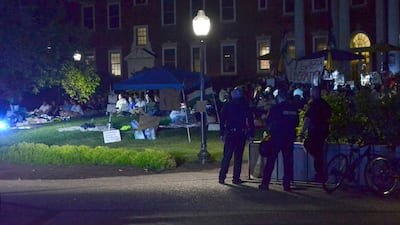
Police move to bring down an encampment after several days of protests by pro-Palestinian activists on the Virginia Tech campus. AP -

Vish Gill, a prominent figure at pro-Palestine protests, is arrested at Virginia Tech campus. AP -
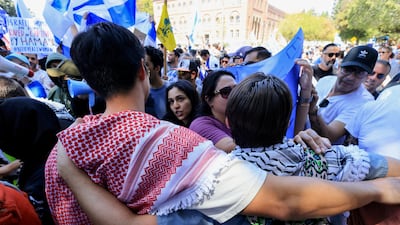
Pro-Israel counter-protesters gather at a pro-Palestine demonstration at the University of California, Los Angeles. Reuters -
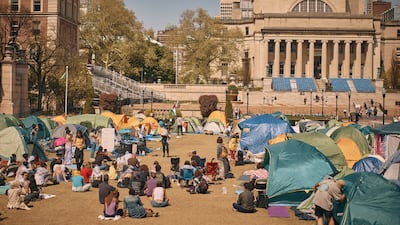
Pro-Palestine demonstrators gather on the campus of Columbia University. AP



