

In September 2005, prominent Syrian dissident Fawaz Tello was a political prisoner in Adra prison near Damascus, when guards brought him from his cell late at night for a meeting with prison director Samir Al Sheikh.
Mr Al Sheikh, who would later become governor of Syria's Deir Ezzor province, was wearing a suit when Mr Tello arrived in his office – a change from his usual military fatigues.
He handed Mr Tello a piece of paper, which, if signed, would supposedly result in his immediate release.
“I looked at the paper and it said that if I promise to reform, I would be freed,” Mr Tello told The National from Berlin, where he now lives in exile.
“I told him I was not going to sign it, and that the regime is the one who should be undergoing reform, not me.
“He tried to start a dialogue with me. I asked to be returned to my cell.”
Nearly two decades later, it is Mr Al Sheikh who finds himself in a cell.
US officials arrested him last week in Los Angeles, California. He is believed to be the highest-ranking Assad regime official to be detained.
The years-long journey to his capture began with a note, too.
In 2021, Syrian activist Omar Alshogre received a message on social media from a woman who said she knew Mr Al Sheikh's daughter – and that the man was in the US.
Catching Samir Al Sheikh
The Syrian Emergency Task Force (SETF), with whom Mr Alshogre works and which co-ordinated with the US government on the arrest, confirmed to The National that federal law enforcement agents detained Mr Al Sheikh on July 10 as he attempted to leave the US on a one-way flight to Beirut.
The complaint filed in California's Central District accuses Mr Al Sheikh, 72, of attempted naturalisation fraud in his effort to seek US citizenship, claiming he lied about whether he has “persecuted” anyone for their political beliefs or had been involved in any killings.
Mr Al Sheikh “committed, ordered, incited, assisted, and otherwise participated in acts of violence against political dissidents and other prisoners at Adra Prison while he was the head of the prison from 2005 to 2008,” the criminal complaint states.
Peter Hardin, Mr Al Sheikh's defence attorney, told The National that “Mr Al Sheikh vigorously denies these abhorrent allegations."
"He looks forward to clearing his name and returning home to live out his days in Syria," Mr Hardin said.
The case began after Mr Alshogre, a survivor of torture inside President Bashar Al Assad's prisons, received the surprise social media message.
Mr Alshogre told The National the woman said she didn't “know if we can do anything, and that's why I released this [information] to you,” the message read.
She delivered “pictures of him and his address.”
So began the US hunt for Mr Al Sheikh.
Mr Al Sheikh left Syria for the US in 2020 after his wife obtained American citizenship, according to Syrian human rights lawyer Anwar Al Bunni, who said that he provided information to authorities that contributed to the arrest.
Mr Al Bunni was a political prisoner at Adra when Mr Al Sheikh was in charge of the facility.
After Mr Alshogre received the message from the woman, who chooses to remain anonymous, SETF began the careful task of verifying Mr Al Sheikh's identity and bringing him to the attention of US authorities.
Mouaz Moustafa, SETF's executive director, says he “took it from Omar [Alshogre] at that point”.

That initially meant meetings with the woman who sent the message, her family and eventually the US State Department's Bureau of Democracy, Labour and Human Rights and its Near Eastern Affairs desk, he said.
“All of them said this looks like it's something we can act on. But nobody was moving fast enough … and at some point, the FBI is told about this,” Mr Moustafa told The National.
A US State Department did not comment on the case but said the department supports the work of Syrian civil society organisations.
They help to “bring perpetrators to justice through their documentation of human rights violations and abuses, which contribute to criminal prosecutions, including under the principal of universal jurisdiction, and other transitional justice efforts,” the official told The National.
In February 2022, after the FBI began looking into the case, Mr Moustafa booked a flight from Jordan to California.
That's when SETF began working with the Department of Justice, they say, “not only giving them all the details of where he is now, give him details of exactly what his role was in the past, including in Adra prison and in Deir Ezzor as governor”.
A 'polite man' performing 'physical and psychological' torture
According to the criminal complaint Mr Al Sheikh “knew about, approved, ordered, and participated in the execution of prisoners at Adra Prison” near Damascus and also oversaw executions.
Mr Tello first encountered the former official when the Assad regime was under international pressure over the suspected role of its security forces in the assassination, seven months earlier, of Lebanese statesman Rafik Hariri.
Mr Al Assad sought to counter the pressure by partially easing his iron rule at home.
In January 2006, Mr Tello had a second encounter with Mr Al Sheikh, during which he again refused to sign that same piece of paper – but with that international pressure bearing down, he was released anyway.

After the 2011 revolt against the Assad regime, President Al Assad appointed Mr Al Sheikh as governor of Deir Ezzor, a strategic area near the border of Iraq that contains oil and gasfields. It was also a major centre of revolt against the government.
While there, he supervised regime forces who “committed war crimes”, Mr Al Bunni alleged.
Federal prosecutors have not charged Mr Al Sheikh with war crimes.
Mr Al Sheikh's intelligence and security background was the main reason he was appointed governor, Mr Tello said.
Most of the Damascus Spring leaders, including Mr Tello, were imprisoned on charges of undermining national morale.

Syrian opposition members say that as governor, Mr Al Sheikh headed the so-called Security Committee of Deir Ezzor, which existed in every governorate to co-ordinate actions by the different security divisions. As its head, they say, he directly participated in the crackdown on the revolt.
One source from Deir Ezzor said the real power in the committee belonged to Maj Gen Jameh Jameh of Military Intelligence, who died under mysterious circumstances in Deir Ezzor in 2013.
Mr Tello notes that Mr Al Sheikh projected an aura of a “somewhat educated man”.
“He was very smart and very polite,” said Mr Tello, adding that Mr Al Sheikh, like many officers in Syria's political intelligence division, had studied law.
Although there were human rights transgressions in Adra and other facilities where prisoners of conscience were held, the level of abuse of prisoners paled in comparison to “the crimes the regime committed” since the 2011 revolt.
-
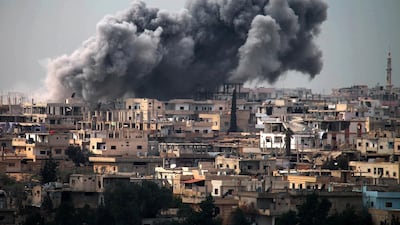
Smoke billows following air strikes on a rebel-held area in the southern city of Daraa on March 16, 2017. AFP -
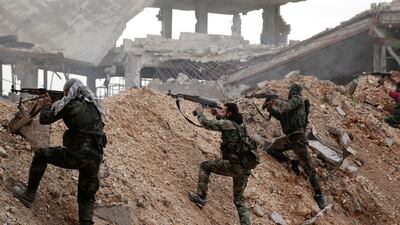
Syrian army soldiers fire their weapons during a battle with rebel fighters at the Ramouseh front line, east of Aleppo, on December 5, 2016. AP Photo -

Russians, Syrians and others gather next to an American military convoy stuck in the village of Khirbet Ammu, east of Qamishli city, on February 12, 2020. AP Photo -
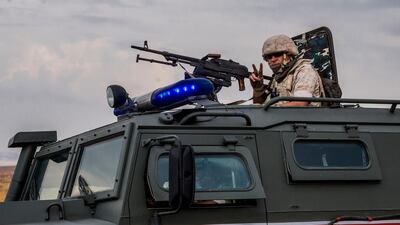
A Russian soldier mans a machine gun during a patrol near the Syrian and Turkish border in north Syria on October 25, 2019. AP Photo -
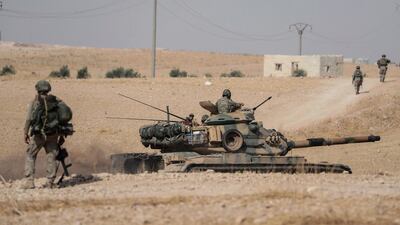
Turkish tanks and troops stationed near Syrian town of Manbij. AP -
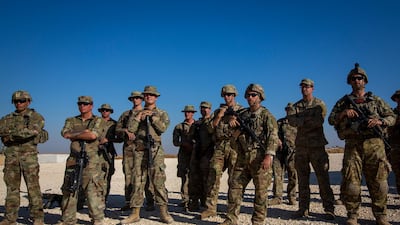
Crew of Bradley fighting vehicles stand at a US military base in north-eastern Syria on November 11, 2019. AP Photo -
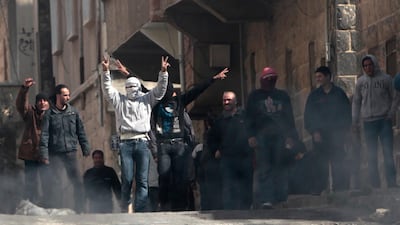
Anti-government protesters flash victory signs as they protest in the southern Syrian city of Daraa on March 23, 2011. AP Photo -
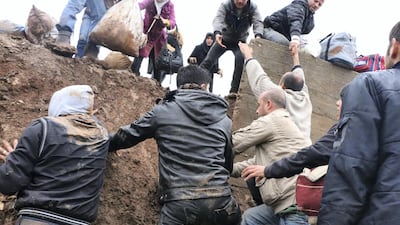
Syrians climb up a mud bank as they flee across fields to reach the Syrian-Turkish border on March 10, 2014. AFP -
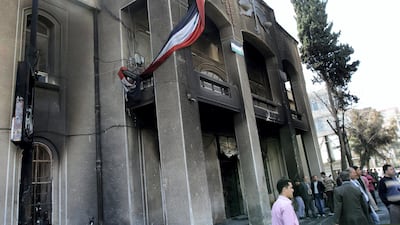
Syrian men gather outside the courthouse in Daraa that was torched a day earlier by angry protesters on March 21, 2011. AFP -
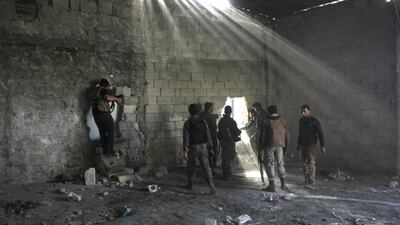
Rebel fighters inside a building during clashes with pro-government forces in the Sheikh Al Said neighbourhood of Aleppo city on November 28, 2013. AFP -
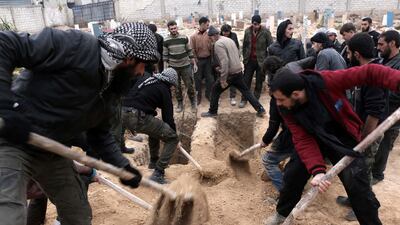
Syrians bury victims in a group funeral following air strikes in the rebel-held city of Douma on January 7, 2016. AFP -
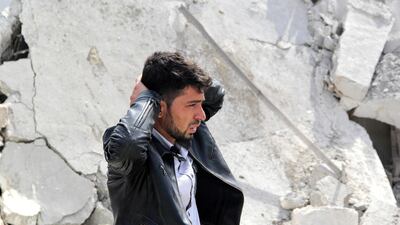
A man reacts to the destruction of his home in an air strike by government forces on the northern Syrian city of Aleppo on February 22, 2014. AFP -
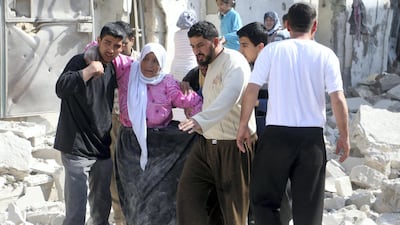
A woman is helped through the rubble of buildings hit by a reported Syrian government air strike in Al Sakhour district of Aleppo city on April 4, 2014. AFP -
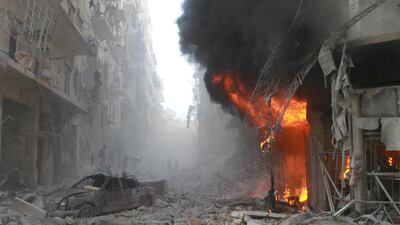
Debris fills a street and flames rise from a building following an air strike by Syrian government forces in the Sukkari neighborhood of Aleppo on March 7, 2014. AFP -
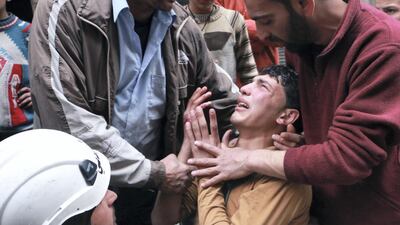
A man is comforted following an air strike by government forces that killed a rescue worker in Aleppo city on March 9, 2014. AFP -
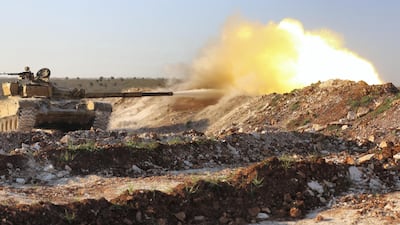
A tank seized by rebel fighters fires at a pro-government position near the Syrian city of Hama on February 19, 2014. AFP -
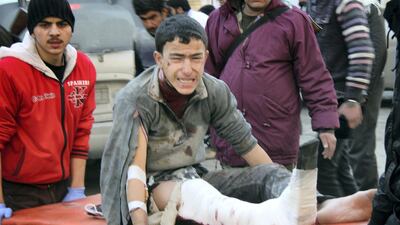
An injured Syrian youth cries as he is carried on a gurney following an air strike in the Maadi neighbourhood of Aleppo city on December 17, 2013. AFP -
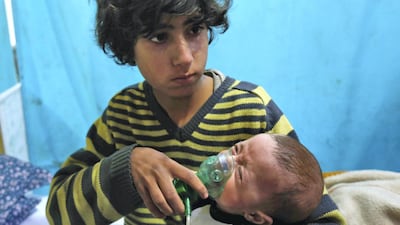
A Syrian boy holds an oxygen mask to an infant's face following a reported gas attack in Douma on January 22, 2018, when the town near Damascus was held by rebels. AFP -
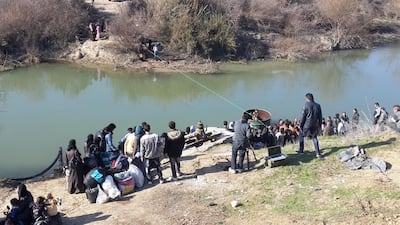
Displaced Syrians wait to enter Turkey from Idlib province across the Orontes river on February 5, 2014. AFP


The long road to accountability
For Mr Alshogre, this is only the start on the path towards accountability.
“Now there's a next phase of work,” he said, adding that the US government “has received a lot of evidence and observation that will be used and are now being used to build a very strong case”.
“We don't want to prosecute him for lying about his visa,” Mr Alshogre said.
Mr Tello, meanwhile, said the arrest sends an important message.
“Otherwise he and people like him would continue to think that they will get away with what they did,” he said.

The arrest comes after recent victories in international court cases against Assad regime officials.
In May, French judges convicted three senior Syrian officials for their role in the 2013 imprisonment, enforced disappearance and torture of two dual Syrian-French citizens, Patrick Dabbagh and his father Mazzen.
And in 2022, a German court sentenced Col Anwar Raslan to life in prison for crimes against humanity over his links to the torture of more than 4,000 people in a Syrian regime jail known as “Hell on Earth”.
Weeks ago, Germany and Sweden arrested eight people on suspicion of committing war crimes in Syria.
Mr Alshogre, who lives in Stockholm, added that Mr Al Sheikh's high-ranking status within this regime is important for other cases against former Syrian officials.
“This is a governor, which means the prosecution of this person is not like the previous prosecutions … this provides more evidence that Assad himself is giving orders for the killing, for massacres taking place in Syria.”
Many Syrians, he said, do not feel faith in justice.
“They don't believe in justice, because they see the world has forgotten about us,” he added.
“It took me a long time to normalise the idea that justice can be achieved.”
Ellie Sennett reported from Washington and Khaled Yacoub Oweis reported from Amman

