


Live updates: Follow the latest on Israel-Gaza
Student protesters on campuses across the US have been demanding their universities disclose financial investments and divest from companies or academic institutions connected to Israel's actions in the Palestinian territories.
Other protesters have included requests for their universities to call for a Gaza ceasefire, no policing on campuses, amnesty for those arrested during protests, and better services protecting and serving Muslim and Arab communities.
Amid widespread university-ordered police operations on pro-Palestine protest camps, some institutions have chosen to negotiate with students.
Columbia University in New York, where the protests first gathered steam, has said that it will not divest from Israel, although other institutions have proven more willing to negotiate.
But at Union Theological Seminary, an affiliated college, the board of trustees said it would support calls to divest from “companies substantially and intractably benefiting from the war in Palestine”.
Brown University, an Ivy League institution in Rhode Island, agreed to have its highest governing body vote on divestment in October, after protest organisers met administrators to discuss their demands.
“The devastation and loss of life in the Middle East has prompted many to call for meaningful change, while also raising real issues about how best to accomplish this,” Brown president Christina Paxson said on April 30.
“Brown has always prided itself on resolving differences through dialogue, debate and listening to each other.”
While the protest camp there has moved on, the Brown Divest Coalition said the fight continues.
“We will not let our agreement be used to pacify this movement,” it said in a post on X. “Rather, we will use it to fuel us further.”
On May 20, the New School's investment committee of the board of trustees at the university in New York agreed to vote in June on whether to "completely divest in companies" connected to Israel, after a student camp was cleared by police and the first faculty-led camp was set up in a campus building.
The University of Washington on May 17 agreed to improve transparency on its investment portfolio and meet student leaders to discuss how to approach divestment in the future.
The administration also said it would support scholarships for displaced students from Gaza, collaborate with Palestinian universities and look into whether existing study-abroad programmes exclude Arab students.
On May 14 at Harvard University, protesters ended their camp after president Alan Garber offered them a meeting with governing boards about questions on its investments and discuss their hopes for divestment.
Johns Hopkins University in Baltimore, Maryland, said on May 12 that it "promised a timely review of the protesters' key question of divestment" in return for an end to their protest camp.
On May 10, the University of Wisconsin-Madison agreed to let pro-Palestine students meet "relevant decision-makers" to discuss their "concerns and requests" on its endowment and investments.
At Evergreen State College in Washington, administrators said on May 8 that a committee would start to formulate strategies on “divestment from companies that profit from gross human rights violations and/or the occupation of Palestinian territories”.
On May 7, Sacramento State under California State University announced that it will no longer invest in "corporations that profit from genocide, ethnic cleansing and activities that violate fundamental human rights".
-
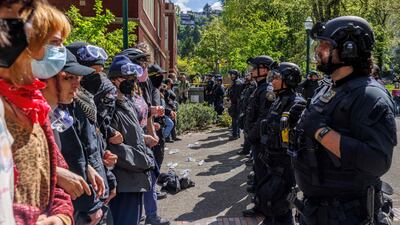
Students and activists protesting against the Gaza war face police after demonstrators were evicted from the library at Portland State University in Oregon. AFP -

A car is damaged after it was driven towards protesters at Portland State University. AFP -
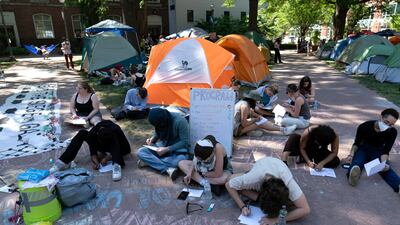
Students write letters in support of Palestinians in Gaza at an encampment at George Washington University, in Washington. AP -

Pro-Palestinian protesters confront a state trooper at the University of Texas in Austin. AFP -

Texas State troopers stand guard at the University of Texas. AFP -
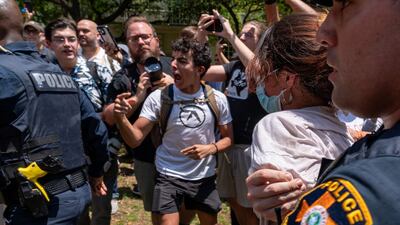
A protester confronts University of Texas police. AFP -

A demonstrator protests outside the encampment established in support of Palestinians in Gaza at Columbia University, in New York City. AFP -
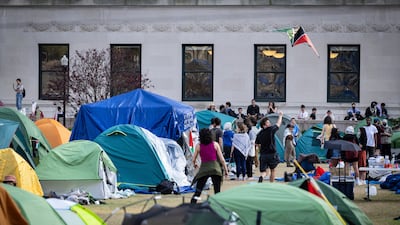
A student protester flies a kite inside the protest encampment at Columbia University. AP -
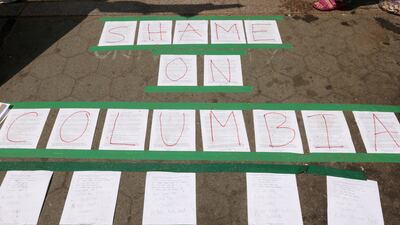
Students at Columbia University write a message as the conflict between Israel and Hamas continues. Reuters -
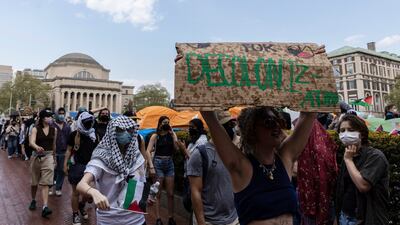
Student protesters march round their encampment at Columbia University. AP -

A student is arrested at a protest encampment on the Virginia Tech campus in Blacksburg. AP -
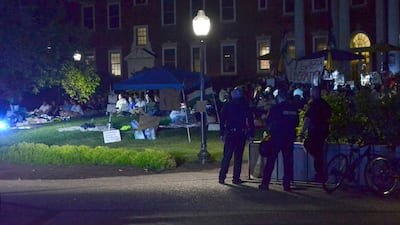
Police move to bring down an encampment after several days of protests by pro-Palestinian activists on the Virginia Tech campus. AP -

Vish Gill, a prominent figure at pro-Palestine protests, is arrested at Virginia Tech campus. AP -

Pro-Israel counter-protesters gather at a pro-Palestine demonstration at the University of California, Los Angeles. Reuters -

Pro-Palestine demonstrators gather on the campus of Columbia University. AP


Also on May 7, Occidental College in Los Angeles said it would call a special session of the investment committee of the board of trustees to consider the student divestment proposal, and hold an official board vote on the issue this June.
Protesters and Vassar College's president agreed on May 4 to have students present a proposal from divesting at a board of trustees meeting this May and in October.
The student protest group hopes to focus on "weapons and surveillance manufacturers, including those that supply Israel with the materials that carry out the genocide of the Palestinian people".
Rutgers University in New Jersey on May 2 agreed to most of the demands presented by protesters, except for divestment from Israel, which it said was already under review.
The president later said "divestment from Israel is wrong".
It also said a request to sever ties with Tel Aviv University is a “matter of scholarly inquiry”.
And the University of Minnesota on May 1 said it would disclose details on its financial holdings within weeks and that student protesters could speak with the board on divestment in a May meeting.
The university said it was open to hearing proposals on partnerships with Palestinian and Israeli universities.
Northwestern University in Illinois said on April 29 that it would provide opportunities for students to speak with the board of trustees' investment committee about their concerns and vowed to answer questions about university holdings in a timely manner.
While some view the move by these universities as successful, activist critics have argued that setting up committees to present proposals in the future is not directly meeting demands in a timely manner.
Divestment is not new to universities: Academic institutions have removed investments connected to apartheid in South Africa and to fossil fuel over climate change concerns.
On May 21, administrators and camp organisers at Ontario Tech University in Oshawa said that they had reached a divestment agreement, bringing the campus protests against investments connected to Israel's military to an end.
Ontario Tech is the first major educational institution in Canada to reach an agreement with protesters.
Columbia has drawn attention for requesting a police response twice and it has been clear in stating that it will not divest from Israel.

“While the university will not divest from Israel, the university offered to develop an expedited timeline for review of new proposals from the students by the advisory committee for socially responsible investing, the body that considers divestment matters,” president Nemat Shafik said in a statement on April 29.
“The university also offered to publish a process for students to access a list of Columbia’s direct investment holdings, and to increase the frequency of updates to that list of holdings.”
Internationally, Ireland's Trinity College Dublin reached an agreement with protesters to have them clear their camp on May 8 after it vowed to “complete a divestment from investments in Israeli companies that have activities in the occupied Palestinian territory and appear on the UN blacklist”.
The senate at the University of Barcelona also voted on May 8 to cut relations with Israel-linked companies and academic institutions “as a mechanism of pressure on the state of Israel until the genocide ends”.
Its motion still needs approval by the university board of directors and governing council.

