


Live updates: Follow the latest on Israel-Gaza
As Washington seeks to crack down on campus anti-Gaza war protests, the US House of Representatives overwhelmingly passed a bill that expands the definition of anti-Semitism.
Senators were on Thursday reportedly running a “hotline” to field internal discussion on the Anti-Semitism Awareness Act, which passed the House of Representatives in a 320-91 vote.
The bill would codify the International Holocaust Remembrance Alliance (IHRA) working definition of anti-Semitism, which includes criticism of Israel and Zionism.
The development is largely seen as a response to the wave of campus protests against Israel's war in Gaza, in which the debate around whether “anti-Zionism is anti-Semitism” has been at the fore of American discourse.
The bill's lead sponsor in the Senate, Republican Tim Scott, celebrated its passing in the House as “a momentous step towards rooting out anti-Semitic hate and protecting the rights of Jewish students on college campuses across America”.
House Speaker Mike Johnson has led the Republicans in announcing a party-wide effort to crack down on anti-Semitism in response to the national protests, which bi-partisan members of Congress have sought to portray as anti-Semitic.
Senate Majority Leader Chuck Schumer, the highest-ranking Jewish elected official in US history, has not commented on when he would bring the bill to the Senate floor for a final vote.
Mr Schumer recently made headlines for calling for elections in Israel over claims that Prime Minister Benjamin Netanyahu was an obstacle to peace. It was a rare breach from Mr Schumer in a relationship that has long touted that there is “no daylight” between Israel and the US.
The bill has warranted significant criticism from civil liberties groups.
Pro-Palestine protests continue at US universities – in pictures
-

Students and activists protesting against the Gaza war face police after demonstrators were evicted from the library at Portland State University in Oregon. AFP -

A car is damaged after it was driven towards protesters at Portland State University. AFP -

Students write letters in support of Palestinians in Gaza at an encampment at George Washington University, in Washington. AP -

Pro-Palestinian protesters confront a state trooper at the University of Texas in Austin. AFP -

Texas State troopers stand guard at the University of Texas. AFP -

A protester confronts University of Texas police. AFP -

A demonstrator protests outside the encampment established in support of Palestinians in Gaza at Columbia University, in New York City. AFP -

A student protester flies a kite inside the protest encampment at Columbia University. AP -
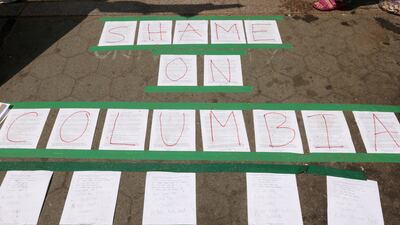
Students at Columbia University write a message as the conflict between Israel and Hamas continues. Reuters -

Student protesters march round their encampment at Columbia University. AP -

A student is arrested at a protest encampment on the Virginia Tech campus in Blacksburg. AP -

Police move to bring down an encampment after several days of protests by pro-Palestinian activists on the Virginia Tech campus. AP -

Vish Gill, a prominent figure at pro-Palestine protests, is arrested at Virginia Tech campus. AP -

Pro-Israel counter-protesters gather at a pro-Palestine demonstration at the University of California, Los Angeles. Reuters -

Pro-Palestine demonstrators gather on the campus of Columbia University. AP


The American Civil Liberties Union sent a letter urging Congress to oppose the bill ahead of the vote, saying the definition is “overbroad” and “enshrining it into regulation would chill the exercise” of free speech in the US.
“Criticism of Israel and its policies is political speech, squarely protected by the First Amendment,” the ACLU wrote in its letter to Congress.
Congresswoman Sara Jacobs, a Democrat on the Foreign Affairs Committee and a Jewish-American, was among the minority of House members to vote against the bill, saying it “fails to effectively address the very real rise of anti-Semitism”.
Progressive Jewish American groups such as Americans for Peace Now have spoken out against the legislation, pointing out that even the lead drafter of the IHRA, Kenneth Stern, has warned against “using it as a cudgel against the millions of Americans, including many Jewish Americans, who object to the Netanyahu government’s decisions and actions”.
“Anti-Semitism is the hatred of Jews,” said APN's chief executive, Hadar Susskind. “Unfortunately, one doesn’t need to look far to find it these days. But the supporters of this bill are looking in the wrong places. They aren’t interested in protecting Jews.
“They are interested in supporting right-wing views and narratives on Israel and shutting down legitimate questions and criticisms by crying 'anti-Semite' at everyone, including Jews, who oppose the Netanyahu, Ben-Gvir, Smotrich government,” Mr Susskind added in a statement.

