

Republican leaders on Tuesday said Gaza protests at US university campuses were “out of control”, after students at Columbia University in New York took over a building in a move condemned by the White House.
House Speaker Mike Johnson said that Columbia is unable to operate as students prepare for final exams, calling the situation “unfair” and “unsafe”.
He also announced a "House-wide effort to crack down on anti-Semitism" on campuses.
Leaders also asked President Joe Biden's administration whether foreign students engaged in "radical activity" on US campuses would have their visas revoked.
The comments come as protests against the war in Gaza continue to rage across US university campuses.
Chairman of the House judiciary committee Jim Jordan said his panel had sent formal letters to the Biden administration asking whether it would remove foreign citizens taking part in the anti-war campus protests.
"We as Republicans in the Congress want to know … first, how many students on a visa have engaged in the radical activity we've seen now, day after day, on college campuses?" Mr Jordan asked.
"Question two, if you know that number, have you asked the State Department to revoke their visas?
"And then third, and maybe most importantly to Secretary [of Homeland Security Alejandro] Mayorkas – if you've done that, if you know that answer, have you started removal proceedings?"
Dozens of protesters took over Hamilton Hall on the Columbia campus early on Tuesday, barricading the entrances with tables and chairs, and unfurling a Palestinian flag out of a window in the latest escalation of demonstrations.
Supporting protesters locked arms in front of the academic building overnight, as occupiers moved furniture and metal barricades to block entry ways and hung banners that read “Free Palestine” and "intifada".
Late on Tuesday, New York City police officers arrived at the campus and began the process of retaking control of Hamilton Hall. Footage showed dozens of police officers entering the building via a ladder that was extended from the roof of a police vehicle.
The CU Apartheid Divest coalition posted on X that an “autonomous group” had occupied the hall and renamed it Hind's Hall, in honour of six-year-old Hind Rajab, who was killed along with her family by Israeli fire as they travelled in a car.
The coalition also announced that occupiers would "remain in Hamilton until the university divests from death," reiterating its protest demand for the school to disclose and divest from finances linked to Israel's actions.
“The President [Joe Biden] believes that forcibly taking over a building on campus is absolutely the wrong approach,” National Security Council spokesman John Kirby told reporters.
Deputy press secretary Andrew Bates added that the President "respects the right to free expression but protests must be peaceful and lawful".
"Hate speech and hate symbols have no place in America," he added, referring to the Biden administration's objection to the use of the word "intifada" as dangerous. The word means "uprising" and "shaking off" in Arabic.
New York City Mayor Eric Adams and city police claimed that there were "outside actors" unaffiliated with the school" participating in the Hamilton Hall occupation.
They were people known to have been involved in protest activity over the years and have helped students with new tactics, officials said.
The move to occupy a building came after Columbia president Nemat Shafik said negotiations between faculty and demonstrators had failed, and the school started to suspend remaining participants.
"We regret that protesters have chosen to escalate the situation through their actions," Columbia's spokesman Ben Chang said in a statement, adding that property had been vandalised.

The students occupying Hamilton Hall face expulsion.
"This is about responding to the actions of the protesters, not their cause," Mr Chang said.
Hamilton Hall is an eight-story building that was built in 1907 and is named after American founding father Alexander Hamilton, who attended King's College, what was once Columbia's original name.
The building has also been occupied in past student protests in 1968 and 1996.
“We call for the police to come in and take care of it,” Mr Johnson said of the situation at Columbia. “If they're unable, then we need the National Guard. We have to have control of campuses.”
Tom Emmer, the Majority Whip, added that “since President Joe Biden, far-left congressional Democrats and Ivy League administrators have chosen to side with Hamas over protecting Jewish students”, Republicans needed to pass legislation to combat anti-Semitism on campuses.
Republicans on the House judiciary committee submitted a letter to the Biden administration asking how many "students on a visa" have engaged in campus protests, and whether the State Department has been asked to "revoke visas" or "start removal proceedings".
Pro-Palestine protests at US universities continue – in pictures
-
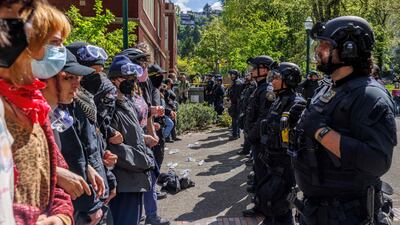
Students and activists protesting against the Gaza war face police after demonstrators were evicted from the library at Portland State University in Oregon. AFP -

A car is damaged after it was driven towards protesters at Portland State University. AFP -
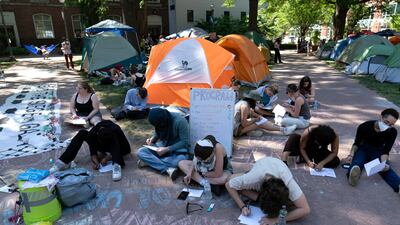
Students write letters in support of Palestinians in Gaza at an encampment at George Washington University, in Washington. AP -
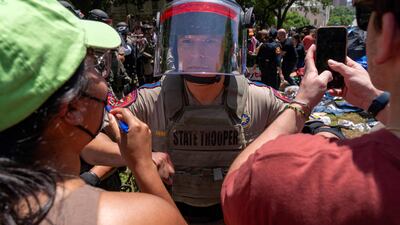
Pro-Palestinian protesters confront a state trooper at the University of Texas in Austin. AFP -
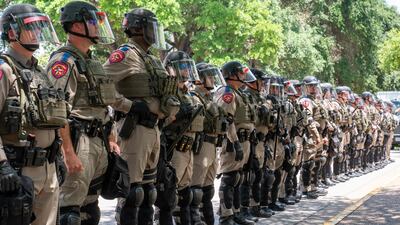
Texas State troopers stand guard at the University of Texas. AFP -
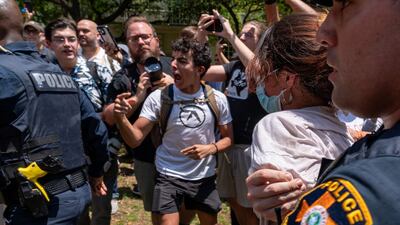
A protester confronts University of Texas police. AFP -

A demonstrator protests outside the encampment established in support of Palestinians in Gaza at Columbia University, in New York City. AFP -
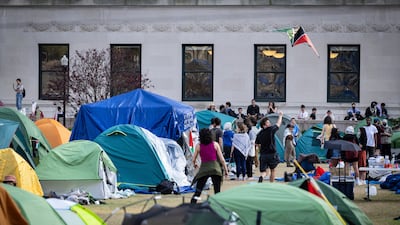
A student protester flies a kite inside the protest encampment at Columbia University. AP -
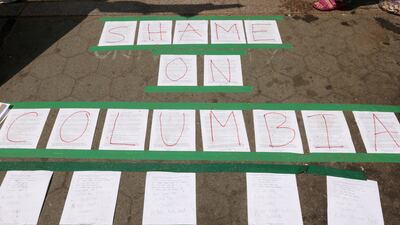
Students at Columbia University write a message as the conflict between Israel and Hamas continues. Reuters -
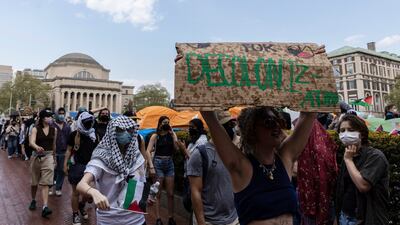
Student protesters march round their encampment at Columbia University. AP -
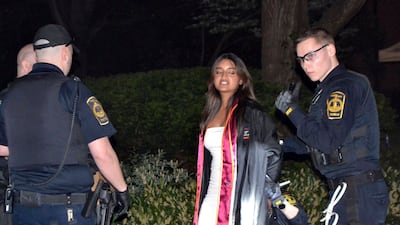
A student is arrested at a protest encampment on the Virginia Tech campus in Blacksburg. AP -
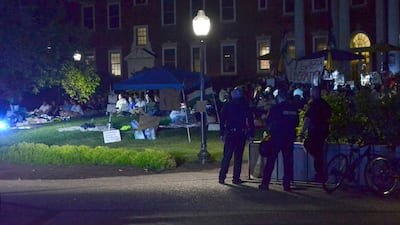
Police move to bring down an encampment after several days of protests by pro-Palestinian activists on the Virginia Tech campus. AP -

Vish Gill, a prominent figure at pro-Palestine protests, is arrested at Virginia Tech campus. AP -
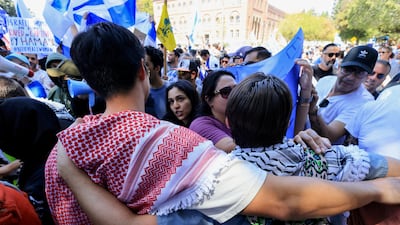
Pro-Israel counter-protesters gather at a pro-Palestine demonstration at the University of California, Los Angeles. Reuters -
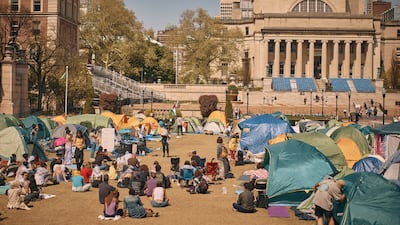
Pro-Palestine demonstrators gather on the campus of Columbia University. AP


The protests and the university response have garnered attention globally.
"I think it is essential in all circumstances to guarantee the freedom of expression and the freedom of peaceful demonstrations," UN Secretary General Antonio Guterres said on Tuesday.
"And at the same time, it is obvious that hate speech is unacceptable. Based on my experience in government, I believe it is up to the university authorities to have the wisdom to properly manage situations like the ones we have witnessed."
UN human rights chief Volker Turk said he was troubled by the use of policing against the protests.
“Freedom of expression and the right to peaceful assembly are fundamental to society – particularly when there is sharp disagreement on major issues, as there are in relation to the conflict in the occupied Palestinian territory and Israel,” Mr Turk said.
“I am concerned that some of law enforcement actions across a series of universities appear disproportionate in their impacts."
At Yale University in Connecticut, campus police blocked access to an encampment while workers took down tents on Tuesday morning. No arrests were made, but protesters have vowed to return, The Yale Daily News reported.
Not all universities have called on police to clear encampments and some leaders have chosen to resolve things through dialogue.
Northwestern University in Illinois announced it has reached a deal with pro-Palestinian protesters, ending an encampment of students and faculty, but allowing peaceful demonstrations to continue through June 1, ABC reported.
Brown University's campus newspaper reported on Tuesday that the school had reached a deal with demonstrators, in which it would vote on divesting from companies connected with Israel in an October meeting in exchange for students voluntarily ending their encampments.
Arrests continued at protests at the University of Texas at Austin, where 79 people were taken into custody on Monday.
Austin was also the site of a police arrest of journalist Carlos Sanchez, who was photographing a protest gathering for a local Fox affiliate when he was caught in a scuffle between police and students.
Criminal trespass charges against the journalist were dropped, the Society of Professional Journalists reported.

