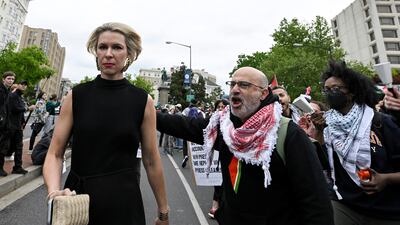

Washington’s media found itself under the spotlight at the weekend, when hundreds of pro-Palestinian demonstrators flipped the cameras on correspondents attending an annual industry gala.
Live-streaming protesters stood outside the White House Correspondents' Association dinner and yelled “Shame on you,” at a who’s who of big-name US journalists, celebrities and their guests as they arrived in tuxedos and gowns.
“Every time the media lies, a journalist in Gaza dies,” they chanted. “Shame on you for breaking bread … 120 journalists dead.”
Pro-Palestinian protesters have hounded President Joe Biden, who headlined Saturday’s dinner, since shortly after the October 7 Hamas-led attacks killed about 1,200 people and started the war in Gaza.
But it was the first time the western media had, en masse, been confronted with charges of helping to enable Israel’s actions in Gaza by playing down the horrors unfolding in the tiny Palestinian territory, where health officials say more than 34,500 people have been killed.
As I arrived at the event, a group of mask-wearing protesters accused me of being complicit, never mind the fact that I work for a Middle East outlet that has devoted itself to covering the war in Gaza from every possible angle within our means.
Several protesters wore fake flak jackets emblazoned with the word “Press”. Others waved red-ink-dyed hands and shouted that the western media is a front for Israel. And some demonstrators played dead and lay on the pavement, representing the journalists killed since October 7.

Before the dinner, arguably the main event on DC’s social calendar, a collection of Palestinian journalists had issued a public call for colleagues around the globe to boycott it.
“Western media has played an integral role in manufacturing consent for Israel’s ongoing violence against the Palestinian people, while obfuscating US complicity,” they wrote in a statement.
“For journalists to fraternise at an event with President Biden and Vice President Harris would be to normalise, sanitise and whitewash the administration’s role in genocide.”
The war in Gaza has been brutal for the enclave's entire population, and journalists are no exception.
According to the Committee to Protect Journalists, at least 97 journalists and media workers have been killed in Gaza since October 7. The toll marks the deadliest period for journalists since the CPJ started collecting data in 1992.
Journalists in Gaza face almost impossible working conditions as they report from the sites of Israeli bombings and sieges, and many have been killed while in the field.
The Israeli military denies it targets journalists, but news organisations have repeatedly accused it of doing exactly that.
The protesters' blanket assertion that the western press is ignoring what is happening in Gaza is unfair. For instance, US outlets have run a string of effective stories describing how inexact Israel's bombing campaign has been.
But there are of course gaps, and Israel has made it easy to report from Jerusalem but almost impossible to visit Gaza.
The Israeli military has blocked foreign correspondents from getting into the strip, with the exception of a few tightly controlled embeds, and it has fallen entirely on local journalists to describe what is happening.
So how did President Biden and the filet-mignon munching 2,600 guests at the Washington Hilton address the protests happening outside?
They didn't.
A room filled with inquiring minds who had gathered to celebrate press freedom, the First Amendment and the courage of journalists reporting under difficult conditions largely ignored the situation in Gaza.
The only reference in official remarks came as Mr Biden was being introduced, when the WHCA president, Kelly O'Donnell, fleetingly mentioned that about 100 journalists had been killed in Gaza.
But there was nothing from Mr Biden, whose approach to the war in Gaza has infuriated Arab Americans and progressives to an extent that his administration still can't fathom and may well cost him the election in November.
Instead, he focused on skewering his rival Donald Trump with a series of gags, at one point likening the former president to a “six-year-old” and teasing him for falling asleep during his criminal trial in New York, where “Sleepy Don” is accused of falsifying business records in 2016 to pay off an adult film star.
Mr Biden and the WHCA rightly spoke at length about wrongly imprisoned US journalists in Russia and Syria, and Israeli reporter Barak Ravid, the one-man scoop factory for Axios, was given an award for journalistic excellence.
So it was against this backdrop that the near silence on the plight of Gaza journalists seemed all the more jarring.
Instead of tackling the elephant in the room, Mr Biden and the Washington establishment did themselves a disservice that will further fuel critics' claims that we are not fairly and impartially covering the war in Gaza.


