


Live updates: Follow the latest on Israel-Gaza
About 200 New York University students gathered in Washington Square Park on Tuesday, a day after a pro-Palestine protest camp on the school's grounds was cleared by police.
Demonstrators gave speeches and led “free, free Palestine” chants, while others held signs that read “Zionist donors and trustees, hands off our universities” and “Divest”.
More than 130 students and faculty were arrested when police cleared a university plaza filled with tents on Monday.
The same plaza was barricaded with a wall of wooden plywood the next day, with campus officers not allowing anyone on to the grounds.
“I watched as the NYPD [New York Police Department] arrested my thesis adviser and two of my other professors among 20 other faculty, along with nearly 100 of my classmates and colleagues,” NYU graduate student Alana told The National.
“It was really shocking to see my campus being militarised when I was in the middle of writing my thesis.”
NYU's administration said it had warned students that no more participants could join the protest, but barricades were breached.
Public safety officials “witnessed disorderly, disruptive and antagonising behaviour that has interfered with the safety and security of our community”, the administration said.
Members of faculty surrounded the protest before the arrests in an attempt to protect students.
NYU's protest camp was influenced by one set up on Columbia University's Upper West Side campus, which also saw arrests but still holds a presence at the school.
Protests continue at Columbia University after pro-Palestine encampment arrests – video
Yale University in the nearby state of Connecticut also had 60 arrests over another pro-Palestine tent camp.
At Columbia and other protests, students are calling for schools to disclose their investments in Israel and elsewhere, and divest from any financial connections to Israel's actions in Gaza and the West Bank.
“They are only interested in protecting their investments and their trustees, and many of them are deeply either invested in organisations [or] companies that fund the genocide in Gaza,” NYU student Mya told The National during a demonstration.
NYU has had a presence in Tel Aviv as part of its global study programme since 2013, and students say the campus of a few dozen students is against their “anti-discrimination policy”.
“We have been asking that NYU shut down its Tel Aviv campus because it is inherently discriminatory,” Mya said.
NYU has a history of divesting over political issues. In 1985, it eliminated financial ties to South Africa's apartheid system.
“The movement will continue, the student movement will live on, and we will not stop and we will not let up until NYU discloses and divests,” Mya said.
Student Gaza protests at US universities – in pictures
-

Activists and students take part in an encampment protest at George Washington University, in Washington. AFP -
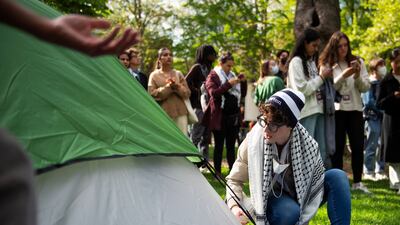
Students and faculty of Drexel University and University of Pennsylvania erect an encapment to protest against the war in Gaza, at the University of Pennsylvania campus, in Philadelphia. AFP -
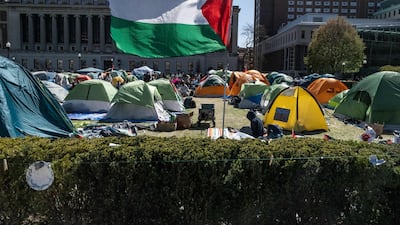
Columbia University students continue their demonstration on campus afterlast week's arrest of more than 100 protesters, in New York City. Getty Images -
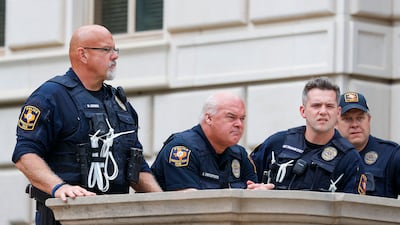
Police watch as students and faculty show support at a Protect Palestine Rally at the University of Texas, in Austin. EPA -
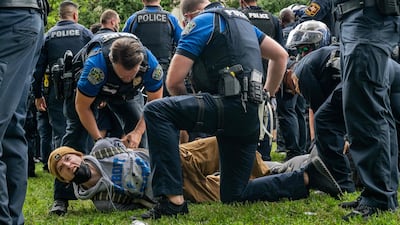
A student is arrested during a pro-Palestine demonstration at the University of Texas at Austin. Getty Images -
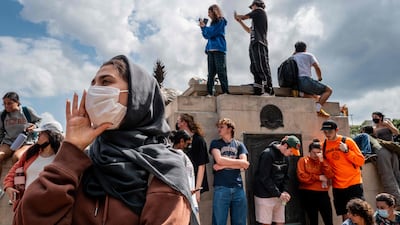
Students rally at the University of Texas at Austin, where police arrested scores of protesters. Getty images -
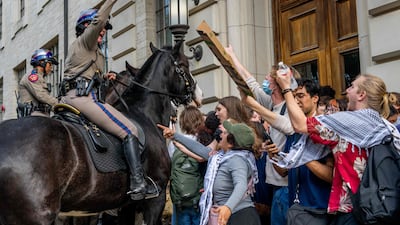
Mounted police confront students protesting against the war in Gaza, at the University of Texas at Austin. Getty Images -
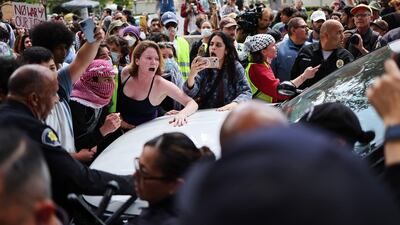
Pro-Palestine demonstrators argue with University of Southern California officials, who attempted to take down an encampment set up in support of Gaza, at the institution in Los Angeles. Getty images -
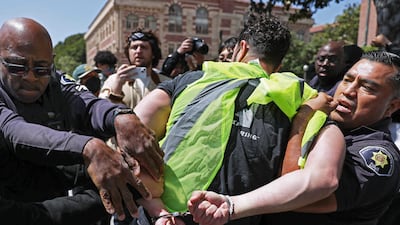
University of Southern California police officers detain a pro-Palestine demonstrator. Getty Images -
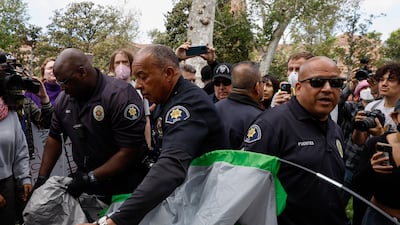
University of Southern California officers dismantle protesters' tents. EPA -
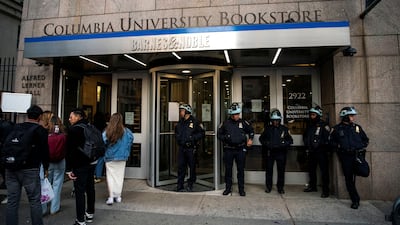
Police stand guard at an entrance to Columbia University, in New York City, where students continue to protest in support of Palestinians, amid the war in Gaza. Reuters -
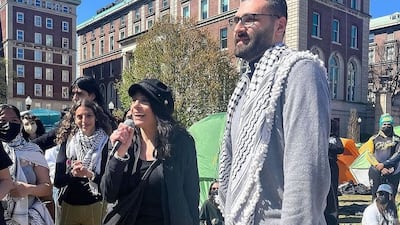
Najla Said, daughter of Palestinian-American academic and literary critic Edward Said, and Motaz Azaiza, a Palestinian photojournalist from Gaza, join the Gaza solidarity encampment at Columbia University. Photo: Columbia Students for Justice in Palestine -
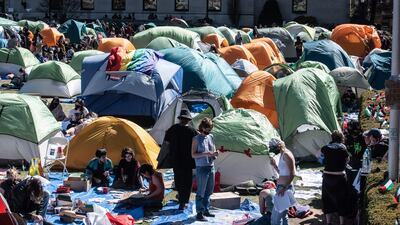
As the campus protests continue, Columbia has moved its classes online. AFP -
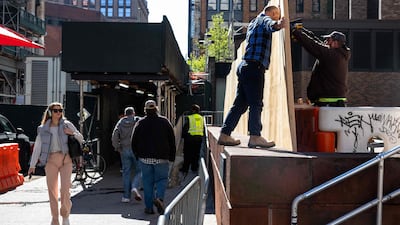
Workers erect a wooden barrier at New York University Stern School of Business after an encampment set up by students was cleared out on Monday night. Getty Images -
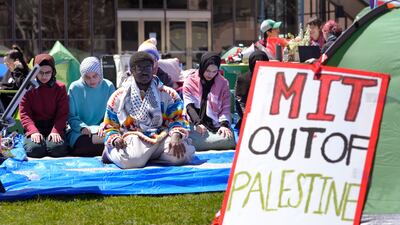
Massachusetts Institute of Technology student Isa Liggans, front left, takes part in Muslim prayer with others, at an encampment of tents at the college, in Cambridge, Massachusetts. AP -
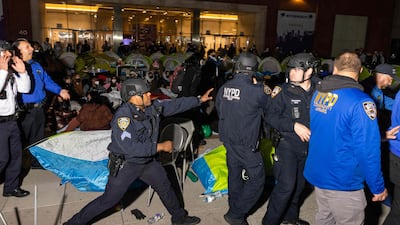
Police officers disperse pro-Palestinian students and protesters who set up an encampment on the campus of New York University. AFP -
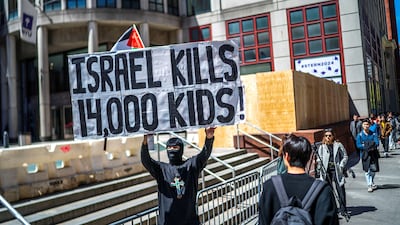
A protester outside New York University. Reuters -
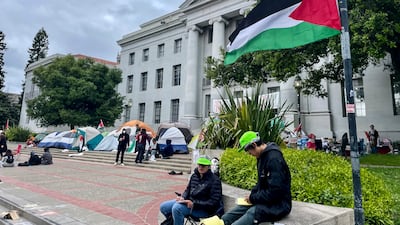
Pro-Palestinian protesters gather in front of Sproul Hall on the campus of the University of California, Berkeley. AP -
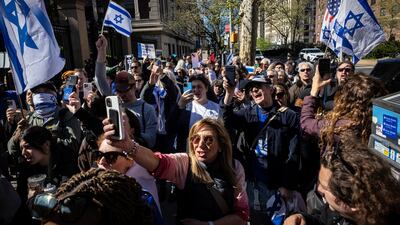
Pro-Israeli demonstrators chant 'shame' after Columbia University assistant professor Shai Davidai was denied access to the main campus. AP -
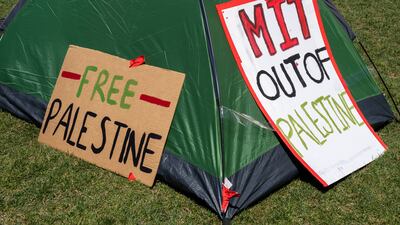
A tent used by pro-Palestinian demonstrators at MIT. Bloomberg -
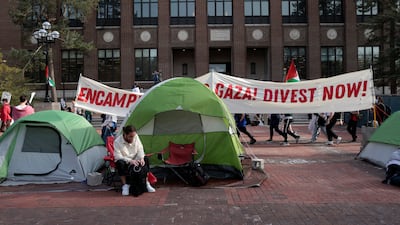
A coalition of University of Michigan students rally to pressure the university to divest its endowment from companies that support Israel. Reuters -
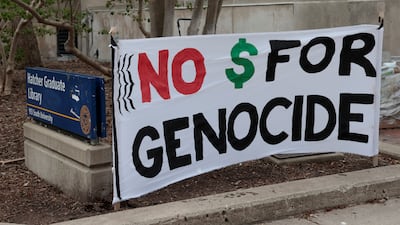
A sign at the University of Michigan. Reuters -
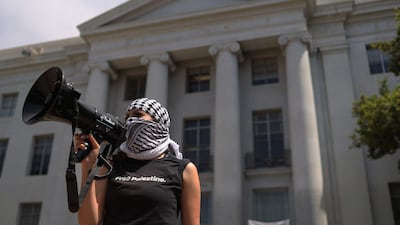
A pro-Palestinian protester in front of Sproul Hall in Berkeley, California. Getty Images / AP -
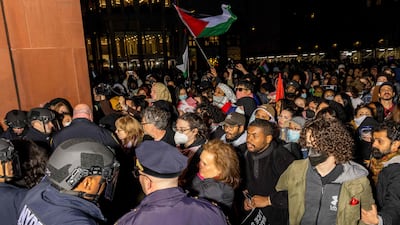
Police officers detain pro-Palestinian students and protesters at New York University. AFP -
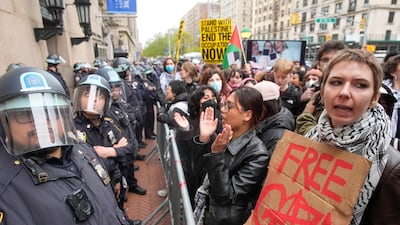
Police in Riot gear stand guard as demonstrators chant slogans outside the Columbia University campus. AP -
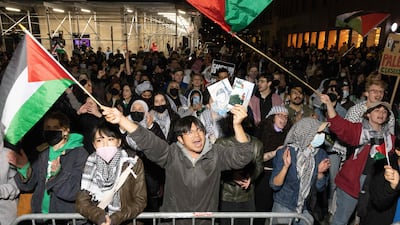
Pro-Palestinian students and activists protest against the Israel-Gaza war on the campus of New York University. AFP


American universities have had a rise in pro-Israel and pro-Palestine protests and speech in the months since Israel launched military operations in Gaza after a deadly Hamas-led attack.
Israeli officials say about 1,200 people were killed on October 7, while Gaza's Health Ministry says about 34,200 people have been killed in the enclave.
Students expressed their hope for ceasefire in Gaza and a “free Palestine”.
“My primary objective is, of course, initially the end of the genocide in Gaza, ceasefire immediately, and an end to the occupation and to apartheid in Palestine,” Alana said.
“I also am Jewish, coming from Jewish background, and much of my family does live in Israel so, you know, I'm witnessing my family participate in a genocide.
“I'm deeply, deeply embedded, deeply, deeply invested in seeing a free Palestine in my lifetime.”

