

The British Museum has postponed an event marking Jewish Culture Month over concerns it would be marred by protests.
Organisers realised that a “significant proportion of registered attendees were individuals intending to deliberately disrupt the event", due to take place on Thursday, and that this could have prevented others from participating and undermined the programme.
The museum “fully recognises the importance of lawful protest and freedom of expression in a democratic society. Equally, we have a responsibility to ensure that events hosted within the museum can proceed safely, securely and without intimidation for speakers, staff and visitors alike”, it said in a statement shared on X by its chairman, former UK chancellor George Osborne.

The event was a lecture called Ancient Israel and Judah in the British Museum. Paul Collins, keeper of the Department of the Middle East, had been due to speak about how artefacts held in the museum can show how “the histories of the kingdoms of Israel and Judah can be illuminated by the archaeology and art of the wider ancient Middle East”.
The museum said that after a discussion on security, the event was postponed until it could take place in an environment that safeguards the audience and the integrity of the programme. It will be reschedule to take place early next month.
It said: “This decision was made to protect the event – not to diminish it. We will continue to support Jewish Culture Month and remain committed to providing a space where history, culture and scholarship can be explored openly, respectfully and without disruption.”
Conservative Party leader Kemi Badenoch urged Keir Starmer’s government to intervene and tell the museum to “do what’s necessary” for the event to go ahead.
She said: “Jewish Culture Month is meant to promote awareness of and celebrate Jewish culture in the UK. This decision achieves precisely the opposite.
“Jewish acts and actors are now being routinely cancelled from events across the UK. As with the marches and protests going past synagogues and knocking on doors intimidating Jews, the end result is an erasure of Jews and Jewish culture from Britain’s public space.
“The government says it wants to combat anti-Semitism. It needs to tell publicly funded institutions like the British Museum to do what’s necessary to put this event on. The Conservatives will always make sure that Britain feels a safe place for Jews.”
The British government has pledged to take urgent action to tackle anti-Semitism. There has been a notable increase in such incidents since the October 7 Hamas attacks, with a number of attacks on Jewish people and locations in London.
-
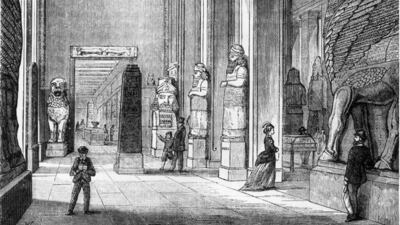
The Nineveh Gallery at the British Museum in London in 1852. All photos: Getty Images -
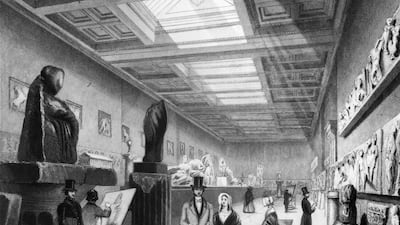
The Elgin Room at the British Museum in 1840 -
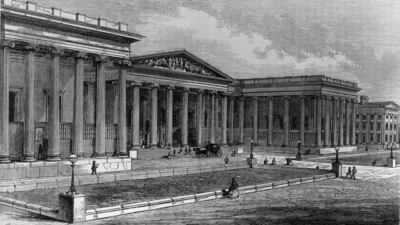
The neo-classical exterior of the British Museum in 1865 -
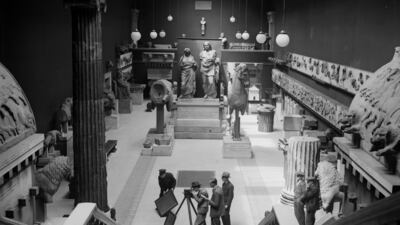
Filming takes place in the British Museum in 1928 -
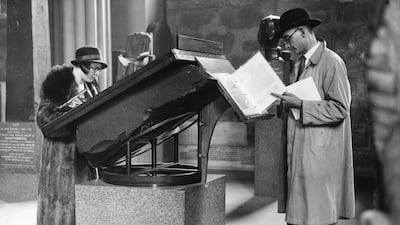
Visitors reading information concerning the Rosetta Stone, from the top of the stone itself, in the Egyptian Gallery in 1932 -
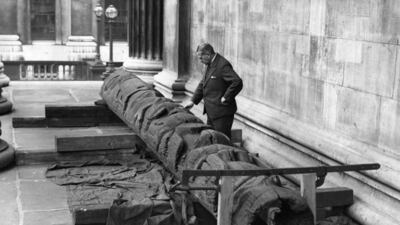
A man examines a totem pole which was purchased from a village in British Columbia and brought to the museum in 1933 -
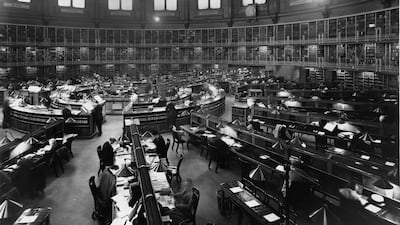
The Reading Room in 1937 -
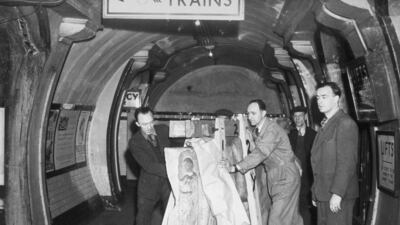
'Operation Elgin' is carried out in 1945, when 100 tonnes of priceless Elgin Marbles were moved from their wartime hideout in Aldwych Tube station to the British Museum -

Visitors viewing the Parthenon Sculptures, also known as the Elgin Marbles, in the Egyptian Galleries in 1954 -

A statue of Egyptian pharaoh Rameses II in 1954 -
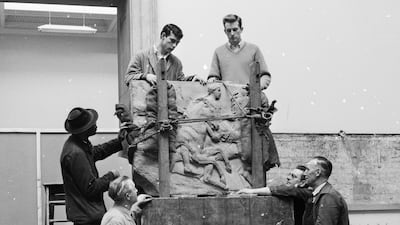
Workmen unload a portion of the Parthenon frieze before affixing it to the wall in the new Elgin Marbles room in 1961 -
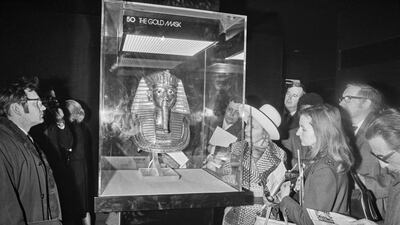
The gold death mask of Egyptian pharaoh Tutankhamun on display in 1972 -
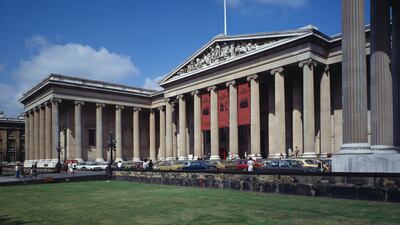
The exterior of the museum in 1980 -
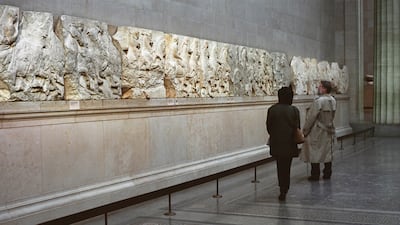
A frieze which forms part of the Elgin Marbles, taken from the Parthenon in Athens almost 200 years ago, on display in 2002 -
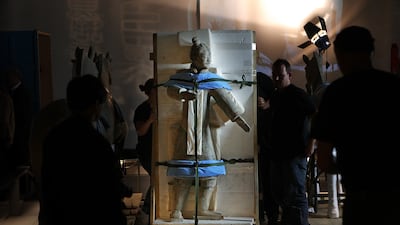
A Terracotta Warrior statue, wrapped in protective foam, is moved into place in the Reading Room in 2007 -
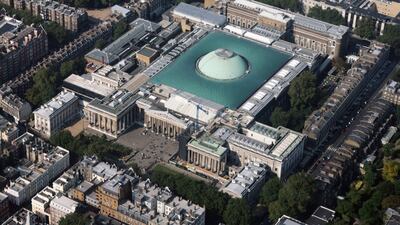
An aerial view in 2008 -

Gardeners from the Royal Botanic Gardens at Kew prune the foliage in an Indian-themed garden on the west lawn of the British Museum in 2009 -
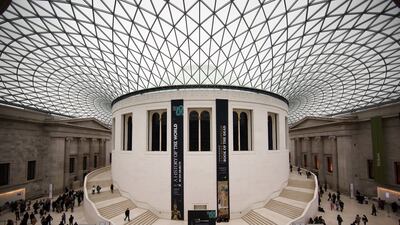
Visitors walk in The Great Court of the museum in 2011 -

The British Museum's new World Conservation and Exhibitions Centre, right, adjoining the original building, in 2014 -
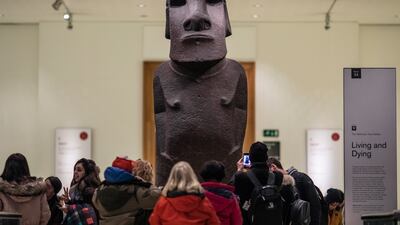
A basalt Easter Island Head figure, known as Hoa Hakananai'a, on display in 2018 -
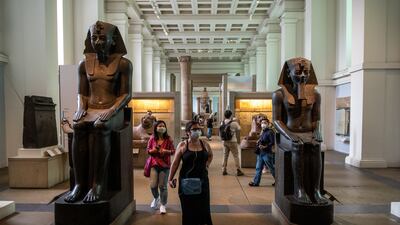
Visitors wearing face masks walk through the Egyptian exhibition as the museum reopened to the public after being closed for 163 days due to Covid lockdowns -
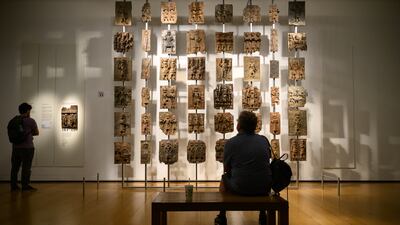
Items from a collection of metal plaques and sculptures taken from modern-day Nigeria in 1897, commonly referred to as the Benin Bronzes, are seen in a gallery of African relics in 2023


In February, the British Museum became the focus of concern over claims that the word Palestine had been expunged from the institution.
The museum’s executive director, Nick Cullinan, spoke to Palestinian ambassador Husam Zomlot after reports circulated that the "Palestine" labels for artefacts had been removed following pressure from the British charity UK Lawyers for Israel.
Some labels and maps in the Middle East galleries had been amended over the previous year to show ancient cultural regions, using terms such as “Canaan”, which the museum believes are more relevant for the southern Levant in the later second millennium BC.

