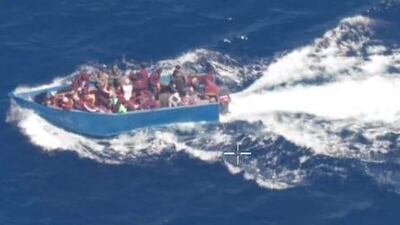

Two Syrians suspected of smuggling hundreds of migrants across the Mediterranean have been arrested in Libya in a joint operation with UK law enforcement.
The pair were detained separately as the result of what Britain’s National Crime Agency (NCA) said was intelligence sharing with the Libyan authorities, leading to the arrests of four suspected people smugglers.
It comes as the NCA expands its international operations to target people-smuggling networks transporting migrants to the UK from northern France, including arrests made in Iraq's semi-autonomous Kurdish region in a ground-breaking operation.
In what the agency describes as the “most significant arrest”, Libyan police detained a “significant member” of a suspected Syrian people-smuggling network alleged to have moved “at least 2,000 people” into Europe using fragile fibreglass boats.
When his phone was examined after his arrest on March 12 there was evidence that suggested the end destination for some of those travelling would have been the UK.
Two days earlier, police in Sabratha arrested another Syrian, who is suspected of arranging the transportation of about 400 migrants. He is alleged to have been part of a network involved in the large-scale smuggling of people in boats.

On the same day, a man identified by the NCA as being implicated in the smuggling of migrants of various nationalities into Greece was detained in the north-east coastal town of Tobruk.
Those arrests follow that of a Sudanese citizen in January, also in Sabratha. At the time of his detention he was in charge of 11 Iraqi-Kurdish migrants who were due to be transported to Europe.
“I hope these arrests, like those we recently supported in the Kurdistan Region of Iraq, send out a message to others involved that no matter where they are, they are not untouchable," said Rick Jones, the NCA’s international deputy director. "Our reach is global and they cannot act with impunity.”
Mr Jones said the criminals involved in people smuggling “don’t care about human life” and think nothing of “putting hundreds of people at a time into ramshackle boats completely unfit for the purpose of long sea crossings”.
“While those arrested in these operations are suspected of moving migrants across the Mediterranean, there is no doubt that some of those smuggled would likely have ended up risking their lives again trying to cross the [English] Channel too,” he said.
The Labour government of Keir Starmer has pivoted towards law enforcement measures to "smash the gangs" of people smugglers, who continue to transport migrants across the English Channel in steady numbers.
An agreement was signed allowing NCA officers to work in Iraqi Kurdistan, a centre of the people-smuggling business. An investigation by The National revealed this has resulted in smugglers going into hiding.
Mr Jones said the UK's fight against organised immigration crime "is not limited to the English Channel" and "we need to co-operate with our international partners, and these arrests in Libya demonstrate that co-operation is bearing fruit. We are grateful for the support of the Libyan authorities in this work".
The arrests in Libya come after the conviction of a UK-based people smuggler who was organising crossings from the North African country to Italy.

NCA investigators, working with Italian law enforcement, were able to provide evidence of Egyptian citizen Ahmed Ebid’s involvement in at least seven separate crossings, which brought about 3,800 people across in 2022 and 2023.
The 42 year old, who was living in Isleworth, London, during the time of his offending, had previously pleaded guilty to people-smuggling offences.
At a hearing, a judge rejected his claims that he had played only a small part in the crossings and accepted evidence gained by the NCA demonstrating his organisational role.
The court was told that Ebid made more than £12 million ($15.5 million) from sending thousands of migrants across the Mediterranean in an operation he ran from his London home.
The former fisherman was linked to the smuggling operation after he made phone calls to satellite phones on board the migrant boats. Those numbers were then used to call the Italian Coastguard telling it the location of the migrant ships, so they could be towed to safety and those on board taken ashore.

