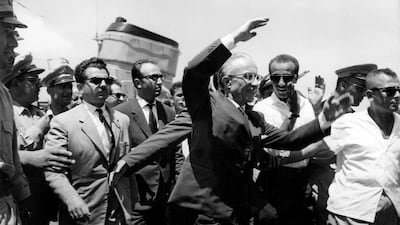

Faisal Al Kudsi has vivid memories of visiting the Presidential Palace in Damascus when his father, the banker and politician Dr Nazem Al Kudsi, became head of the state in 1961.
The decade leading up to his father’s presidency had been a turbulent one, marked by coup d’etats and a tug of war between a military state and parliamentary democracy. His democratic government was the last before the Baath party takeover two years later.

Dr Al Kudsi, who led the People’s Party in Aleppo, was viewed as the architect of that democracy, playing a pivotal role in the drafting of Syria’s 1950 constitution, which empowered parliament for the first time, and limited the role of the president.
Syrians today are calling for that constitution’s revival after the toppling of president Bashar Al Assad's regime, remembering the decade as a Golden Age for their political rights.
Faisal Al Kudsi, who with his younger brother Fares digitised their father’s archive, is supporting the call for its comeback. “This was a constitution issued by a constituent parliament that represented all the people of Syria, and it was a free election,” Mr Al Kudsi told The National.
A photograph of the two brothers with their father in the palace – they were the last two of eight children – is in the online archive, as well as a copy of the constitution and the minutes of meetings to debate and draft it.

Despite assurances from Syria’s new President Ahmad Al Shara that a new constitution would be inclusive and pave the way for democracy, there is concern that it could be shaped in the image of the Islamist group he led until January, Hayat Tahrir Al Sham.
Mr Al Shara on Thursday signed a temporary constitutional declaration as the basis of a five-year transitional period. He said he hoped the charter would mark the start of “a new history for Syria, where we replace oppression with justice”.
The new charter would divide powers between the president and parliament, and enshrine the preservation of freedom of expression and opinion. In language that echoes the 1950s document, it declares that Islamic jurisprudence will be the main basis of the law. Courts will be independent and the rights of women to vote, to work and study are also enshrined.
Much of this is in the “spirit” of the 1950s constitution, according to briefings by government sources. The Al Kudsi family believes the 50s document could provide the road map for the country's future in the long term.
“We’re saying to [the new administration] please adopt a constitution … that represents all the people of Syria. To be able to get international recognition for the new regime, any constitution has to be adopted by an elected parliament that will represent all the facets of society,” Mr Al Kudsi added.
“Issuing a constitution by Tahrir Al Sham is not the same as the constitution of 1950 which was drafted by a committee of elected parliamentarians.”

Democratic moment
Former president Dr Al Kudsi regarded the drafting of the constitution as the “highlight” of his long political career, his son recalled.
The charter was developed after a turbulent year, which saw three military coups within a few months. Syria’s previous president, Husni Zaim, who had taken power by military coup in 1949 had started to make changes to the constitution to consolidate power towards the president.
Dr Al Kudsi became prime minister under President Hashem Al Atassi, and the document he helped to draft sought to bring power back to parliament and focus on elections. “It was one of the most advanced constitutions in the Arab world,” his son Faisal said.
The constitution's first article defines Syria as “a fully sovereign Arab republic with a democratic parliamentary regime”, where men and women over 18 vote in elections. It stresses the country's unity and opposes any division of the territory along ethnic or religious lines.
“Sovereignty is based on the principle of the rule of the people, by the people, for the people,” it states.

The committee’s members had studied at Europe’s top universities as well as in Damascus, he added. “They took elements of every advanced constitution and injected it into that constitution,” he said. The constitution paved the way for Syrian democracy.
“There was a working democracy,” said Dr Joshua Landis, a historian of Syria and specialist of the period, who leads the Centre for Middle East Studies at the University of Oklahoma. “There were elections that were much more free than anything Syria had ever seen. Sure, there was corruption and other stuff. But there were real elections, and it's considered the Golden Age.”
Yet the turbulent decade would be marked by coups and a union with Egypt, which saw the constitution withdrawn and reinstated twice, under president Hashem Al Atassi in 1954 and under Dr Al Kudsi in 1961.
“It was that classic wrangle between the Aleppans and the Damascenes,” Dr Landis explained, with Aleppan merchants seeking alliances with the Iraqi monarchy and Turkey, and the political class of Damascus pivoting to Cairo and Riyadh.

The 1950s constitution also found a consensus between the country’s Islamists and secularists, many of its supporters say.
Minutes from the meetings of the constitutional committee show a long and lively debate about the role that Islam should play. It was decided that the head of the state would be a Muslim to represent the country’s dominant religion, rather than the state being Islamic itself. Islamic law was defined as the “main” source of jurisprudence.
“There are several issues that are central to this debate,” Dr Landis said. “One was over Islam and the other was central power. Those issues are at the heart of what’s going on in Syria today. There are many people pushing for the constitution to be revived to limit the power of Mr Al Shara, and limit the authority of Islam.”
But the consensus ended in 1963, with the Baath party outlawing Islamist and opposition parties.
Mr Al Kudsi returned to Syria for the first time in 15 years in February, and the visit left him feeling optimistic about the future, despite his concerns about the new administration.
“There was a lot young people eager to do something, to build something, from all sorts of areas in Syria, converging on Damascus,” he said. “It is a good sign. You can only build with young people. Old people like me can advise, but stay on the side.
“We’re talking about a country that has gone into civil war for 15 years, the lack of government leadership is to be expected.”
He hoped that the UK and Arab states including Saudi Arabia would help steer the new administration in the right direction.

Alternative models
There are those who say the nostalgia for the 1950s is misplaced. There are lessons from the past 14 years which the previous constitution will not cover. “It won’t work,” said Syrian human rights lawyer Anwar Al Bunni, who is calling for a federal government.
“We need a constitution that will deliver elections and a parliament and be inclusive. Those calling for it can’t think of any alternatives,” he told The National.
The Berlin-based advocate has developed an alternative constitution through a series of workshops with 200 Syrians living in exile in Europe, which they published online in September last year, months before the downfall of Mr Al Assad.
The proposed model calls for a federal system, a senate and representatives, and two seats for every Syrian minority regardless of community’s size.
Former diplomat Bassam Barabandi said few changes to the current constitution were needed – other than to remove the laws that had kept the Baath party in power and gave the presidency overarching controls.
But he feared that a new constitution would lack credibility among Syrians if not handled correctly. Mr Al Shara and his administration needed a constitution in place to enshrine their power, and were likely to rush the process.
“This government is doing its best to empower itself, and empower its members and its agenda,” Mr Barabandi told The National. “Are they doing it in a way that will get Syria out of the trap that it's in? That takes Syria to a better place? They’re not.”
Though the committee appointed to draft the document last week had demonstrable expertise in the field, the fact they were little known among the Syrian public would further undermine trust in the charter, Mr Barabandi said. “That doesn't mean they are not experts, but they are not known. This poses an issue for credibility,” he added.
It includes legal experts such as UK-based Bahia Mardini, who met Mr Al Shara during a visit to Damascus in January.
Ms Mardini came to the UK as a refugee in 2011, after being detained for her journalism in Damascus. She served as a communications director for the traditional coalition of Syrian opposition groups, which sought an end to Mr Al Assad’s rule during the war.

