

Britain’s Ministry of Defence is staging a war game to test how the country’s supplies of ammunition and equipment would hold up during a conflict, as it encourages soldiers to enter a “warfighting mindset”.
The week-long exercise, at the Defence Academy in Oxfordshire, will involve defence company representatives for the first time to simulate Britain's ability to fight a major war. The head of the army, General Sir Roland Walker, recently warned that the country needs to prepare for that scenario within three years.
As part of the preparations, soldiers have been asked to start donating blood regularly to ensure the military has enough supplies for a war, following an exercise in Germany that analysed blood stock levels to determine their impact on treatment. In an email explaining the decision, the military encouraged troops to enter a “warfighting mindset”.
“Based on warfighting projections and the need to maintain NHS outputs concurrently, anyone requiring more than two pints of blood would be triaged as untreatable due to sustainment stock levels available,” it said.
The military’s games this week involve “real-time, wartime scenarios” that will put supply chains under stress to test the UK’s readiness for war, focusing on artillery weapons and drones. In 2021, the army ran out of ammunition before the completion of a 10-day war game exercise, according to the former head of the US Army in Europe, Lt Gen Ben Hodges.
The warnings come as retried General Sir Richard Barrons told MPs on Tuesday that the armed forces were facing a "skills crisis" over the personnel needed for modern day warfare.
During questioning on the UK’s strategic defence review, in which he is leading with two others, he said the shortage was “not unique to defence” and was prominent in cyber, AI and digital skills.
“The review is examining that and will make some very powerful recommendations," he added. "I'm pretty confident on the way to fix it. That is as important as deciding how much ammunition you have got.”
He saidthe review, ordered by Prime Minister Keir Starmer in the summer, was also provoking “a very challenging discussions” across defence.
Former Nato secretary general George Robertson, who is also conducting the review, that the forces would be able to innovate better, particularly taking on board the developments in Ukraine, “once the review has finished”.
Asked about the general security situation Lord Robertson said: “I just wish sometimes that people were as worried as I am, on behalf of my children and my grandchildren when I know what's going on.”
The pair also disclosed that they were meeting the defence secretary once a week and had had meetings with the prime minister and the chancellor.
UK troops arrive at Brize Norton- in pictures
-
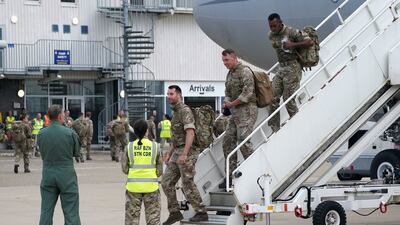
Some of the last British soldiers to leave Afghanistan, members of the 16 Air Assault Brigade, arrive at RAF Brize Norton, west of London. AFP -
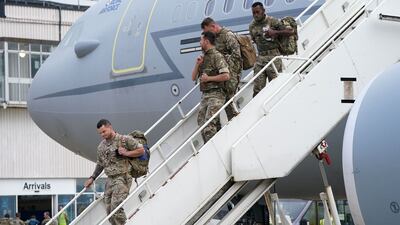
The troops left Kabul on Saturday, bringing to an end Britain's 20-year military involvement in Afghanistan. AFP -
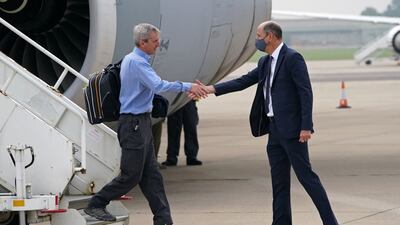
The British ambassador to Afghanistan, Sir Laurie Bristow, arrives with the troops. AFP -
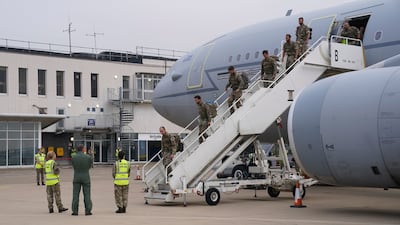
Britain flew more than 15,000 people from Kabul in the past two weeks, authorities said. AP -
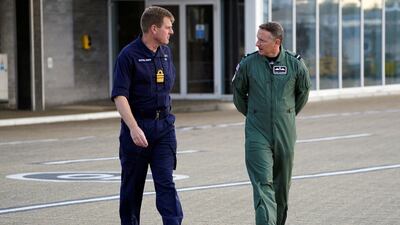
Vice-Admiral Ben Key, who supervised the UK's withdrawal, and Air Mobility Force Commander to Air Commodore David Manning prepare to address the media as members of the British armed forces arrive at RAF Brize Norton. Reuters -
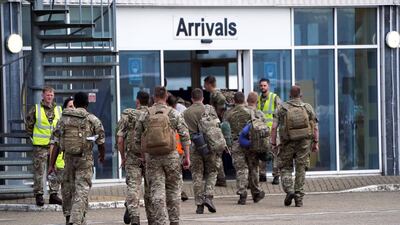
The troops arrive at RAF Brize Norton. Reuters -
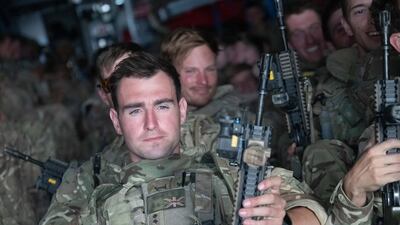
British soldiers on board an aircraft departing Kabul. EPA -
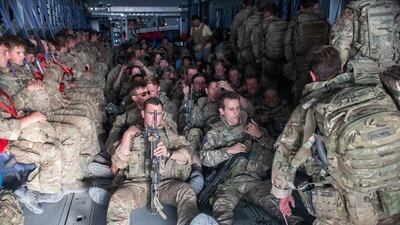
The troops prepare to leave Kabul. EPA -

Prime Minister Boris Johnson said in a video as the troops departed that the suffering and hardship of all soldiers involved in more than 20 years of conflict in Afghanistan was "not in vain". EPA


Defence Secretary John Healey told the London Defence Conference on Monday that the UK is staging its war games with “key industry players” to ensure they understand decisions that will be required of government “in order to be able to sustain our war fighters on the front line when supply chains are disrupted, or when we may be faced with extended conflict”. Participating companies include BAE Systems and Lockheed Martin.
“In the face of rising global threats, we need public and private together, investors, industry innovators, and my message is this, invest in defence and send a strong signal to Putin and other adversaries that would do us harm,” Mr Healey said.
In January, Gen Walker's predecessor, Gen Sir Patrick Sanders warned that Britain might need to train and equip a citizen army to fight Russia in a future war.
Any preparation for any conflict would need to be a “whole-of-nation undertaking”, he said, adding that citizens should be trained and equipped to be in a state of readiness.
He said the army would not be big enough to fight an all-out war with Russia even if it had 120,000 fully trained soldiers. The UK army is predicted to number just 72,500 soldiers by 2025.

