


Live updates: Follow the latest on Israel-Gaza
A surge in applications from Gaza has boosted interest in academic fellowships to the UK, as a charity warns that more academics are fleeing persecution and conflict than ever.
The Council for At-Risk Academics (Cara), which gives academics refuge in the UK, said it had received an unprecedented number of pleas for help, with almost half of applications (44 per cent) in the past six months coming from Palestinians.
More than 2,000 people have applied for fellowships with the charity since September 2021, which is five times more than in the previous three-year period. Conflicts in Gaza, Ukraine, Afghanistan and Syria were behind the stream of applications, which the charity said were at the highest rate in its 90-year history, after it was founded to help academics escape Nazi Germany.
The charity supported 220 academics in 2023, and expects that number to be higher still for 2024. Most of the academics in 2024 – around four in five – were from just four countries. After the Palestinians, one in five were from Afghanistan (21 per cent), followed by Syria (9 per cent) and Sudan (9 per cent). Female academics in Afghanistan were particularly vulnerable, the charity's executive director Stephen Wordsworth said.
The charity has blamed the deep instability of our times, in which “crisis is being piled upon crisis”. Mr Wordsworth, a former British diplomat, said: “We are now at a critical juncture. We have received more pleas for help in the last three years than at any time since we were founded in the 1930s – a stark reminder of history’s darkest moments.”
The charity facilitates the academics’ escape – often with their families, helps them find a placement at a UK university, and provides funding support. Each rescue mission can take six months to co-ordinate from start to finish, and sometimes travel to the UK can be “very complicated, and sensitive”, Mr Wordsworth said.
Political scientist Rowida Fahr left Khartoum after the start of the war in Sudan, and is now a PhD candidate at the University of Durham, thanks to a fellowship from Cara.
Shortly after the war broke out between the Sudanese Army and the Rapid Support Forces militias in April last year, Ms Fahr fled the capital with her family to the north of Sudan. “My whole life was in Khartoum, my home, my workplace, my husband’s work, and my daughters’ schools. We were forced to move to northern Sudan under very dangerous conditions,” she said.
But with the British embassy in Sudan closed, she travelled again to Uganda to get her visa. This involved another perilous journey from northern to east Sudan to reach what had become the country’s only functioning airport. “Our journey was very arduous and dangerous,” she said.
Steep visa fees, which increased under the former government, are among the challenges the charity faces to bring academics to the UK. The Immigration Health Surcharge requires working visa holders and their families to pay an additional charge, which can take the total upfront costs for a family to more than £10,000, Mr Wordsworth said.
He hopes the new government will establish a “permanent programme” for academics with a special visa regime, which would mirror the Researchers at Risk scheme that was set up by the UK government for Ukrainians fleeing Russia’s invasion. He also called for “intensified international efforts to resolve conflicts, improve the rule of law and promote peaceful development.”
Though now safe in the UK, Dr Fahr misses home, and is haunted by the news of her colleagues – stark reminders of what could have been her fate had she stayed in Sudan. “We hear unpleasant things about our colleagues in Khartoum. The latest was the discovery of the body of our colleague Dr Kabashi Madani Suleiman, who had been dead inside his home for 20 days,” she said.
The university building itself was at risk of destruction. “My current fear is that my university will be destroyed because it is located in the city centre and close to the vital disputed areas. The buildings of this university are a historical legacy and part of Sudan’s identity,” Dr Fahr said.
She was unable to contact many of her friends and colleagues in the area, due to communications blackouts. “We only hear from their families outside of Khartoum that they are still [there]. We cannot do anything about this and we cannot support them.
-
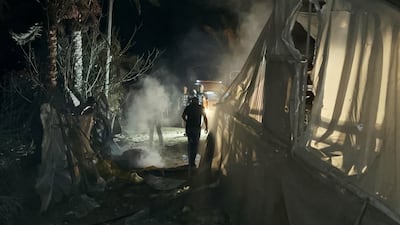
Rescue teams search for survivors after an Israeli air strike on a tent encampment in Al Mawasi, a designated safe zone in Khan Younis, southern Gaza, on Tuesday. Getty Images -
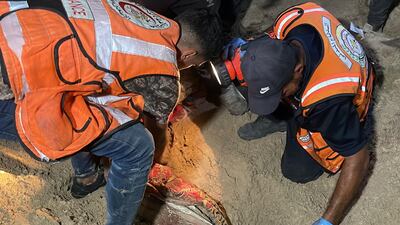
It was reported that the missile attack created a nine-metre deep crater, with rescue workers saying many people were buried under the sand. Getty Images -
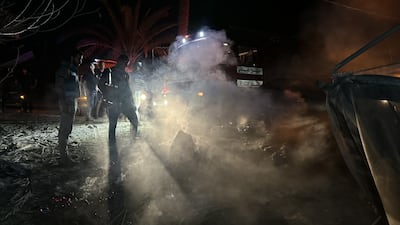
Witnesses said five missiles were used in the attack, in an area that has been designated as a safe zone by the Israeli military. Getty Images -
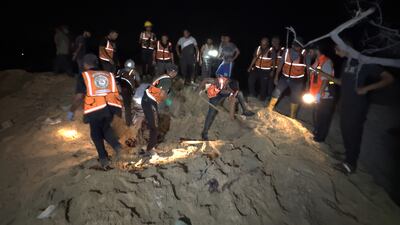
At least 40 people were killed and about 60 injured in the strike, Palestinian media have reported. Getty Images -
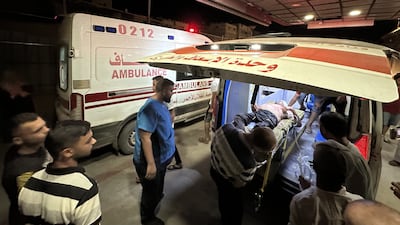
The Israeli military said it had used high-precision missiles in the strike, which it said was aimed at a Hamas command centre in the area. Getty Images -

Hamas has denied Israel's allegations that its militants were operating from a command centre in Al Mawasi, calling the accusations 'clear lies'. Getty Images -
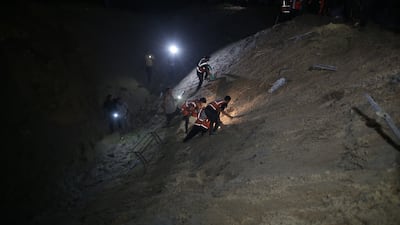
Gaza civil defence personnel have called the strike one of the worst attacks of the war in the enclave. Getty Images


The protracted nature of conflicts today means that many academics will stay on longer in the UK than expected. “Our hope and that of our fellows, is always that they will be able to return home when it is safe for them to do so. We are not in the ‘brain drain’ business,” Mr Wordsworth said.
“If the academics can eventually return, they can help with the process of rebuilding, though it can still take decades for countries to recover. If they can never return, the loss becomes permanent,” he said.
Dr Fahr echoes these fears, and is thinking about the long-term impact of the war on future generations. “I fear that the war will last longer and the future of students will be affected. And the challenges that university education will face in rebuilding what the war has destroyed,” she said.

