
British Prime Minister Keir Starmer arrived in the US on Thursday for talks with President Joe Biden on resolving the wars in Ukraine and Gaza.
The two leaders were also expected to discuss strengthening co-operation to secure supply chains, increasing climate resilience and advancing a free and open Indo-Pacific.
Mr Starmer is due to meet Mr Biden in the Oval Office on Friday afternoon, the White House said, where talks between the two leaders are expected to focus on Ukraine’s demands to use western-supplied long-range missiles for deeper strikes into Russia.
A White House official said the UK’s recent decision to suspend some arms exports to Israel would also be discussed.
On what is Mr Starmer’s second trip to the US as Prime Minister, the conflicts in the Middle East will be on the agenda, along with any progress that could be made towards the release of hostages and a ceasefire deal in the Israel-Gaza war.
World leaders attend the Ukraine peace summit - in pictures
-
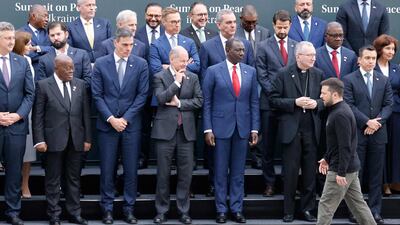
Ukrainian President Volodymyr Zelenskyy joins heads of states and country representatives during the Ukraine peace summit at the Burgenstock resort, near Lucerne, Switzerland, on June 15. AFP -
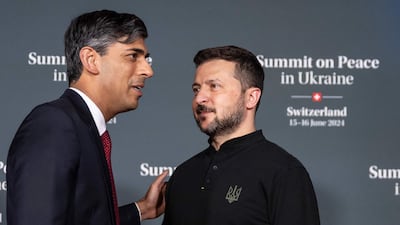
British Prime minister Rishi Sunak, left, is welcomed by Mr Zelenskyy. AFP -
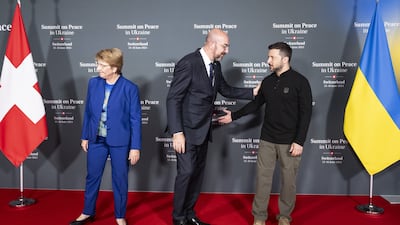
Swiss Federal President Viola Amherd, left, with Charles Michel, President of the European Council, centre, and Mr Zelenskyy. EPA -
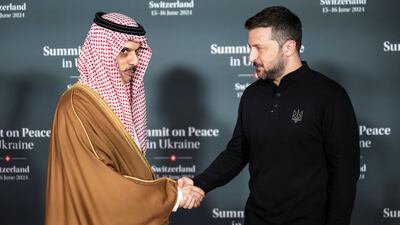
Saudi Arabia's Minister of Foreign Affairs Faisa bin Farhan Al Saud is welcomed by Mr Zelenskyy. Reuters -
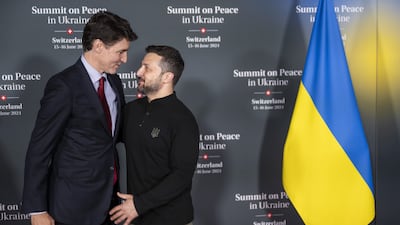
Canadian Prime Minister Justin Trudeau, left, with Mr Zelenskyy. EPA -
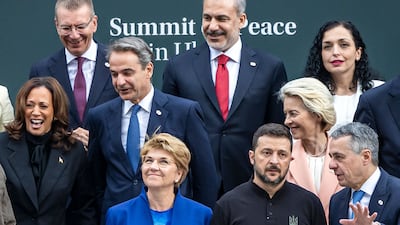
US Vice President Kamala Harris, middle left, Greece's Prime Minister Kyriakos Mitsotakis, middle, Swiss Federal President Viola Amherd, bottom left, Turkish Minister of Foreign Affairs Hakan Fidan, top centre, Mr Zelenskyy, bottom right, President of the European Commission Ursula von der Leyen, middle right, and Swiss Foreign Minister Ignazio Cassis, bottom right. AFP -
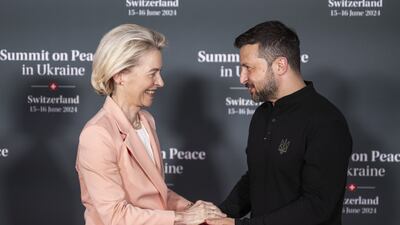
Mr Zelenskyy welcomes Ms von der Leyen. EPA -
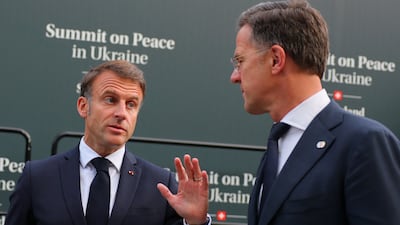
French President Emmanuel Macron speaks with Dutch Prime Minister Mark Rutte. Reuters -
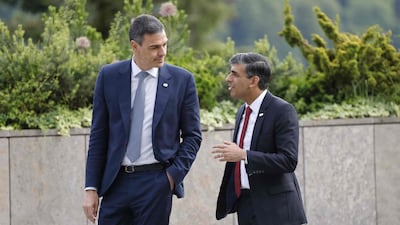
Spain's President Pedro Sanchez, left, and Mr Sunak walk to the podium for a photograph with heads of states and country representatives. AFP -
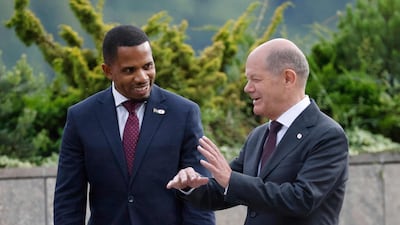
German Chancellor Olaf Scholz, right, with Gambia's Minister of Information Ismaila Ceesay. AFP -
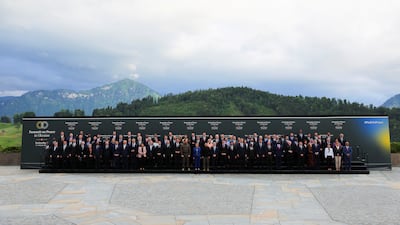
World leaders pose for a family photo at the summit's opening ceremony. Reuters -
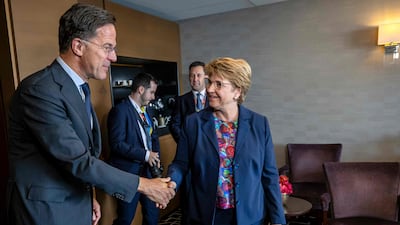
Ms Amherd welcomes Mr Rutte. AFP -
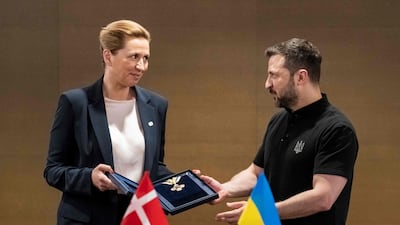
Mr Zelenskyy awards Denmark's Prime minister Mette Frederiksen with the 'Order of Freedom of Ukraine' title before a meeting on the sidelines of the summit. AFP -
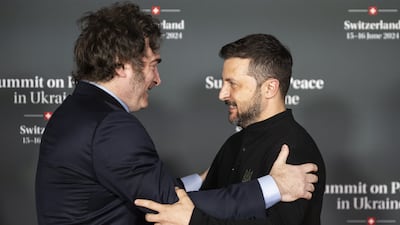
Mr Zelenskyy welcomes President Javier Milei of Argentina. EPA


Starmer responds to Putin's Nato war threat
Before his visit, Mr Starmer backed Ukraine’s right to defend itself after Russian President Vladimir Putin suggested his country would be “at war” with Nato if the West allows long-range weapons to be used against it.
On Thursday, Mr Putin said allowing long-range strikes “would mean that Nato countries, the US and European countries, are at war with Russia.
"If this is so, then, bearing in mind the change in the very essence of this conflict, we will make appropriate decisions based on the threats that will be created for us."
Responding to Mr Putin's remarks, Mr Starmer told reporters: “Russia started this conflict. Russia illegally invaded Ukraine. Russia could end this conflict straight away.
“Ukraine has the right to self-defence and we’ve obviously been absolutely fully supportive of Ukraine’s right to self-defence – we’re providing training capability, as you know.
“But we don’t seek any conflict with Russia – that’s not our intention in the slightest. But they started this conflict and Ukraine’s got a right to self-defence.”
Mr Starmer’s visit to Washington follows British Foreign Secretary David Lammy’s trip to Kyiv alongside US Secretary of State Antony Blinken. Neither was drawn on granting Ukraine permission to use the long-range missiles supplied by the West to attack targets in Russia, a key request of Ukrainian President Volodymyr Zelenskyy. Concern over escalation is one of the reasons why consent has not yet been given.
Mr Lammy and Mr Blinken announced more financial support for Ukraine, featuring a $785 million package from the UK and $717 million from the US to meet immediate humanitarian, energy and stabilisation needs.
The UK package includes an earlier pledge of $317 million made by former prime minister Rishi Sunak, and $484 million worth of guarantees for World Bank lending before the end of the year. The US package includes $325 million to support Ukraine’s energy needs.
Weapons wanted by Ukraine - in pictures
-
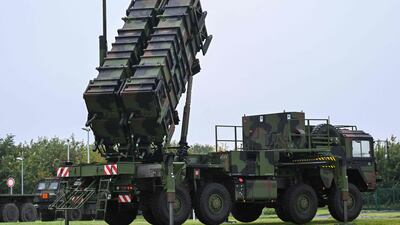
Air defence: Ukraine’s air defence largely depends on the Patriot system. AFP -
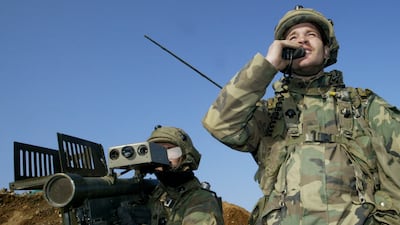
Air: Stinger short-range surface-to-air missile. Reuters -
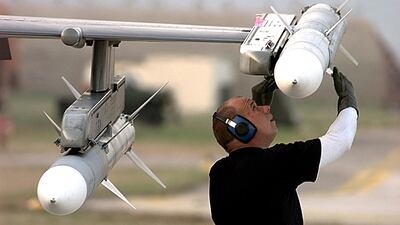
Air: Aim-120 air-to-air missiles. More than 14,000 of the missiles, that have a range exceeding 120km, have been produced with their accuracy so good that they have been nicknamed “Slammer”. Getty Images -
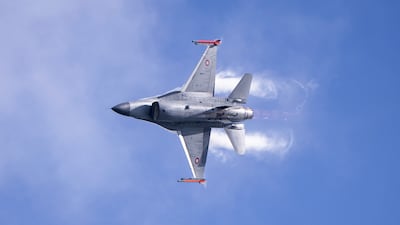
Air: F-16s will provide greater surveillance and the ability to attack high-value targets behind Russian lines in occupied Ukraine. EPA -
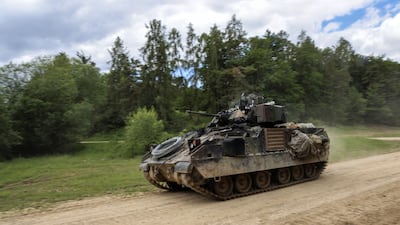
Armour: Bradley IFV. The Ukrainians have found the Bradley infantry fighting vehicle, with its 25mm cannon, very useful in protecting troops and providing decent firepower. Bloomberg -
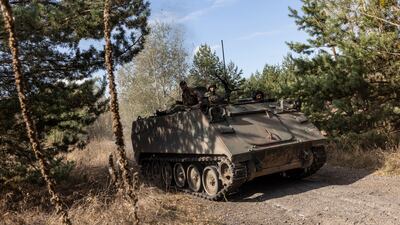
Armour: M113. The 1960s-designed versatile M113 armoured personnel carrier has proven effective in protecting troops against minefields. Getty Images -
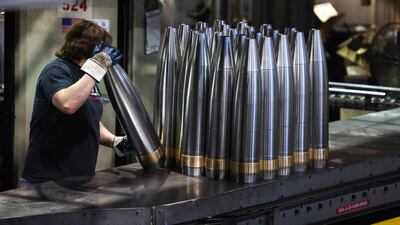
Artillery: 155mm artillery rounds. A massive delivery of 155mm rounds could prove crucial in preventing further Russian advances, particularly in its expected summer offensive. AFP -
Artillery: ATACMs long-range precision missiles. The ATACMS have a range of 300km with the ability to land within a few metres of a target. Getty Images -
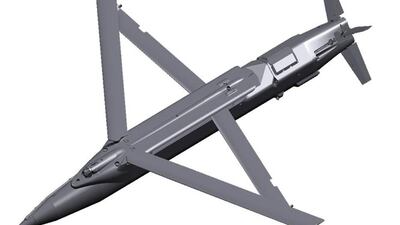
Artillery: Ground-Launched Small Diameter Bomb (GLSDB). It can be fired from the HIMARS system. Photo: Wikimedia Commons -

Artillery: M777 guns and replacement barrels. The Ukrainians need many M777 howitzer barrels to replace those worn down by extensive use. Getty Images


Iran in denial
Iran has been hit with sanctions by the UK and US after the two countries accused Tehran of supplying ballistic missiles to Russia, which the regime denies.
France and Germany also announced new sanctions on Tuesday, against Iranian air transport.
"We will be taking immediate steps to cancel bilateral air services agreements with Iran," the three European countries said in a joint statement. They will also "work towards imposing sanctions on Iran Air".
In an Iranian response, the British, Dutch, French and German envoys "were summoned by the Ministry of Foreign Affairs after sanctions and unconstructive remarks by European parties", the official Irna news agency reported. The Netherlands summoned Iran's ambassador on Wednesday over the alleged missile transfer, Iranian media reported.
During Thursday's meeting, the Foreign Ministry "strongly condemned ... recent destructive actions and statements" by European officials, Irna said.
"The insistence on adopting such positions and actions is considered a continuation of the West's hostile policy against the Iranian people."
Britain called in Iran's envoy in London on Wednesday and warned him his government would face a "significant response" if it continued to supply Russia with missiles to use in Ukraine.
The US has also increased sanctions against Iran, including on Iran Air "for operating or having operated in the transportation sector of the Russian Federation economy", the Treasury Department said.
Iranian missiles are unlikely to be used for at least two weeks, western officials said on Thursday as the war continues in Ukraine. They said Russia is losing 1,200 soldiers a day but can only recruit 1,000 a day by using cash incentives to encourage people to enlist.
Despite this, Russia is still making gains in Ukraine, with the city of Pokrovsk under pressure. A western official said Ukraine has vowed to "kill Russians to a halt" to prevent the key eastern city being taken.
"Russia has damaged or captured approximately 50 per cent of Ukrainians power generation capacity and obviously, as we go into the winter, that continues to be a significant concern," they said.
Jihan Abdalla contributed to this report from the White House

