A Muslim woman waits for Friday prayers in Liverpool, one of the cities where race riots broke out this month. Reuters

British Muslim women living in fear as hate surges after riots


Nicky Harley
  • English
  • Arabic

For two decades Baroness Shaista Gohir has been championing Muslim women’s rights and set up a charity to help those facing abuse and hate.

Since the UK was rocked by recent riots, following false information circulating online that the suspect in a fatal stabbing of three young girls was a Muslim asylum seeker, she has worked on compiling a report to address the impact on Muslim women.

The charity she founded, the Muslim Women's Network, has recorded a huge surge in calls to its helpline.

We had Islamic prayer signs on our front door to welcome guests and we had to take them down, so our house was not recognisable
Amina Atiq

A poll conducted by the charity, which she plans to present to Prime Minister Keir Starmer, found three quarters of women now feel unsafe compared with 16 per cent before this month's rioting.

Nearly one in five of the 200 people interviewed said they had encountered hostility since.

Damage caused by riots in the UK - in pictures

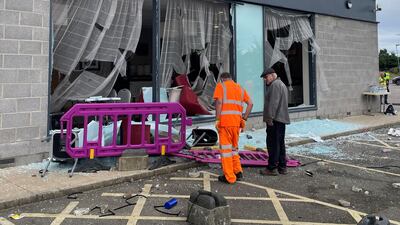
  • Damage to the Holiday Inn Express in Rotherham, South Yorkshire, where windows were smashed and fires were started in demonstrations purportedly against asylum-seekers. PA
    Damage to the Holiday Inn Express in Rotherham, South Yorkshire, where windows were smashed and fires were started in demonstrations purportedly against asylum-seekers. PA
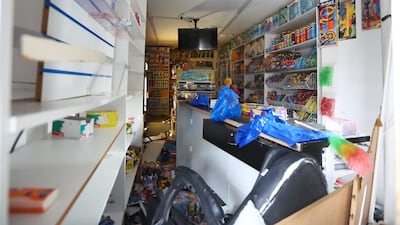
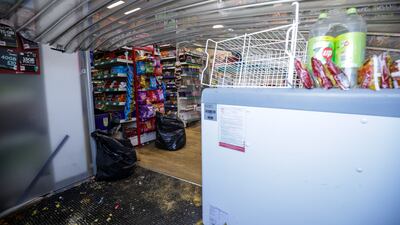
  • The interior of a tobacco and vapes shop which was ransacked after a night of violent disorder in the northern English city of Liverpool. EPA
    The interior of a tobacco and vapes shop which was ransacked after a night of violent disorder in the northern English city of Liverpool. EPA
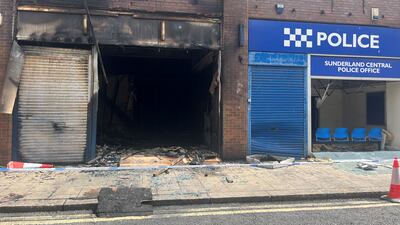
  • A fire-damaged Citizen's Advice Bureau office in Sunderland, Tyne and Wear, northern England. PA
    A fire-damaged Citizen's Advice Bureau office in Sunderland, Tyne and Wear, northern England. PA
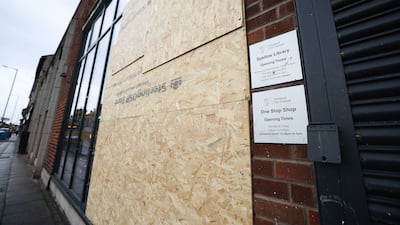
  • Damage to the Spellow Hub community library in the northern English city of Liverpool. EPA
    Damage to the Spellow Hub community library in the northern English city of Liverpool. EPA
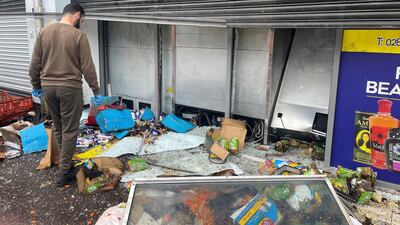
  • A man tries to clean up a supermarket damaged by fire on Donegall Road following anti-immigration protests in Belfast, Northern Ireland. AP
    A man tries to clean up a supermarket damaged by fire on Donegall Road following anti-immigration protests in Belfast, Northern Ireland. AP
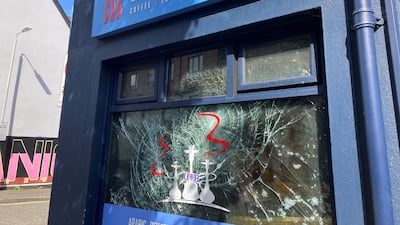
  • Damage to the Bash Cafe in south Belfast, which was burned during riots. PA
    Damage to the Bash Cafe in south Belfast, which was burned during riots. PA
  • Damage at the Clumsy Swan pub in the east of the England Midlands city of Birmingham. PA
    Damage at the Clumsy Swan pub in the east of the England Midlands city of Birmingham. PA
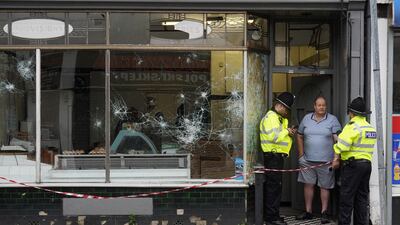
  • Police officers outside a damaged butcher's shop in Hartlepool, a seaside town in County Durham. PA
    Police officers outside a damaged butcher's shop in Hartlepool, a seaside town in County Durham. PA
  • The Windsor Mini Mart in the English town of Southport, north of Liverpool, was looted. PA
    The Windsor Mini Mart in the English town of Southport, north of Liverpool, was looted. PA

Tell Mama, a monitoring group that tracks complaints of anti-Muslim hate crimes, has said such rose fivefold during the riots when at least 10 mosques were attacked or threatened. For Baroness Gohir the trouble did not ease when the clashes ended.

“Our helpline has been overwhelmed with women concerned about what has been happening,” she told The National.

“The helpline we run is predominantly for abuse but over the last 12 months we have had women calling up over other issues of hate and during the recent riots we have seen a massive spike in incidents.

“Women are telling us that they thought the UK was the safest country in Europe, where they can practice their faith and wear what they want without fear of violence but now they are in shock.

“They knew there was always racism there but with the levels of violence seen recently they are worried not just for themselves if they wear a headscarf, but also for their children going to school.

“We have found they are worried about elderly people going to the shop, they have started doing shopping online because they are afraid to go out. They have started to go out in groups, [are] less likely to take public transport and have even received abuse while driving. They have been forced to change the way they behave and we need to address this.”

In Northern Ireland, schools near the sites of recent anti-immigration protests and racist attacks are to conduct risk assessments for the community as the new term starts.

Education Minister Paul Givan has written to a group of 400 Muslim women to reassure them that there has been a review of safety precautions at schools following the recent unrest.

Businesses owned by Muslims were targeted during race-related disorder in Belfast this month.

In Leeds a group has started Self Defence Sundays, a set of free hour-long classes for Muslim women, specifically to address issues triggered by the riots.

Yemeni-British poet Amina Atiq, who left Yemen aged four and grew up in Liverpool, told The National she and her family were forced into “lockdown” during the riots, too scared to leave the house.

Rioters attacked her local mosque, the Abdullah Quilliam Mosque in Liverpool, in which people were trapped inside.

She has been scared to leave the house in case she was a target due to wearing traditional dress and is anxious about returning to work in an educational establishment next month.

Poet Amina Atiq was too afraid to leave her home during the UK riots. Photo: Amina Atiq

“It has been a very scary time for Muslim women,” she said.

“We saw places where we have [previously] been safe attacked. I have stayed inside, it was like another lockdown for my family and I.

“We had Islamic prayer signs on our front door to welcome guests and we had to take them down, so our house was not recognisable. I’m really active and my dad goes running every day but we just didn’t go out. We did our food shopping online so it was delivered.

“I finally realised I cannot stay at home forever and the more I go out the more I realise another Muslim will feel safe too. I’m a lot more cautious, though, I would go out in sunglasses and headphones but now I don’t because I need to be able to see and hear if anything happens. Before this I felt safe. I’m worried about going back to work in September and travelling on my own.”

She is concerned there will be a rise in youth violence when schools start again.

“It seems like things have calmed down and because of the tough sentences people are having to face the consequences of their actions. But there needs to be work done in my city and others.

“I feel we will see the rise of youth violence, I feel anxious, especially with the young people going back to school. There were a lot of young boys involved in the rioting and I’m worried it will fuel tensions.

“I work to create peace and social cohesion through my creative writing. This is the first time I have felt differently. It is the first time in my life I feel like we have taken a massive step backwards, especially after the changes made by Black Lives Matter we have gone 10 steps back. There needs to be a lot of work done now to address what has happened. We need to be more vocal on Islamophobia and how to protect Muslim women and be a lot more aware.”

Baroness Gohir, who became a life peer following her work with Muslim women, will table a question in the House of Lords next month asking the government what the drivers of hate crime against Muslims are and how this can be addressed.

She has previously published a report on Muslim women’s experiences of the criminal justice system, which shone a light on the justice gap faced by victims of abuse, while her latest report, which will be published next month, focuses on the harm experienced by Muslim women during the recent unrest.

“We need all this hate and abuse logging now, so the government has a true picture of what is happening,” she said. “The aftermath of the riots are going to be felt for many years to come and I want to keep up the momentum.”

When Parliament returns from summer break she hopes to submit her report to each government department to push for tougher laws.

“I think the government needs to strengthen hate crime legislation and we need a campaign to encourage women to report it,” she said.

“There is an issue if the majority who experience it are not reporting it to the police. We need to reform the current system. I will taking this report to all the government departments to show them the impact hate crime has had on Muslim women before and after the riots, and ask what they are going to do about it.

“I want to make sure that the views of Muslims are being considered in that process. I want to make sure Muslims are informed and are shaping it. I hope our report will be a powerful tool to hold the government to account.”

She is also hoping to set up a dedicated helpline for Muslim women to report hate crime.

“It is really important as Muslim women are more likely to be affected by it,” she said. "In my opinion the situation in the UK has got to this point because the previous government did very little to tackle hate crime and it emboldened people to think racism was acceptable.

“There have been very few consequences on the far right until now and, only now after riots, are they being locked up with heavy consequences. They can now see there are consequences for hate crime.

Baroness Shaista Gohir is writing a report into how Muslim women have been affected by the UK riots. Photo: UK Parliament

“I do blame some politicians for what has happened, if they do not call people out then they will carry on. I would like to see stronger codes of ethics in Parliament.”

Her concerns have been echoed by the UN’s Committee on the Elimination of Racial Discrimination, which reviews all countries' records on race hate every few years.

It urged Britain to pass measures to curb hate speech and xenophobic rhetoric, which it said had played a direct role in fuelling the summer riots.

"[The Committee] is concerned about the persistence and in some cases sharp increase of hate crimes, hate speech and xenophobic incidents," it said, following a review of Britain's record.

This included racist and xenophobic speeches by politicians and public figures, it said.

Committee member Gun Kut identified a direct link between xenophobic speeches and racial violence, and raised concerns about institutional racism in Britain's policing and justice system. He urged Britain to set up a mechanism to investigate complaints.

"There is an obvious concern about hate speech by prominent figures in the public," he said.

Baroness Gohir said the views of Muslims need to be at the fore as the dust settles. “We can’t let this rest, we have to keep the momentum up and show the government what is truly happening on the ground,” she said.

“Muslims need a voice as we look to ways to address this.”

The biog

First Job: Abu Dhabi Department of Petroleum in 1974  
Current role: Chairperson of Al Maskari Holding since 2008
Career high: Regularly cited on Forbes list of 100 most powerful Arab Businesswomen
Achievement: Helped establish Al Maskari Medical Centre in 1969 in Abu Dhabi’s Western Region
Future plan: Will now concentrate on her charitable work

Islamophobia definition

A widely accepted definition was made by the All Party Parliamentary Group on British Muslims in 2019: “Islamophobia is rooted in racism and is a type of racism that targets expressions of Muslimness or perceived Muslimness.” It further defines it as “inciting hatred or violence against Muslims”.

Types of fraud

Phishing: Fraudsters send an unsolicited email that appears to be from a financial institution or online retailer. The hoax email requests that you provide sensitive information, often by clicking on to a link leading to a fake website.

Smishing: The SMS equivalent of phishing. Fraudsters falsify the telephone number through “text spoofing,” so that it appears to be a genuine text from the bank.

Vishing: The telephone equivalent of phishing and smishing. Fraudsters may pose as bank staff, police or government officials. They may persuade the consumer to transfer money or divulge personal information.

SIM swap: Fraudsters duplicate the SIM of your mobile number without your knowledge or authorisation, allowing them to conduct financial transactions with your bank.

Identity theft: Someone illegally obtains your confidential information, through various ways, such as theft of your wallet, bank and utility bill statements, computer intrusion and social networks.

Prize scams: Fraudsters claiming to be authorised representatives from well-known organisations (such as Etisalat, du, Dubai Shopping Festival, Expo2020, Lulu Hypermarket etc) contact victims to tell them they have won a cash prize and request them to share confidential banking details to transfer the prize money.

* Nada El Sawy

The Melbourne Mercer Global Pension Index

The Melbourne Mercer Global Pension Index

Mazen Abukhater, principal and actuary at global consultancy Mercer, Middle East, says the company’s Melbourne Mercer Global Pension Index - which benchmarks 34 pension schemes across the globe to assess their adequacy, sustainability and integrity - included Saudi Arabia for the first time this year to offer a glimpse into the region.

The index highlighted fundamental issues for all 34 countries, such as a rapid ageing population and a low growth / low interest environment putting pressure on expected returns. It also highlighted the increasing popularity around the world of defined contribution schemes.

“Average life expectancy has been increasing by about three years every 10 years. Someone born in 1947 is expected to live until 85 whereas someone born in 2007 is expected to live to 103,” Mr Abukhater told the Mena Pensions Conference.

“Are our systems equipped to handle these kind of life expectancies in the future? If so many people retire at 60, they are going to be in retirement for 43 years – so we need to adapt our retirement age to our changing life expectancy.”

Saudi Arabia came in the middle of Mercer’s ranking with a score of 58.9. The report said the country's index could be raised by improving the minimum level of support for the poorest aged individuals and increasing the labour force participation rate at older ages as life expectancies rise.

Mr Abukhater said the challenges of an ageing population, increased life expectancy and some individuals relying solely on their government for financial support in their retirement years will put the system under strain.

“To relieve that pressure, governments need to consider whether it is time to switch to a defined contribution scheme so that individuals can supplement their own future with the help of government support,” he said.

Bert van Marwijk factfile

Born: May 19 1952
Place of birth: Deventer, Netherlands
Playing position: Midfielder

Teams managed:
1998-2000 Fortuna Sittard
2000-2004 Feyenoord
2004-2006 Borussia Dortmund
2007-2008 Feyenoord
2008-2012 Netherlands
2013-2014 Hamburg
2015-2017 Saudi Arabia
2018 Australia

Major honours (manager):
2001/02 Uefa Cup, Feyenoord
2007/08 KNVB Cup, Feyenoord
World Cup runner-up, Netherlands

The%20specs
%3Cp%3E%3Cstrong%3EEngine%3A%20%3C%2Fstrong%3E3.6-litre%2C%20V6%0D%3Cbr%3E%3Cstrong%3ETransmission%3A%20%3C%2Fstrong%3Eeight-speed%20auto%0D%3Cbr%3E%3Cstrong%3EPower%3A%20%3C%2Fstrong%3E285hp%0D%3Cbr%3E%3Cstrong%3ETorque%3A%20%3C%2Fstrong%3E353Nm%0D%3Cbr%3E%3Cstrong%3EPrice%3A%20%3C%2Fstrong%3EDh159%2C900%0D%3Cbr%3E%3Cstrong%3EOn%20sale%3A%20%3C%2Fstrong%3Enow%3C%2Fp%3E%0A
About RuPay

A homegrown card payment scheme launched by the National Payments Corporation of India and backed by the Reserve Bank of India, the country’s central bank

RuPay process payments between banks and merchants for purchases made with credit or debit cards

It has grown rapidly in India and competes with global payment network firms like MasterCard and Visa.

In India, it can be used at ATMs, for online payments and variations of the card can be used to pay for bus, metro charges, road toll payments

The name blends two words rupee and payment

Some advantages of the network include lower processing fees and transaction costs

UAE currency: the story behind the money in your pockets
Super Bowl LIII schedule

What Super Bowl LIII

Who is playing New England Patriots v Los Angeles Rams

Where Mercedes-Benz Stadium in Atlanta, United States

When Sunday (start time is 3.30am on Monday UAE time)


The specs

Engine: 5.2-litre V10

Power: 640hp at 8,000rpm

Torque: 565Nm at 6,500rpm

Transmission: 7-speed dual-clutch auto

Price: From Dh1 million

On sale: Q3 or Q4 2022 

Mercer, the investment consulting arm of US services company Marsh & McLennan, expects its wealth division to at least double its assets under management (AUM) in the Middle East as wealth in the region continues to grow despite economic headwinds, a company official said.

Mercer Wealth, which globally has $160 billion in AUM, plans to boost its AUM in the region to $2-$3bn in the next 2-3 years from the present $1bn, said Yasir AbuShaban, a Dubai-based principal with Mercer Wealth.

Within the next two to three years, we are looking at reaching $2 to $3 billion as a conservative estimate and we do see an opportunity to do so,” said Mr AbuShaban.

Mercer does not directly make investments, but allocates clients’ money they have discretion to, to professional asset managers. They also provide advice to clients.

“We have buying power. We can negotiate on their (client’s) behalf with asset managers to provide them lower fees than they otherwise would have to get on their own,” he added.

Mercer Wealth’s clients include sovereign wealth funds, family offices, and insurance companies among others.

From its office in Dubai, Mercer also looks after Africa, India and Turkey, where they also see opportunity for growth.

Wealth creation in Middle East and Africa (MEA) grew 8.5 per cent to $8.1 trillion last year from $7.5tn in 2015, higher than last year’s global average of 6 per cent and the second-highest growth in a region after Asia-Pacific which grew 9.9 per cent, according to consultancy Boston Consulting Group (BCG). In the region, where wealth grew just 1.9 per cent in 2015 compared with 2014, a pickup in oil prices has helped in wealth generation.

BCG is forecasting MEA wealth will rise to $12tn by 2021, growing at an annual average of 8 per cent.

Drivers of wealth generation in the region will be split evenly between new wealth creation and growth of performance of existing assets, according to BCG.

Another general trend in the region is clients’ looking for a comprehensive approach to investing, according to Mr AbuShaban.

“Institutional investors or some of the families are seeing a slowdown in the available capital they have to invest and in that sense they are looking at optimizing the way they manage their portfolios and making sure they are not investing haphazardly and different parts of their investment are working together,” said Mr AbuShaban.

Some clients also have a higher appetite for risk, given the low interest-rate environment that does not provide enough yield for some institutional investors. These clients are keen to invest in illiquid assets, such as private equity and infrastructure.

“What we have seen is a desire for higher returns in what has been a low-return environment specifically in various fixed income or bonds,” he said.

“In this environment, we have seen a de facto increase in the risk that clients are taking in things like illiquid investments, private equity investments, infrastructure and private debt, those kind of investments were higher illiquidity results in incrementally higher returns.”

The Abu Dhabi Investment Authority, one of the largest sovereign wealth funds, said in its 2016 report that has gradually increased its exposure in direct private equity and private credit transactions, mainly in Asian markets and especially in China and India. The authority’s private equity department focused on structured equities owing to “their defensive characteristics.”

Desert Warrior

Starring: Anthony Mackie, Aiysha Hart, Ben Kingsley

Director: Rupert Wyatt

Rating: 3/5

FROM%20THE%20ASHES
%3Cp%3EDirector%3A%20Khalid%20Fahad%3C%2Fp%3E%0A%3Cp%3EStarring%3A%20Shaima%20Al%20Tayeb%2C%20Wafa%20Muhamad%2C%20Hamss%20Bandar%3C%2Fp%3E%0A%3Cp%3ERating%3A%203%2F5%3C%2Fp%3E%0A

THE SPECS

Engine: Four-cylinder 2.5-litre

Transmission: Seven-speed auto

Power: 165hp

Torque: 241Nm

Price: Dh99,900 to Dh134,000

On sale: now

Ms Yang's top tips for parents new to the UAE
  1. Join parent networks
  2. Look beyond school fees
  3. Keep an open mind
The specs: 2018 Nissan Patrol Nismo

Price: base / as tested: Dh382,000

Engine: 5.6-litre V8

Gearbox: Seven-speed automatic

Power: 428hp @ 5,800rpm

Torque: 560Nm @ 3,600rpm

Fuel economy, combined: 12.7L / 100km

MATCH INFO

Serie A

Juventus v Fiorentina, Saturday, 8pm (UAE)

Match is on BeIN Sports

Ferrari
%3Cp%3E%3Cstrong%3EDirector%3A%3C%2Fstrong%3E%20Michael%20Mann%26nbsp%3B%3C%2Fp%3E%0A%3Cp%3E%3Cstrong%3EStarring%3A%3C%2Fstrong%3E%20Adam%20Driver%2C%20Penelope%20Cruz%2C%20Shailene%20Woodley%2C%20Patrick%20Dempsey%3C%2Fp%3E%0A%3Cp%3E%3Cstrong%3ERating%3A%3C%2Fstrong%3E%203%2F5%3C%2Fp%3E%0A
Who's who in Yemen conflict

Houthis: Iran-backed rebels who occupy Sanaa and run unrecognised government

Yemeni government: Exiled government in Aden led by eight-member Presidential Leadership Council

Southern Transitional Council: Faction in Yemeni government that seeks autonomy for the south

Habrish 'rebels': Tribal-backed forces feuding with STC over control of oil in government territory

Visit Abu Dhabi culinary team's top Emirati restaurants in Abu Dhabi

Yadoo’s House Restaurant & Cafe

For the karak and Yoodo's house platter with includes eggs, balaleet, khamir and chebab bread.

Golden Dallah

For the cappuccino, luqaimat and aseeda.

Al Mrzab Restaurant

For the shrimp murabian and Kuwaiti options including Kuwaiti machboos with kebab and spicy sauce.

Al Derwaza

For the fish hubul, regag bread, biryani and special seafood soup. 

Updated: August 30, 2024, 6:00 PM