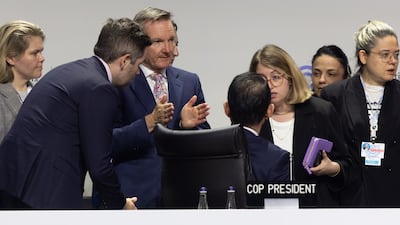

The collapse of talks at the UN's Cop31 summit will not stop international action against climate change, according to analysts, who expect economic and technological forces to continue to drive the world's shift away from fossil fuels.
Despite running two days beyond its November 9–20 schedule, as negotiators made a last-ditch push for a deal, the event in Antalya was the first Cop since Copenhagen in 2009 to end without a final agreement among all parties.
A major sticking point was that the draft final "cover decision" did not highlight the need to transition away from fossil fuels. Dozens of nations reportedly refused to sign because of this omission.
A commitment to move away from fossil fuels was in the document agreed at the end of Cop28 in Dubai three years ago, but similar pledges were absent in Azerbaijan in 2024 and Brazil last year.
A fragmented world
Dr Nicholas Howarth, director of strategy and programmes at Frontier 25, a UAE-based climate change advisory organisation, said the failure to agree on the language on the transition away from fossil fuels was “a sign of how fragmented the world has become”.
But he said the Cop28 UAE Consensus still stood, while the 2015 Paris Agreement “provides an enduring framework for international climate co-operation” that includes the Global Stocktake process, which requires nations to periodically renew commitments to limit their carbon emissions.
“Rather than spending scarce time and effort reaffirming commitments already agreed, as important as these decisions were, the international community should be focusing on the future and implementing practical solutions,” he said.
Another point of disagreement in Turkey centred on calls for richer nations to triple their annual support for developing countries to adapt to climate change.
A “35-by-35” commitment that by 2035, electricity should account for at least 35 per cent of energy consumption – the current figure is 23 per cent – was included in Cop31’s final, unapproved draft cover decision.
The failure to agree on this pledge was one of the “most regrettable” outcomes of Cop31, said Bob Ward of the Grantham Research Institute on Climate Change and Environment, part of the London School of Economics and Political Science.
“I would hope that is resurrected in the coming year and is part of the decision reached at next year’s Cop,” he added.

“What I would expect now is that the Turkish presidency [of Cop31] and the incoming Ethiopian presidency [of Cop32] will work together to try to build consensus around the key issues.”
Cop31 took place less than three months after a UN Environment Programme report revealed that it was, in effect, impossible for the world to limit temperature increases to no more than 1.5°C above pre-industrial levels, the goal of the 2015 Paris Agreement, which was agreed at Cop21. Beyond this threshold, much more severe effects from climate change are expected.
Bright spots
But Mr Ward said Cop31 had still seen many valuable agreements, even though an overarching final deal had not been reached.
Dr Howarth said a “bright spot” of Cop31 had been an electrification delivery package that brought together initiatives in more than 150 countries.
“[This] is a reminder that, despite what will no doubt be widely acknowledged as a disappointment in Antalya, there is good reason to maintain faith in climate diplomacy and the multilateral process,” he said.
“What everyone should be able to agree on is that more effort turning international commitments into investment and action on the ground is needed, particularly in developing countries.”
Analysts also highlighted how technological advancements are driving down the cost of renewable energy and making electrification more attractive, thereby speeding a transition away from fossil fuels.
“So far this year, electricity demand has grown by close to four per cent, while total energy demand has remained largely flat. This is a strong indication that the energy transition is well under way, irrespective of any Cop outcome,” Dr Howarth said.
The Iran war has highlighted the need for many nations to accelerate the transition to renewable energy and electrification to cut their dependence on imported fossil fuels.
“The price of solar is now cheaper than most other sources of energy, including fossil fuels,” said Mr Ward. “Electric vehicles are now cheaper [to run] than their gasoline equivalent. The price of wind energy has come down. For all sorts of reasons, the transition is unstoppable, not just because of climate concerns.”
Political paralysis
Some environmentalists have nevertheless reacted with dismay to events in Antalya.
Ghiwa Nakat, the executive director of Greenpeace Middle East and North Africa, said the failure to forge an overarching agreement meant that governments had “once again failed the communities on the front lines of the climate crisis”.
“Rejecting a weak deal that favoured fossil fuel interests was necessary, but leaving without an agreement is still a failure,” she said. “Our communities cannot afford another year of political paralysis.”
She said the lack of consensus on climate finance demonstrated “hypocrisy” from developed nations, which were “claiming the moral high ground on ambition” but not providing the funds to turn commitments into action.
“Climate finance is not charity, nor is it a bargaining chip to be traded in negotiating rooms,” she said. “It is a lifeline for communities facing the impacts of a climate crisis they did not create, and an obligation rooted in historical responsibility and international agreements.”