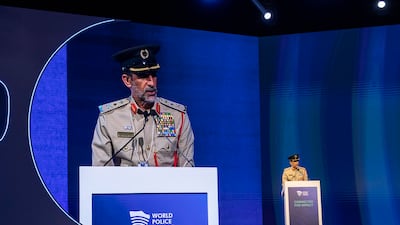

The head of Dubai Police has spoken about a need for closer links between nations to tackle organised crime and cyber threats.
Maj Gen Abdullah Khalifa Al Marri warned that forces around the world need to step up co-operation to face the challenges posed by organised criminals whose methods are evolving with the opportunities presented by artificial intelligence.
The commander in chief made his comments on the opening day of the World Police Summit in Dubai.

“Extremist groups are exploiting global developments to spread their ideologies and destabilise societies, while transnational criminal networks are becoming increasingly sophisticated,” said Maj Gen Al Marri in a keynote speech.
“Security is a cornerstone of development and shaping the future begins with dialogue, the exchange of expertise and best practices, as well as building alliances that strengthen our ability to confront changing circumstances.”
The UAE has stepped up its work with other countries to help bring criminals to justice in recent months.
In August, the Emirates handed over alleged drug kingpin Daniel Kinahan to Irish authorities following an extradition process.
The 49-year-old is facing charges related to organised crime, including leading a criminal organisation, murder and drug trafficking.
The following month, French Justice Minister Gerald Darmanin told The National that the UAE’s relationship with France in combating organised crime was the perfect model for the international community to adopt.
Since the start of last year, 28 French citizens have been extradited from the UAE, while 33 apartments owned by suspected French drug traffickers were seized in the UAE in 2025, Mr Darmanin said.
He said France and the UAE had developed complete co-operation against drug trafficking and the financial networks that prop up organised crime gangs, including money laundering through cryptocurrency and property.
Effects of AI
Also on the agenda at Monday's summit was how the advent of AI had changed the equation for criminals and police.
“We are living through the fastest technological transformation in the history of humanity and it's only accelerating from here,” said Rick Smith, founder and chief executive of Axon Enterprise, a US tech firm that specialises in the law enforcement sector.
AI has already created an environment in which drones can reach emergency scenes before police officers, while body cameras stream live audio and video to AI systems, allowing commanders to monitor incidents and understand what officers are doing in real time.
However, Mr Smith warned that the technology was being adopted by criminals, which meant it is essential for governments and security agencies to develop digital defences capable of adapting as quickly as threats evolve.
He called for countries to rethink how they protect critical digital infrastructure, warning that data centres were becoming potential targets during conflicts.
Mr Smith highlighted Ukraine's efforts to protect critical data by migrating some servers to other countries in Europe. He urged other nations to consider distributing their digital infrastructure geographically to reduce risks.
“We must preserve both the security and the ability to keep our systems operating during both physical and cyber attacks,” he said.

