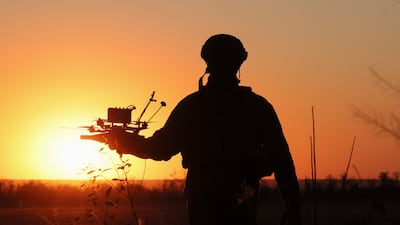

Russia is recruiting a “gaming army” of 165,000 troops to control its growing drone legions to counter Ukraine’s dominance in an increasingly robot-driven war.
A Pentagon adviser on Russia's military machine has mapped an emerging network of drone operators and electronic warfare specialists with skills honed in online gaming.
The military is now focusing its recruitment on men and women with advanced computer skills and “a gaming background”, said Sam Bendett, a Russia drone expert who advises the Pentagon.
The recruits who have highly developed digital skills from years of Xbox or Nintendo gaming are tasked with operating a massive range of drones from land, sea and air in Moscow’s new Unmanned Systems Forces (USF).
“Ultimately the gamification of this particular conflict is feeding a new pipeline of Unmanned Systems Forces’ recruits,” he told the Royal United Services Institute land warfare conference.
“The Russian military is adapting,” said the expert for US Centre of Naval Analysis. “This force is growing in numbers and technologies and they're becoming more lethal and more successful.”

A key component of the USF will be the 50th Brigade of 7,000 drone troops ready for operations by December.
Its soldiers will fly everything from FPV (first person view) drones, fixed-wing and multi-rotor, alongside a “growing roster” of unmanned ground vehicles, as well as UAV (unmanned aerial vehicles) interceptors.
Rubicon raiders
Russia’s “most capable and most dangerous UAV formation” is an operation nicknamed the “Rubicon Unit” but officially the Centre for Advanced Unmanned Technologies
The elite military unit acts as a combined combat force, research laboratory and training centre for advanced aerial, ground and naval drones and is responsible for allegedly destroying 33,000 Ukraine targets.

“Rubicon is tasked with identifying where Ukrainian operators are located, where their technologies are based and where Ukrainian logistics and supply that feed the UAV pipeline are located,” Mr Bendett told an audience of senior officers. “So Rubicon is probably enemy number one on the Ukrainian battlefield today.”
Night bombers
He also highlighted the “emerging capability” of ground robots that are becoming increasingly common on the front line, and noted Moscow’s Courier tracked drone, which has a version armed with a 82mm mortar that is fed shells by a robotic hand.
But more importantly, unlike advanced armoured vehicles, they “are small, cheap, and attritable (destroyable)” and very useful “because you can't operate large, expensive, exquisite systems any more as they will be eaten by FPV drones”.

There was also a warning that Russia will very soon introduce an advanced AI command and control system called SVOD that will be link up soldiers in front line platoons back headquarters.
But the Russians remain “envious” of Ukraine’s ability to field heavy drones known as “Baba Yaga”, named after a mythical bogeyman, that act as night bombers carrying 20kg of explosives, mortar rounds and anti-tank mines that can level bunkers in the dark.
Kyiv is gaining more resources develop its defence base after the EU transferred 3.2 billion euros in the first tranche of its loan scheme to the country on Thursday. At a meeting with European leaders at the Ukraine Recovery Conference in Gdansk, Poland, officials said they expected to sign 10 billion euros for 160 projects that will include reconstruction.

Adapt fast
Western armies also need to adapt very quickly to the advances or will be highly vulnerable to Russian attack, a Ukrainian drone pilot told the conference.
“I suggest that you guys integrate the Ukrainian lessons as soon as you can,” said Dmytro Zhluktenko. “There is a big urgency because our strategic adversaries they are learning much faster than Western countries.”
The former FPV front line drone operator added that up to 90 per cent of Russian casualties “are being destroyed, deleted by Ukrainian drones”.
Many of those Russians were hit between 5 and 20km behind the front line, he added. “Those guys don't even get to shoot their rifles. They don't see the combat before we draw on them. Ukraine is literally your war-fighting university.”

‘Hauntingly brutal’
His views were echoed by Brigadier Jim Hadfield who said unless the British military adopted those lessons “paid for in blood” then “we won't generate the capabilities we need”.
“Too often I hear, we wouldn't fight like this. I disagree. Russia will fight like this and so we must be ready to fight back.”
Britain too needed to form a “gaming army” with software engineers and data analysts embedded across all its formations.
Soldiers also needed to develop the “robustness” demonstrated by Kyiv’s troops. “The Ukrainian battlefield is hauntingly brutal. It demands soldiers capable of absorbing and delivering violence at a scale and ferocity that few have experienced.”
In an era where the only cover from fire was underground and the “rifle is increasingly a sidearm”, Ukrainian expertise had to be embedded across the armed forces.
He added that his experimental unit, 20 Brigade, would act as a test bed or laboratory “where failure is allowed but only once” and whenever they discover tactics that work they will be shared with Nato.
“We're in an era of cheap, massed precision,” he concluded. “Everything is seen. Everything is targeted. Everything is expendable.”

