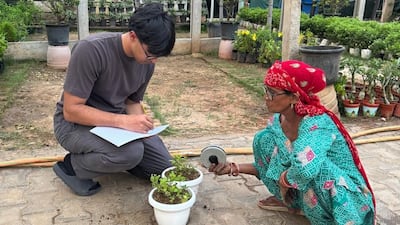
Three enterprising UAE teenagers are turning discarded chicken feathers into biofertiliser in a project they hope could eventually help farmers and reduce agricultural waste.
Adit Mital, Anushka Harlalka and Maanit Misra have spent months developing BioFeathers, a process that uses bacteria to break down chicken feathers and convert them into nutrients that can be used by plants.
What started as a school science project has now moved into trials at 16 farms and nurseries in the UAE, Oman and India.

The Year 13 pupils at Dubai International Academy have also filed a joint provisional patent application and plan to approach Dubai authorities in an effort to expand their plans.
Speaking to The National, the teenagers said the idea came from a shared interest in science and the possibility of turning something normally thrown away into something useful.
“We saw an opportunity there, or a gap between what is currently being used to get rid of that waste versus what it could actually be used for," Adit said.
Several million tons of poultry feathers are discarded around the world every year. They contain a substance that is resistant to natural degradation, which leads to large amounts of waste and environmental concern.
The teenagers began by collecting about 2kg of feathers from a poultry farm in Sharjah and spent hours preparing them for lab testing.
Their families were initially surprised by the idea, but they later helped the teenagers travel to laboratories and connect with people who could support their work.
Turning waste into fertiliser
The pupils wanted to find a way of extracting useful material from feathers without burning or other energy-intensive methods.
“The main idea is that chicken feathers basically have keratin in them, and keratin is a very useful protein, but it's also very hard to break down and extract,” Adit said.
They began contacting academics and universities through cold emails before working with researchers at the University of Sharjah.

“We did a lot of cold emailing to these professors,” Anushka said. “There were limitations to what some people could help us and offer us, so we reached out to more. We did a lot of research.”
Through their experiments, the students developed nine nutrient-rich formulations that could be used as fertilisers or plant-growth boosters.
Their first laboratory experiments began during the winter break in December 2025. By February, they had completed three rounds of trials before moving on to testing the formulations on plants.
Early controlled tests using bok choy and radishes showed some growth measurements about 20 to 30 per cent higher than commercial comparison treatments.
However, results are preliminary and further testing is required.
Putting plans to the test

The team has since taken the product outside the laboratory and tested it at farms and nurseries in the UAE, Oman and India.
The pupils said more than 1,200 farmers have been involved in trials, helping the pupils understand how the product could work in real agricultural settings.
“Seeing what is the actual application, what are the requirements to be able to take this further, that is the main thing that we are picking up from farmers," Maanit said.
School, exams and 60 plant pots
Developing the project while attending school has also meant fitting laboratory work around lessons and exams.
The pupils spent much of their winter break travelling to Sharjah, at times working in the laboratory almost every day.
Regional tensions earlier this year disrupted their access to the university laboratory. Instead of stopping the project, they moved part of the testing home.
“I had some 60 plant pots in my backyard, and we would come there every other week, and we would do experiments on them, collecting our data,” Adit said.
The group also dealt with delays in obtaining chemicals and problems with laboratory equipment. Adit said the experience forced the group to adapt.
“There were nights or evenings where we were there up until almost 7am,” he said. “It became really difficult.”
Their teachers, university researchers and families became an important support network.
Patent filed as project grows
The pupils filed a joint provisional patent application in April for elements of the process they developed.
They said their method builds on existing approaches but includes changes to chemicals, concentrations and other parts of the process.
“There were already existing protocols for developing a biofertiliser through the same process, but our method involved a few nuanced and unique takes,” Adit said.
The teenagers estimate the raw formula costs less than Dh1 per 100ml to produce. Because the feathers are waste, the main raw material is inexpensive.
However, the pupils said packaging, storage and transport would add to the cost if the product were produced on a larger scale.
The students now plan to present the project to Dubai Municipality and explore opportunities through the Dubai Farms programme.