
One of the UAE's leading universities has joined forces with a green-focused biotechnology company to launch a landmark waste recycling plant putting composting at the forefront of efforts to boost food security.
The organic waste valorisation plant - established by a collaboration between Emirates Biotech and the United Arab Emirates University - will be capable of processing up to 40kg of organic waste once up and running.
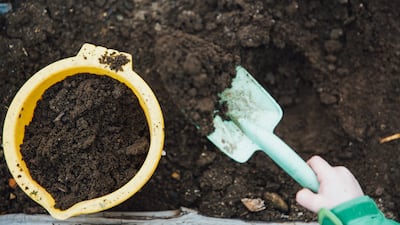
The Al Ain facility, heralded as the first of its kind in the Emirates, will convert food leftovers and compostable packaging into renewable biogas and nutrient-rich compost.

Construction of the unit is expected to take six to 12 months on a plot near the university.
Composting -the managed, natural process of recycling organic waste - is a method which dates backs thousands of years and is now primed to play a key role in the UAE's modern-day environmental drive.
When organic material is discarded its potential energy is wasted and it ends up as another item in landfill. Researchers are trying to change that.
“As humans, we are organic; we decompose. We know everything has a cycle. So for food waste, plastic, why can't we have the same cycle?” Zafar Said Sher, associate professor in the department of mechanical and aerospace engineering at UAEU, tells The National.

Self-sufficient future
The professor wants the UAE to lead the region in circularity – a model focused on reusing and regenerating products to eliminate waste and contribute to self-sufficiency. If the project succeeds, the team hopes to expand it across the region to reduce landfill waste.
“Composting is the future, organic waste is an opportunity,” says Prof Sher. “It will take time but after a couple of decades we might have been able to enhance the fertile land and replace the sand or desert, which means having security in food production.”
Francois de Bie, chief commercial officer for Emirates Biotech, says: “The UAE wants to be more self-supporting when it comes to agriculture. To build a growing agricultural base, you need fertile land to grow. Compost, which is what we produce, will help to achieve that.”
Organic waste dumped in landfills produces methane, which is up to 28 times more harmful than carbon dioxide. In the UAE, a staggering 40 per cent of generated waste is organic.
“In Europe, in the US, in India, in China, this has been realised a long time ago, so there is separate collection of green waste, of organic waste completely set up,” Mr de Bie adds. “The only viable option for the collected organic waste is to compost it … which will help to fertilise the land again.”
Ambitious plans
Emirates Biotech is also building the region’s largest polylactic acid (PLA) plant in Kezad, which it hopes to have up and running by 2029. Polylactic acid plastics are considered among the most environmentally friendly, made from natural materials such as corn starch and sugar cane, and are biodegradable.
The new plant will produce 80,000 tonnes of PLA annually and will also have an on-site recycling complex to close the loop.

“Producing that material locally will reduce the need to import PET [polyethylene terephthalate] from China or Indonesia,” Mr de Bie tells The National.
The closure of the Strait of Hormuz due to the Iran war has delayed the project, which requires large machinery to be brought in through Khalifa Port.
“We have ordered the key pieces of equipment to be installed and, unfortunately, the project has been confronted with some delays due to the geopolitical situation,” he adds.
Farming heritage
Part of the reason Al Ain was chosen for the new plant is the city's farming history, which dates back to the traditional irrigation system, falaj, used for thousands of years.
Organic waste will be collected and then contaminated with PLA products to demonstrate that they are biodegradable. “The goal is to become self-sufficient in agriculture,” says Prof Sher.
Importance of circular economy
In recent years, the UAE has prioritised a circular economy, launching many initiatives to divert material from landfill.
Nema, the National Food Loss and Waste Initiative launched in 2022, aims to cut food waste by 50 per cent by 2030.
Naseej, the national initiative for textile circularity, was launched in June to keep textiles from being carelessly discarded.
“I think the 2030 goals are extremely ambitious,” Mr de Bie says. “They [the UAE leadership] set bold goals but what I've seen in the past is they make it happen.”
The country has set its sights on achieving net-zero emissions by 2050, with an emissions-reduction target of 18 per cent by 2030.

