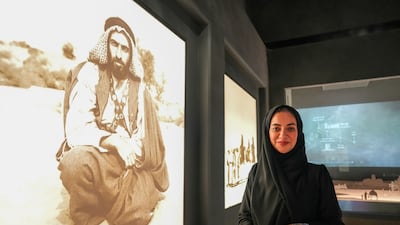
Not only does Zayed National Museum offer a glimpse into the nation’s past but it also helps us understand the man that was the UAE Founding Father, the late Sheikh Zayed bin Sultan Al Nahyan.
The life and achievements of Sheikh Zayed are very much centre stage at the museum, which provides visitors with an insight into the mindset that helped to shape the country.
The first gallery is called Our Beginning and is where the story starts: with Sheikh Zayed and the question of what shaped him said Hind Al Khoori, the museum's marketing and communications director.

“It’s not only 1971 and unity,” she said. “It’s actually what happened before that. What made him the leader he is?”
The answer stretches back much further than the formation of the UAE. The museum traces the history of the land back 300,000 years and its six galleries move the story from early human life through the country’s connections, traditions and modern history.
Ms Al Khoori’s favourite photograph of Sheikh Zayed catches an element she finds difficult to put into words: a man who could be humble and commanding at once. His eyes are fiery.
“You can see how that strong man behind this photo is also showing you the humbleness,” she said.
Nearby is another image — Sheikh Zayed leaning on his traditional stick, or asa, used in meetings and when drawing in the sand, sketching out ideas as he thought about how to bring his vision to life. For Ms Al Khoori, it also represents his connection to the land.
She tells another story from 1959, before the Union, when Sheikh Zayed and his brother Sheikh Shakhboot invited Danish archaeologists to investigate tombs they had discovered.
They wanted to know what the crypts could tell them about the past. Sheikh Zayed understood this history mattered, said Ms Al Khoori.

Voices from the past
One of the objects that makes that history feel immediate is the Marawah woman. The museum’s reconstruction is based on a burial site discovered on Marawah Island. The tomb dates back 8,000 years.
She is shown wearing a jacket made of feathers, with her accessories represented as they were found with her. “From the way she was buried, it shows that she was a prominent figure at that time,” said Ms Al Khoori.
She was one of several women whose stories were highlighted in Women of the Nation, a new one-hour thematic tour at Zayed National Museum, which ran from August 1 until the end of September to mark Emirati Women’s Day.
The galleries also tell stories of trade and diplomacy, and of everyday life: education, health care and the falaj irrigation system.
One striking project is the Magan Boat, built in partnership with Zayed University and NYU Abu Dhabi, using natural materials and techniques to recreate a vessel from about 4,000 years ago.
About 1,500 objects are on display from a collection of nearer 8,000, she said. The collection keeps growing through loans and donations. Objects will rotate throughout the galleries, and temporary exhibitions will bring others out of storage.
The Zayed National was recently named one of the world’s most beautiful museums of 2026 by Prix Versailles, the annual international prize presented at the Unesco headquarters in Paris.
Ms Al Khoori hopes visitors leave having learnt something. For Emiratis and everyone who considers the UAE home, she wants them to leave with “a moment of pride and connection”.
The museum shows people adapting to the land and using what was around them to make tools and build lives. “Resilience was embedded on this land way before Sheikh Zayed was here, way before 1971,” she said.
That is also why she calls it “a living museum”. Emirati hosts and guides, including senior Emiratis who lead tours, bring their own knowledge and experience to the galleries. “We’re a multisensory museum,” she said. “Everything we do is embedded within our roots, within our heritage.”

