
The new Etihad Rail service should offer a major economic boost to Fujairah, after it was revealed the city’s station was the first on the network to be completed.
While services for the public have yet to begin, senior officials recently took a train to the station in the Sakamkam neighbourhood of Fujairah, near Al Hilal City, to view the station.
The rail service will leave businesses in the emirate well-positioned to benefit from a boost to the local economy, said one expert.

“Improved connectivity has the potential to be a strong driver for Fujairah’s tourism and business travel sectors,” said Jan Hanak, the Radisson Hotel Group’s managing director for the UAE, Oman, Bahrain, Qatar, Egypt and Iraq.
He said the company’s Radisson Blu Resort, Fujairah and its Radisson property in Fujairah City, opening this year, were “well-positioned to benefit once passenger services begin”.
“Greater accessibility will make it easier for residents and visitors from across the UAE to explore Fujairah, supporting domestic leisure demand, corporate travel, and the emirate’s broader tourism and economic growth ambitions,” he added.
The arrival of passenger trains could also increase domestic tourism as the country tries to recover from the Iran war – seen as crucial in advance of a general tourism recovery.
“This domestic demand will play a critical role in stabilising and resetting tourism across the UAE and the wider Gulf region,” said Carlos Cendra, chief marketing officer at the Data Appeal Company, which offers travel analytics.
“Increased travel frequency and improved accessibility will help drive occupancy and gradually restore pricing structures, particularly as hotel rates remain under pressure.”
Mr Cendra said the company's data shows that UAE hotel rates for the next six months are “around 14.4 per cent lower year-on-year”.
“Etihad Rail therefore acts as both a short-term demand buffer and a long-term growth platform: first by stimulating domestic and regional travel and later by enhancing the international visitor experience once global conditions improve,” he said.
Samir Imran, a UAE-based partner at the consultancy Arthur D Little Middle East, described the rail link to Fujairah as “a game-changer” for the emirate.
“For passengers it makes Fujairah more reachable,” he said. “It makes it much more accessible for the tourists, for the workers.
“It’s not the station itself, it’s what Fujairah will build around it. It’s going to become more of a destination hub for tourism.
“There’s going to be station-area development … there’s a very exciting master plan to develop a mixed-use district around the station, including commercial and residential.”
The railway line will, he said, encourage “a more transit-orientated community” with expected improvements in other mobility offerings, including buses, taxis and autonomous vehicles.
It would also, he suggested, lead to an increase in the number of people who live in other emirates but work in Fujairah, and vice versa.
As a result of the benefits Etihad Rail is expected to bring – linking major ports, manufacturing centres and free zones, for example – he said the scheme should be seen as not so much a transport project but as “economic infrastructure”.
“It’s going to enable different types of development around logistics, around the moving of goods, tourism and hospitality, and make it easier to reach the destinations,” he said. “Real estate and mixed-use development gets a huge boost. It’s not just in Fujairah but across the UAE.”
More connection
Having rail connections to Fujairah will likely give visitors more confidence about travelling there, said Marcus Enoch, professor in transport strategy at Loughborough University in the UK and the author of Roads Not Yet Travelled: Transport Futures Beyond 2050.
“If you have people flying into Dubai or Abu Dhabi and they’re thinking of exploring the country, previously they would have had to have hired a car, but now you won’t have to do that,” he said. “Visitors tend to be more reassured if there’s a railway [rather] than getting on the bus.”
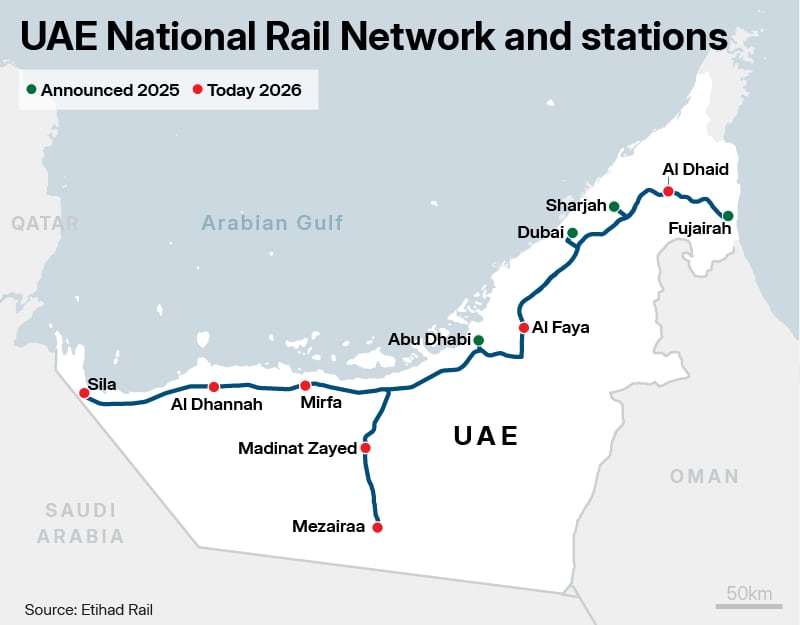
Etihad Rail announced earlier this year that Abu Dhabi, Dubai and Fujairah would be the first locations connected on the network, which after a phased programme will lead to services running to 11 stations.
The trip between the capital and Dubai is expected to take about an hour, and 90 minutes between Dubai and Fujairah. A separate high-speed electrified line between Dubai and Abu Dhabi will offer a journey time of just 30 minutes.
Paul Plummer, professor emeritus at the University of Birmingham in the UK and a former vice chair of the International Railway Research Board, said railways had a more than 200-year history of “enabling cities to grow”. The UAE, he indicated, had been able to develop these connections very deliberately.
On track
“Something you have that’s very interesting is you have the opportunity to plan a new network and connect cities in a planned way,” he said.
Many cities have been given an economic boost from being connected to a railway – and sometimes the uplift starts even before that line is operational.
Prof Plummer said the announcement that Birmingham would be connected to London by a high-speed line – a link not set to open for several years – had triggered “massive investment” in the city.
Another UK example is the planned railway line between Oxford and Cambridge, known as East West Rail.
“You see that whole corridor being developed by merely the announcement that there will be a railway line,” he said.
He said that often new capacity “is used right away” because people realise, for example, that they “can live and work in very different places”.
Railways can spark growth even in cities that already have good road links, he said, especially for the “long-distance business and leisure markets”.

Prof Enoch cautioned that the outcomes of new railway connections could be mixed, because if a city became easier to reach, companies may decide, for example, that they no longer needed a separate base there.
“Sometimes what you see is the external place sometimes actually loses out because it’s easier for people to travel there for the day and come back,” he said.
“ … There’s [also] the argument that if you put in a new railway line you make it more attractive for people to live further from work, which potentially brings economic benefits.”
He said that new rail lines were “positive overall for the country”, but it was not always clear which areas were likely to benefit.
The Etihad Rail service is not the only rail transport network in the UAE under development.
As reported, tunnelling work began on Sunday for the Dubai Metro Blue Line, which is scheduled to open in September 2029, while only last month plans were unveiled for the Gold Line, which is due to open in 2032 and connect to the Red Line, the Green Line and Etihad Rail.

