

As Etihad Rail prepares to launch passenger services later this year, planners and transport experts say the success of the network may depend on how easily passengers can reach the stations.
It will determine how embedded the service becomes in everyday life, they say, particularly in a country where car use is dominant and summer temperatures hit 50°C.
“For most people, the journey is never ‘station-to-station’ but ‘door-to-door’,” said Dr Simona Azzali, associate professor of architecture at Canadian University Dubai and an expert in urban mobility.

“So, even a high-quality rail service can feel inconvenient if the first and last mile are slow, unclear or uncomfortable.”
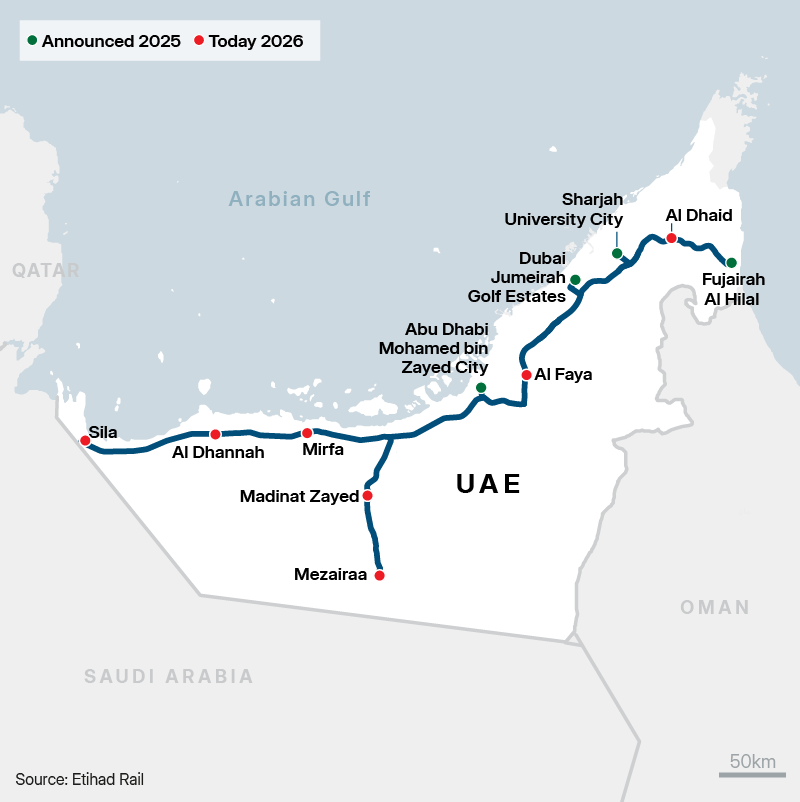
While a precise launch date has not been revealed, Etihad Rail last week said the first routes will connect Abu Dhabi, Dubai and Fujairah on the country’s east coast. The stations at Mohamed bin Zayed City in Abu Dhabi, Jumeirah Golf Estates in Dubai, and Fujairah’s Sakamkam neighbourhood, near the Al Hilal City development, are nearing completion.
Etihad Rail said it is working to link stations to other modes of transport. Azza Al Suwaidi, deputy chief executive of Etihad Rail Mobility, last week emphasised that how people get to the stations is “just as important as the journey itself”.
"We’re exploring integration with existing public transport, taxis and ride-hailing services – including new partnerships, such as our collaboration with Yango Group," she said. "We’re also looking at parking facilities and future connections, as cities continue to grow and evolve."
This focus on practical links is about creating a door-to-door experience for passengers. “The first/last mile will probably be the make-or-break factor, but it’s encouraging that Etihad Rail is already highlighting it and talking openly about practical solutions,” said Dr Azzali.
“Passengers need a single, simple door-to-door experience. If they can plan the trip easily and use one ticket or at least a seamless payment system across train and local transport, transfers feel straightforward and adoption increases.”
The heat is another factor to consider. Dr Azzali said shaded routes, continuous pedestrian paths, and comfortable waiting areas could influence whether people choose public transport. Some measures are already in place in the UAE, such as air-conditioned bus stops. Urban planners often cite Singapore for its use of sheltered paths linking metro and bus stops.
Dr Azzali said people may rely on park-and-ride and taxis during the initial phase of the rail launch but cautioned against this as a long-term solution, so stations do not become congested “car funnels”.
“The real opportunity is to turn stations into well-connected mobility hubs that gradually make leaving the car behind feel easy. What changes behaviour is frequency and coordination,” she said, pointing to how Doha in Qatar supports its metro with feeder buses to close the last mile gap.
“If feeder buses or shuttles are timed with train arrivals and run often enough, the transfer feels effortless. If the connection is missed and waiting time is long, people quickly revert to driving.”
Martin Tillman, a UAE-based transport expert and founder of TMP Consult, said one of the most common misconceptions is that people “don’t like” public transport, when in reality they dislike “friction such as uncertainty, long transfer times and journeys that feel fragmented”.
“When the first and last mile is designed well, rail becomes an obvious and attractive choice. When it isn’t, people revert to private cars, regardless of how good the train itself may be,” said Mr Tillman, who advises governments in the region on transport issues.
Etihad Rail’s passenger services will run on the existing freight network that crosses the UAE. Eleven passenger stations have been announced, with locations chosen based on existing population centres and areas primed for future growth.
-
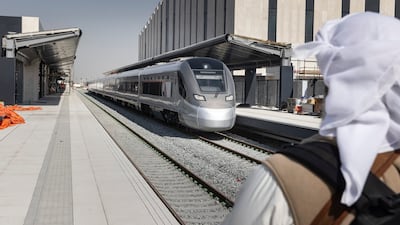
An Etihad Rail passenger train at the Mohamed bin Zayed City station in Abu Dhabi. All photos: Antonie Robertson / The National -
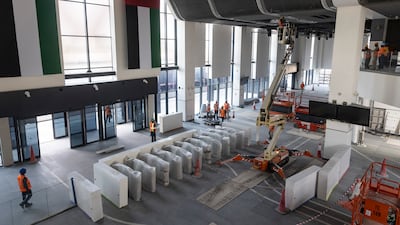
Inside the central concourse of the Mohamed bin Zayed City Etihad Rail station -
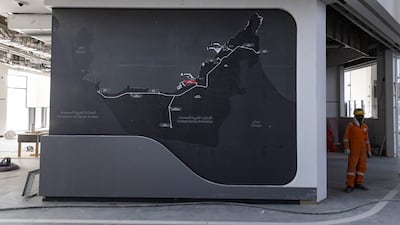
A map of the network at the Mohamed bin Zayed City station -
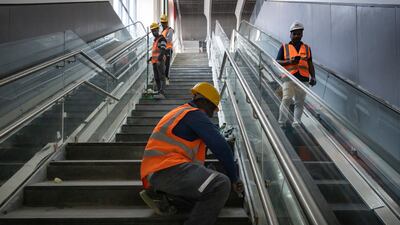
Work is advancing at Mohamed bin Zayed City station to get it ready for the opening -
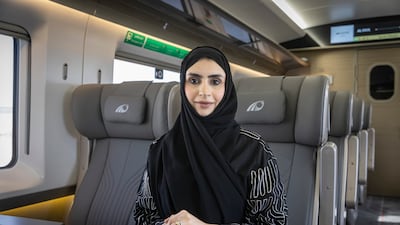
Azza Al Suwaidi, deputy chief executive of Etihad Rail Mobility, said the Mohamed bin Zayed City station is designed to feel open and intuitive, with spacious concourses, clear signage and comfortable waiting areas -
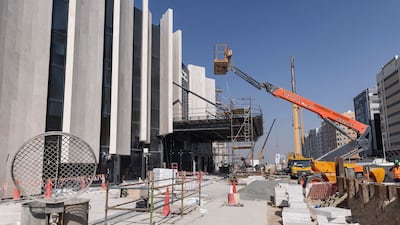
The distinctive exterior of the Mohamed bin Zayed City station -
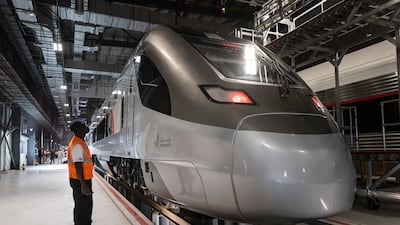
The passenger service is to launch this year -
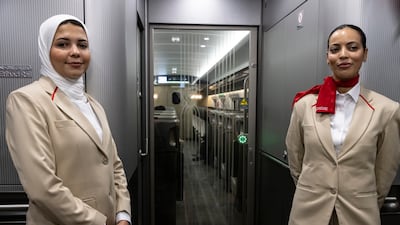
Onboard several seating classes are available such as business class -
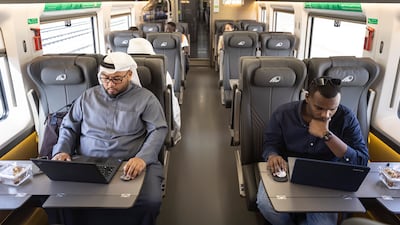
A look at the business class seating onboard -
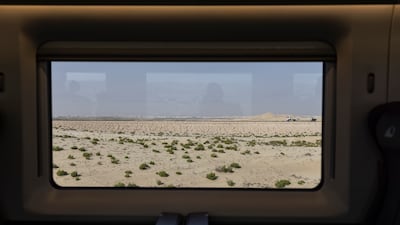
A view from an Etihad Rail passenger train as it travels through Abu Dhabi


The station at Mohamed bin Zayed City, for example, is located in a growing suburb of Abu Dhabi with tens of thousands of residents, along with new housing, schools, and retail outlets.
“Internationally, the most successful rail systems are paired with transit-oriented development – higher-density, mixed-use communities built around stations,” said Mr Tillman, citing the Lohas Park station in Hong Kong’s Mass Transit Railway.
“This is not about density for its own sake but about placing homes, jobs, schools and services within easy reach of rail. Without this integration, stations risk becoming underused assets rather than drivers of economic and social value."
Dr Azzali said early incentives such as introductory fares, feeder-service bundles, employer or student benefits, and well-managed park-and-ride policies could boost ridership.
“Ultimately, it’s a mindset shift,” she said. “People change habits when public transport feels simpler than driving. Not when it feels like a compromise.”
Etihad Rail has yet to announce details on timetables, ticket prices, or booking systems. While passenger projections have varied, it now says it expects 10 million a year once the network is fully operational.
“The trains may define the network,” said Mr Tillman. “But it is the first and last mile that will define whether people actually use it.”

