

A multimillion-dollar drive to safeguard dugongs in the UAE and other threatened species has been unveiled by the Mohamed bin Zayed Species Conservation Fund and Abu Dhabi sovereign wealth fund Mubadala.
As part of the efforts, a UAE Conservation Leaders programme is being launched to support early career conservationists, and the fund is also supporting projects in South-east Asia, with $3 million available in total.
In the UAE, the initiative aims to support grassroots conservation projects. This mirrors the model that the MBZ Fund has operated globally, where over the past 16 years it has offered mostly small grants to a wide range of initiatives to conserve animals, plants, fungi and other threatened species.

“We are open to supporting a diverse set of applicants: students [and] experienced individuals seeking to provide opportunities for hands-on conservation right here in the UAE,” said Razan Al Mubarak, executive managing director of the MBZ Fund.
It will consider projects in areas including conservation strategy, policy and advocacy, applied science and technology, field conservation, storytelling, education, community engagement and nature-based solutions.
“Applicants of all nationalities who are working in the UAE will be invited to participate while priority will be given to those projects that mainly focus on field work,” the fund's statement added.
The selection process will be overseen by a review board of representatives of the MBZ Fund and the Mubadala Foundation. Between six and 10 grants are expected to be awarded each year.
Troubled waters
-
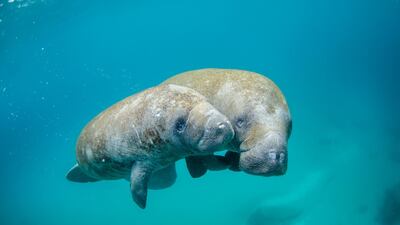
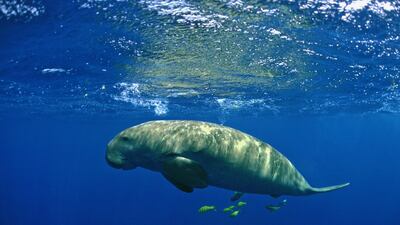
Dugongs and their environment need protection. Photo: Azraq -
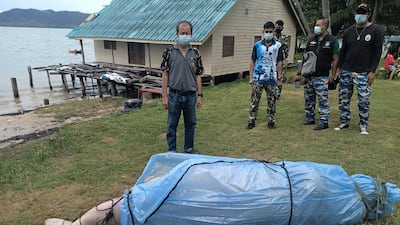
A dugong after it was found dead on a beach at Koh Lanta island, in Krabi province, southern Thailand. The female animal was about three metres long and weighed 300 kilograms. EPA -
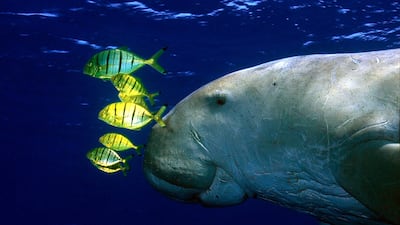
New research by the Zoological Society of London and the Chinese Academy of Sciences has led researchers to declare that one of the ocean's most gentle giants, the dugong, is now functionally extinct in China. PA -
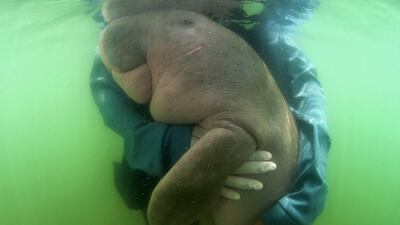
Marium, a baby dugong whose fight for recovery at Phuket Marine Biological Centre in Thailand won hearts and cast a spotlight on ocean conservation, died from an infection aggravated by bits of plastic lining her stomach. AFP -

Dugong skull and mandibles. Victor Besa / The National -
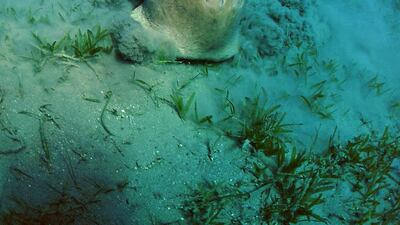
Dugong feed primarily on seagrass, which restricts their habitat to those places where seagrass meadows are found. PA -

Thai Navy rescuers inspect a female dugong found dead on the beach at Koh Lanta island, southern Thailand. EPA -
The dugong has been hunted for thousands of years and its population is fragmented and threatened as a result. PA -
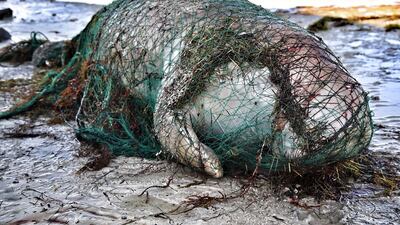
A dead dugong caught in a fisherman's net near Al Rideem, west of Abu Dhabi. Photo: Abu Dhabi Marine Conservation Group -
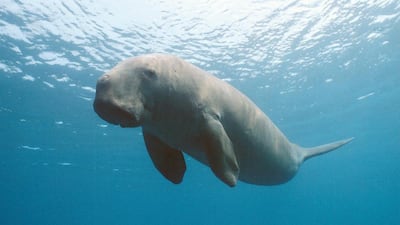
The UAE environment agency's latest report revealed that 17 dugongs died last year, despite being protected under UAE law since 1999. AP -
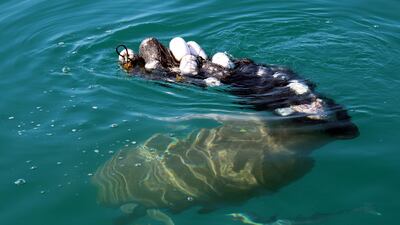
A rare dugong rescued by an Adnoc team after becoming entangled in an illegal fishing net. Photo: Adnoc -
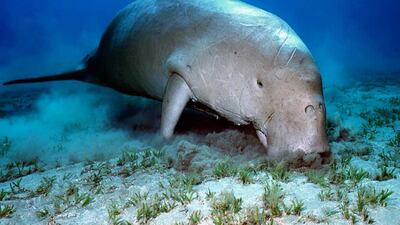
Residents of the UAE want the laws to protect marine species such as the dugong to be strictly enforced. Photo: Environment Agency Abu Dhabi -
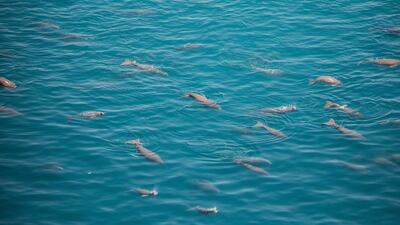
Abu Dhabi has the second-largest dugong population in the world. Photo: Environment Agency Abu Dhabi -
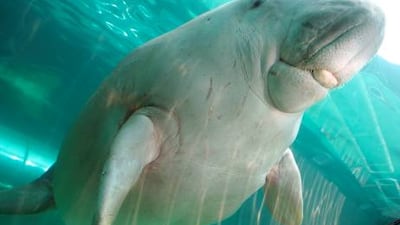
About 2,500 dugongs live off the coast of Abu Dhabi. AFP -
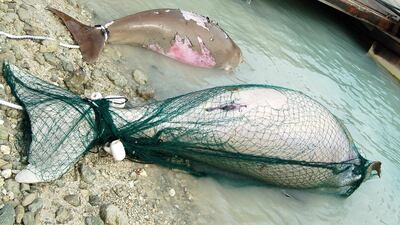
About 80 dugong have been killed by illegal fishing practices in Abu Dhabi over the past four years. Photo: Environment Agency Abu Dhabi -
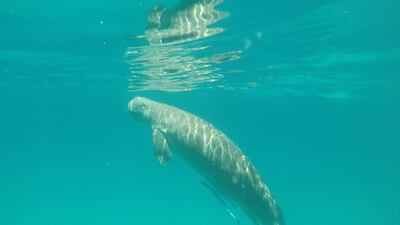
Australia has the world's largest dugong population, but the mammals' low rate of reproduction means the species is vulnerable to extinction. PA


The dugong was declared extinct in China in 2022 in what was described as a “wake-up call” for international efforts to safeguard the gentle marine mammal.
Research by the Zoological Society of London and the Chinese Academy of Sciences said the impact of fishing, ship strikes and habitat loss fuelled by human activity had prompted a decline in numbers, which had been dwindling since the 1970s.
The creature, found in more than 30 countries, including the UAE, is affectionately known as the sea cow because it grazes on ocean seagrass.
It is typically found in coastal waters and is listed as vulnerable by the International Union for Conservation of Nature.
Investing in the future
Homaid Al Shimmari, the deputy group chief executive at Mubadala, said the initiative “underscores our unwavering commitment to nurturing home-grown talent” and developing partnerships to support the environment.
“By empowering young conservationists and investing in the protection of vital species such as the dugong, we are not only preserving biodiversity but also reinforcing the UAE’s position as a global leader in environmental stewardship,” he said.
The initiatives follow the Global Environment Facility’s Dugong and Seagrass Conservation Project, which was led by the MBZ Fund from 2015 to 2019 and involved Indonesia, Malaysia and Timor-Leste. Projects in these three countries, along with Thailand, will benefit from the newly announced drive.
“Beyond species survival, this initiative highlights the role of seagrass as a vital carbon sink and promotes a transformative approach to marine and land resource management,” said Ms Al Mubarak.
As well as strengthening conservation ties between the UAE and other nations, the new initiative will support livelihoods in coastal communities.
A previous three-year partnership between the MBZ Fund and The Mubadala Foundation to support conservation ended in 2024. Ms Al Mubarak said this had been “an incredible journey”.
“Together with our eight partners, we carried out over 300 expeditions across five countries, implementing 11 projects at 63 sites,” she said.
“Local communities gained access to improved health care, education, jobs, eco-tourism, and alternative livelihoods.
“Over this period, we helped expand scientific knowledge of 11 endangered species, raised awareness among thousands of people and supported local communities in important biodiversity hotspots. We are excited and hopeful about the possibilities of our collaboration, including here in the UAE, and abroad.”
Two of the international conservation projects that received funding through the first stage of the partnership will continue to receive support over the next two years.
The first project, in Indonesia, focuses on the Sumatran tiger and small wildcat species. It has already completed one of the most comprehensive camera trap surveys on wildcats in Sumatra.
Another achievement has been the reduction of harmful practices such as snaring, poaching and illegal logging.
In Thailand, the conservation fund and Mubadala have joined forces to bolster work to preserve the Siamese crocodile and two species of otter along the Petchaburi River in the Kaeng Krachan National Park.
In both cases, extending the UAE’s support will allow the local partners to achieve even more ambitious conservation goals, said Ms Al Mubarak.

