

Leaders, philanthropists and health partners in Abu Dhabi on Monday pledged $1.9 billion to help bring the total eradication of polio closer to reality, in what would be a “historic win for humanity”.
It is hoped the move will help protect at least 370 million children from polio every year. It also aims to bolster health systems to prevent youngsters from suffering from other preventable diseases.
The major public health pledge was made at the Investing in Humanity event at Abu Dhabi Finance Week. It was hosted by the UAE's Mohamed bin Zayed Foundation for Humanity in partnership with the Global Polio Eradication Initiative (GPEI), a public-private partnership dedicated to ending polio worldwide.

The total amount includes about $1.2 billion in new funds that will reduce the resource gap for the GPEI's 2022 to 2029 strategy to $440 million and comes at a crucial time with many countries across the world cutting aid budgets.
The event was attended by Sheikh Hamdan bin Mohamed, Vice Chairman of the Mohamed bin Zayed Foundation for Humanity, Ahsan Iqbal Chaudhary, Pakistan's Minister for Planning and Development, Bill Gates, chairman of the Gates Foundation, and Dr Tedros Adhanom Ghebreyesus, director general of the World Health Organisation, alongside leaders from governments, multilateral institutions and the private sector.
Wiping out debilitating disease
-
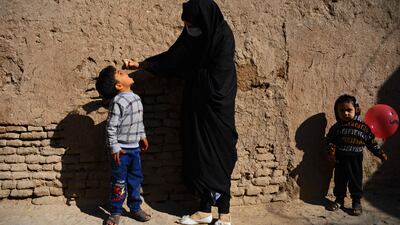
A child receives polio vaccine drops in the western Afghan city of Herat after the UN children's fund said the Taliban agreed to allow the UN to carry out a nationwide campaign. Photo: AFP -
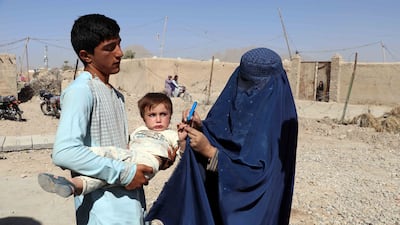
Health workers will go door to door to administer the vaccine drops. Photo: EPA -
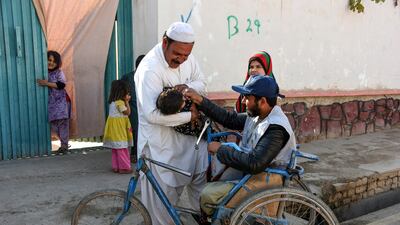
A third of the 10 million children in Afghanistan under the age of 5 have not had access to vaccines in recent years owing to violence and a Taliban ban in areas under their control. Photo: AFP -

Afghanistan and Pakistan are the only two countries where polio is still endemic. Photo: AFP -

Men carry the body of a female polio vaccine worker killed by gunmen in Jalalabad, eastern Afghanistan. Photo: AFP -
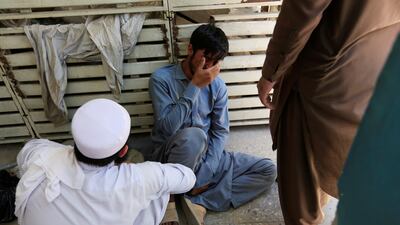
An Afghan mourns the death of his brother, who was one of the health workers shot and killed in Jalalabad. Photo: Reuters -
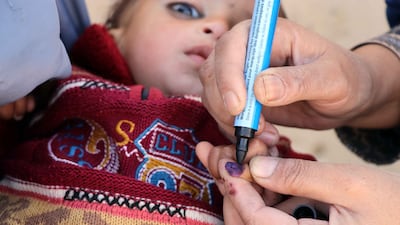
A health worker marks thumb of a child who received the polio vaccine in the southern Afghan city of Kandahar. Photo: EPA -
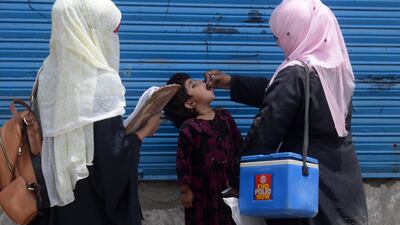
A Pakistani health worker gives the polio vaccine to an Afghan refugee as part of a campaign in Lahore. Photo: AFP


"We are on the cusp of eradicating polio and securing a historic win for humanity,” Dr Tedros said. “But we need all countries, partners and donors to step up now to get the job done. The new support pledged in Abu Dhabi will be instrumental in helping the GPEI reach all children in the final endemic countries and stop variant polio outbreaks around the world."
Polio – a contagious disease for which there is no cure – once affected more than 125 countries around the world and paralysed 1,000 children a day. But the disease has been confronted globally and cases of polio have dropped by 99.9 per cent.
To mark World Polio Day on October 24, global experts said eradication remained on track, despite international aid cuts, renewed conflict and economic pressure, but the threat had not disappeared.
Wild poliovirus is endemic in only two countries – Afghanistan and Pakistan – but outbreaks still threaten children there and around the world. Polio resurfaced in 2024 in Gaza and left a 10-month-old child paralysed, in what was the first reported case there in 25 years.

Authorities in Hamburg, Germany in November found the virus during wastewater testing. It was linked to a strain in Afghanistan but it showed how the disease can spread despite it being viewed as a disease of the past.
Safe and effective vaccines remain the best defence against polio.
Pledges on Monday included $1.2 billion from the Gates Foundation; $140 million from the Mohamed bin Zayed Foundation for Humanity; $450 million from Rotary International; $100 million from Bloomberg Philanthropies; $154 million from Pakistan; $62 million from Germany; $46 million from the US; $6 million from Japan; $4 million from the Islamic Food and Nutrition Council of America; and $3 million from Luxembourg.
UAE role in global health quest
UAE President Sheikh Mohamed is a leader in polio eradication, committing $525 million since 2011 and bringing global resources and attention to the cause.
The Emirates Polio Campaign has distributed more than 850 million vaccine doses to children across Pakistan since 2014.
“Today's pledges demonstrate our shared determination to end polio and protect every child from this preventable disease,” said Sheikha Mariam bint Mohamed, chairwoman of the Mohamed bin Zayed Foundation for Humanity.
“Decades of progress has proved that a polio-free world is within our reach when we act together. Under the guidance of His Highness Sheikh Mohamed bin Zayed Al Nahyan, we are proud to stand with countries, donors and partners as we work hand-in-hand to achieve it.”
Success in the venture would make polio only the second human disease to be wiped out – after smallpox, which was declared eradicated in 1980 – and could save the world more than $33 billion by 2100.
“The fight to end polio shows what is possible when the world invests together in a shared goal. We're 99.9 per cent of the way there – but the last stretch demands the same determination that got us this far,” Mr Gates said. “This renewed funding will help us cross the finish line and strengthen the systems that protect children from this terrible disease for good.”
The pledge comes at a challenging time for global aid. The Organisation for Economic Co-operation and Development, for example, has predicted that total overseas aid will drop between 9 and 17 per cent in 2025.
Tala Al Ramahi, a representative from the Mohamed bin Zayed Foundation for Humanity, told The National the pledge was “incredibly significant” given changed financial landscape.
"For us to convene here during Abu Dhabi Finance Week to secure $1.9 billion in pledges for polio eradication is incredibly important for us to continue building on the momentum we've achieved over the last few decades when it comes to polio eradication," she added.
Ms Al Ramahi said the world was "so close to the finish line" in eradicating the disease, but it now "requires a lot of patience", as well as the capital "to be able get the job done".
She said it was crucial to work with community and religious leaders to boost the vaccination rate in areas where people are living “off the grid”.
“Many of them do not have access to primary healthcare systems, as well as other basic services," she said. "And so that is why the last ... mile of disease eradication or elimination is very difficult. We have to reach every single child.”
Michael Bloomberg, founder of Bloomberg Philanthropies and the WHO's global ambassador for noncommunicable diseases and injuries, said a “monumental achievement” to eradicate polio was now within striking distance.
“This new $100 million in support for the Global Polio Eradication Initiative and our partners around the world will help us get there – and help spare more people from the terrible effects of this disease," he added.
While huge progress has been made globally, wild polio has paralysed 39 children in Pakistan and Afghanistan this year while outbreaks of variant poliovirus continue in 18 countries.
Unicef executive director Catherine Russell said the pledges in Abu Dhabi would help health workers to reach children in countries affected by conflict and turmoil, where access to vaccines can be limited. “Unicef is committed to play our part in eradicating polio once and for all," she added.
Dr Sania Nishtar, chief executive of Gavi, the Vaccine Alliance, said decades of global co-operation, including the convening power of the UAE, helped to bring the world closer than ever before to ending polio. “As we continue to work innovatively towards this shared goal, this new funding gives us renewed confidence that one day soon we can achieve a polio-free future for all children,” she said.
The pledge came on the first day of Abu Dhabi Finance Week - an event set to draw 5,000 financial companies from 100 countries.
Ms Al Ramahi said it was important for the pledge to be made at the event because philanthropy alone could not solve global health challenges.
“We need the innovation of the private sector," she said. "Having a different type of audience at the table in the room, and hoping that they become part of the solution, is really important for us as a foundation. And also for the work of many of the other foundations that were in the room and have committed to this work.”
The pledging event on Monday, meanwhile, is the third hosted by Abu Dhabi. Events in 2013 and 2019 raised $6.6 billion for GPEI’s work to eradicate polio.
It came on the same day the the Mohamed bin Zayed Foundation for Humanity and the Gates Foundation co-hosted the Goalkeepers Abu Dhabi event. It aims to shine the spotlight on underfunded yet solvable challenges, particularly those affecting mothers, newborns and children.

