

A species of ant previously unknown to science has been discovered in the Hajar Mountains – and it has been named in honour of Sharjah.
While finding new species is not necessarily unusual, the name of the new ant makes it stand out and emphasises the link to the place where it was found.
The discovery has been accompanied by a call for the area where the creature was found to be protected to ensure that the species can survive amid rapid development.

Resembling a related ant first found in Zimbabwe more than 70 years ago, the new species was discovered in the Wadi Shees area in Sharjah emirate.
In a study published this month in the Journal of Natural History, the scientist who identified the creature, Prof Mostafa Sharaf of the Sharjah Environment and Protected Areas Authority, has named it Carebara sharjahensis.
“The most stringent environmental conservation measures should be implemented in its locality in the Hajar Mountains to protect the new species from habitat loss due to anthropogenic activity,” he said in the paper.
Prof Sharaf is an ant expert or myrmecologist who has previously identified other new species in the region, including in Oman and Saudi Arabia.
The new species is most similar, he said in the paper, to a Carebara khamiensis, which was discovered in Zimbabwe and first described by a scientist in 1952. Globally, nearly 14,000 ant species have been identified, but researchers think that the total number is much higher, at about 22,000.

The Hajar Mountains are one of the most nature-rich areas of the UAE and home to numerous species that are endemic, meaning that they are not found anywhere else. These include reptiles, such as geckos, and mammals, notably the Arabian tahr, a wild goat.
Gary Feulner, who chairs Dubai Natural History Group and who has published many scientific papers on the UAE’s flora and fauna, said that it was to be expected that a dedicated survey for ants of mountain areas, or most other locations in the country, would yield species that had not previously been found in the Emirates. However, he said that species that were also new to science were more exceptional.
“To determine the significance of any individual discovery, additional work also needs to be done to assess the range, abundance, habitat, etc, of the species in question, as well as whether they are native species, or exotics introduced with agriculture in past centuries, or by landscaping or otherwise in the modern era,” he said.
Under the microscope
The classification of ants, known as their taxonomy, is “notoriously painstaking”, as it also is for spiders and scorpions, Mr Feulner said.
Identifying species requires, he said, high-powered microscopes and the examination of features such as pitting in particular areas of the insect’s rigid external covering or exoskeleton. He said that genetic studies may also be carried out.
Among the features distinguishing the newly identified species are frontal carinae or crests that are “shallowly developed”, the paper states, and “well-developed” hornlike appendages on the head fringed with hairs called setae.
Recognising ant genera – the next category up from species in the scientific classification of organisms – is often more straightforward, being based on more fundamental anatomical features.
“The major difficulty lies in the fact that unlike most vertebrate genera, ant and spider genera may include dozens or even hundreds of species within each genus, with only very arcane differences between them,” Mr Feulner added.
Single specimen
The new species was identified by just a single specimen, a soldier ant – a type of worker ant that is typically larger in size. Although ideally several specimens would be analysed to identify a new species, numerous other species have been identified by just one individual. The paper has gone through a peer-review process, which involves analysis by other scientists.
Walter Tschinkel, emeritus distinguished professor at Florida State University and the author of The Fire Ants and Ant Architecture, the first of which was nominated for a Pulitzer Prize, told The National that the ant fauna of the Arabian Peninsula appeared not to have been as well characterised than that of some other parts of the world.
There are, he said, about 230 species of the Carebaragenus and they are distributed worldwide. “It clearly occupies a range of ecological niches. With 230 species that’s got to be true,” he said. “The world of ants is typically very local. There are some ants that have very wide distribution, but that’s not the norm.”
He said ants were often “keystone species” in ecosystems and tended to be dominant in terms of abundance and total biomass. A study by a colleague found that they made up 80 per cent of the animal biomass in or on the soil.
“Whatever energy they accumulate from their diet, usually things that are smaller than ants but not necessarily, is then available to higher levels of the ecosystem,” he said. “Ants are often the most abundant insect-level predators and scavengers and they in turn can be important food for birds, lizards and other larger insects, and so on.”
UAE wildlife programmes – in pictures
-
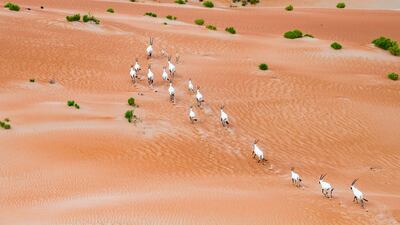
The largest population of Arabian oryx now lives in protected areas in the UAE after previously being listed as extinct in the wild. All photos: Environment Agency - Abu Dhabi -
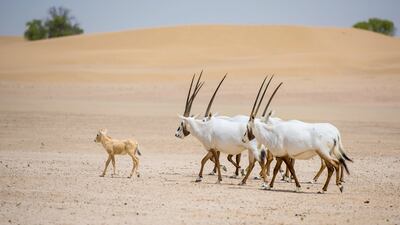
Arabian oryx were reclassified as vulnerable by the International Union for the Conservation of Nature in December 2023 -
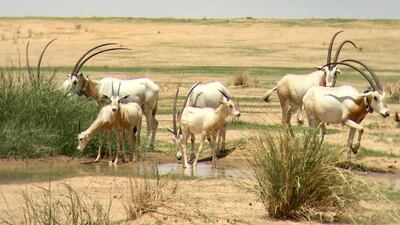
Environment Agency - Abu Dhabi has also spearheaded a repopulation programme for scimitar-horned oryx -
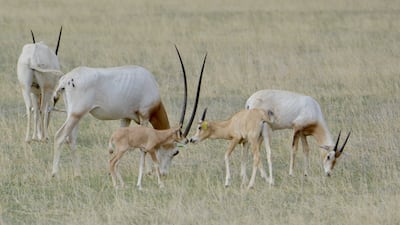
Scimitar-horned oryx calves with their mothers in Chad -
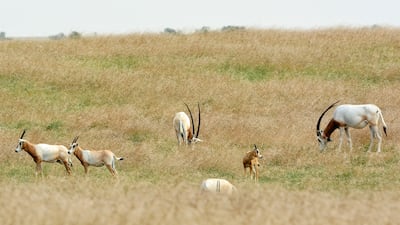
The Sahelian plains of Chad are now home to more than 600 scimitar-horned oryx -

The agency released six Dama gazelles into a wildlife reserve in Chad in May 2024 -
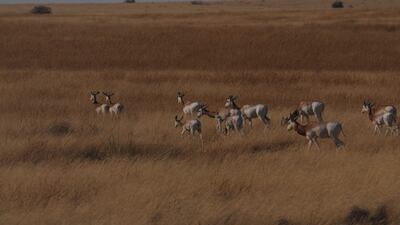
The Dama gazelle is classified as critically endangered -
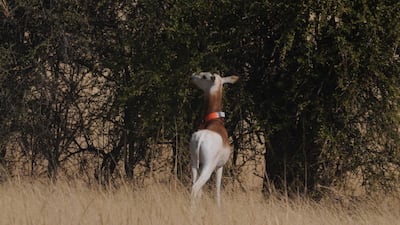
Three of the gazelles are equipped with satellite tracking devices, so the team can monitor the animals’ progress in the reserve -

The agency has also helped repopulate the addax antelope in Chad -
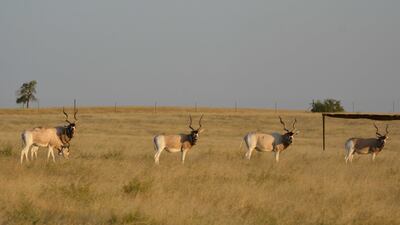
The addax, also known as the white antelope, is native to the Sahara -

The addax is classified as critically endangered



