

A new “mini-city” near Abu Dhabi that will include hotels, a shopping mall and thousands of homes has been welcomed as a sign of the UAE’s continued determination to grow economically.
The centrepiece of the project – a 278,700 square metre shopping mall described as one of the largest in the region – will complement the capital’s world-class cultural offerings, attract tourists and offer an alternative to Dubai’s mega malls, according to analysts.
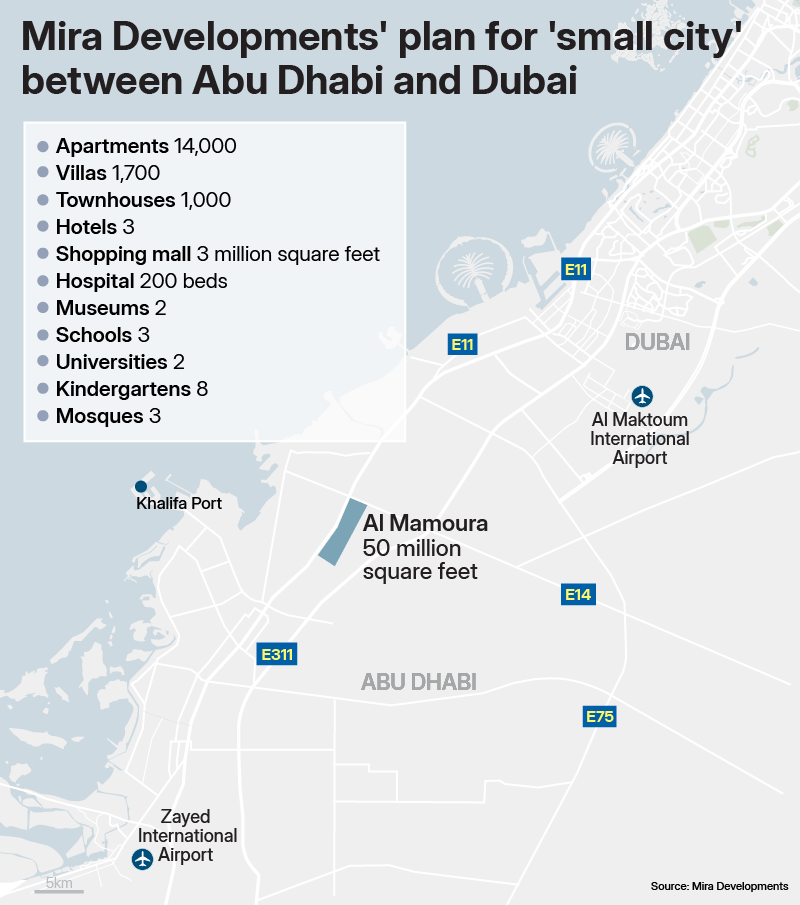
As reported in The National, the project, worth an estimated Dh55 billion ($15 billion), will be off the Abu Dhabi – Dubai motorway in Al Mamoura district.

The land is part of the 16 sq km Town Centre Area of AD Ports Group, which has signed a Dh2.47 billion ($670 million) land deal with Mira Developments, which plans to build three hotels, 1,000 townhouses, 1,700 villas and 14,000 apartments.
There will also be a 200-bed hospital, three mosques, eight kindergartens, three schools, two museums and two universities.
Dr Martin Hvidt, an associate professor in the Centre for Modern Middle East and Muslim Studies at the University of Southern Denmark, indicated that there was likely to be particular demand for growth in retail outlets in the Abu Dhabi area.
“There’s been a lot of housing located there,” he said. “The airport is being built tremendously big and you have a lot of settlements, new housing, in that area. I guess there will be room for another large mall in that area because of that population.”
Abu Dhabi’s investments in important museums and other cultural institutions – among them Louvre Abu Dhabi, Zayed National Museum and Guggenheim Abu Dhabi – highlighted, Dr Hvidt suggested, that the emirate’s authorities “want to boost their reputation as a place to visit”.
Meeting demand
However, he said that alongside these centres there was demand for more facilities in “the leisure, domestic sector”, which would be fulfilled by the new shopping mall. “So far you go to Abu Dhabi for these museums, then you shop in Dubai,” Dr Hvidt said. “Maybe they want a larger piece of this cake so tourists and foreigners stay and spend their money in Abu Dhabi.”
Dr Hvidt, a former professor at Zayed University in the UAE, said that the growth in retail was “a logical development” for the UAE, given the significant population increases of recent years. “This idea of boosting the retail sector follows [the fact] that so many more people will be serviced by the retail sector in the country,” he said.
Growing population
Population growth in the UAE continues apace, with Abu Dhabi announcing in late June that it had reached the four million mark, while Dubai crossed the same milestone two months later.
The announcement of the project comes as Abu Dhabi is upgrading its transport infrastructure, with a tram network set to operate from Yas Island to Zayed International Airport.
The new development, between Zayed International Airport and Al Maktoum International Airport, is one of a flurry of schemes from Mira Developments in Dubai, Ras Al Khaimah, Salalah in Oman and Tbilisi in Georgia.
-
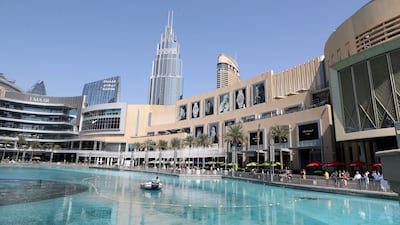
The flagship Dubai Mall remains a huge visitor attraction for tourists and residents alike. Chris Whiteoak / The National -
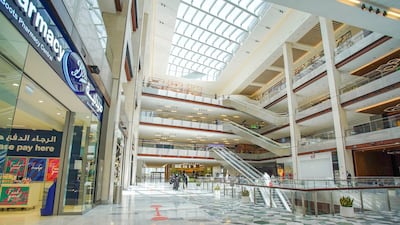
The Galleria Al Maryah Island, in Abu Dhabi, delivers an upscale shopping experience. Photo: Galleria Mall / Edelman PR -

The vast Dubai Mall offers hours of retail therapy. Chris Whiteoak / The National -

A young boy looks at the waterfall in Dubai Mall, Dubai. Chris Whiteoak / The National -

Snow Abu Dhabi at Reem Mall is an example of how shopping centres have diversified in order to draw in the crowds. Victor Besa / The National -

Ramadan decorations at Mall of the Emirates in Dubai. Malls are a popular meeting place during holidays and religious festivals. Pawan Singh / The National -
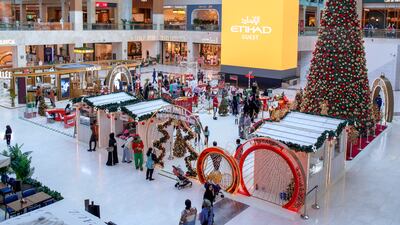
Winter Wonderland at Town Square, Yas Mall in Abu Dhabi. Victor Besa / The National -

View of the NBA store at Yas Mall in Abu Dhabi. Pawan Singh / The National -

Customers queue up early at an Apple Store opening at Yas Mall. Victor Besa / The National. -

A parent-and-child yoga session at The Galleria mall in Abu Dhabi. Photo: Galleria Mall -

Festive decorations at Galleria Mall, Abu Dhabi. Khushnum Bhandari / The National -

Players have fun at the virtual reality entertainment venue, Zero Latency at Abu Dhabi's Galleria Mall. Khushnum Bhandari / The National -

Friends gather at Dubai's Mercato Mall. Antonie Robertson / The National -

Ramadan celebrations at the Carrefour store at Ibn Battuta mall in Dubai. Pawan Singh / The National -

Carpets on display at the Kani Home shop at Ibn Battuta mall in Dubai. Pawan Singh / The National -
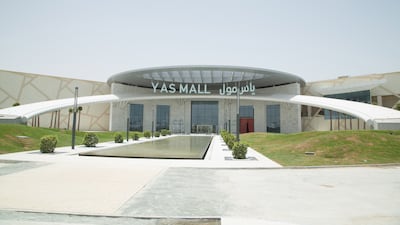
Main entrance of Yas Mall in Abu Dhabi. Photo: Yas Mall -
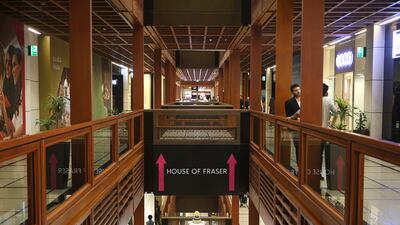
World Trade Centre Mall in Abu-Dhabi. Ravindranath K / The National -

RAK Mall in Ras Al Khaimah. Ruel Pableo / The National -

Al Hamra Mall in Al Hamra Village, Ras Al Khaimah. Photo: Al Hamra Mall -

The Fujairah City Centre shopping mall opened its doors for the first time back in 2012. The National


David Macadam, chief executive of the Middle East Council of Shopping Centres and Retailers, described the continued expansion of the UAE’s retail offer as “a very good thing”.
“There’s a lot of new developments coming on with respect to retail because the population growth is carrying on dramatically, not only in Dubai, but also Abu Dhabi,” he said.
“Part of that is tourism-driven and part of that is for the residents, who need more opportunities for places to shop. It’s part of the plan to keep things growing and moving. It’s a very good thing.
“In Abu Dhabi the residential real-estate market has been growing dramatically, the tourism growth – Abu Dhabi airports and Etihad, hotel growth has been very dramatic as well. Between houses and retail and population growth, it’s part of what needs to happen.”
Dr David Roberts, the author of Security Politics in the Gulf Monarchies and a reader in international security and Middle East studies at King’s College London, indicated that across the Gulf region the authorities were keen for development to continue.
“There’s this feeling for a need for consistent development to have some competitive edge when it comes to brand. Think of it as state branding,” he said.
While the new scheme will offer home for thousands of residents, Dr Roberts highlighted the importance that new schemes have in strengthening tourism, which he said was a key part of the economic diversification strategy of the Gulf states, as they look to reduce their dependence on oil and gas. He cautioned, however, that diversification, was “fiendishly difficult” to achieve.
“There’s this consistent desire to have new elements,” he said. “The economic diversification imperative is very strong … diversification has been the name of the game for a very long time.”
As some other regions of the world struggle with modest growth, Dr Roberts said that the Gulf region was still performing well.“The US, broadly speaking, is looking a bit shaky with the current government. Europe, there’s decline. The Gulf feels there’s enough rich people, for want of a better term, to attract to the region,” he said.
He cited the recent decision by Nik Storonsky, the billionaire co-founder and chief executive of the online bank Revolut, to move to Dubai, as a further indication of the positive economic sentiment linked to the Gulf.

