

Elite Formula One drivers from around the world will be gearing up for glory at the 17th annual Abu Dhabi Grand Prix on Yas Island in December.
The now traditional finale to the high-octane racing calendar is a proud UAE success story – but you might be surprised to learn Lewis Hamilton and Lando Norris are not alone in supplying British grit to go with the glitz and glamour.
A key ingredient in the sporting spectacle's road to success is greywacke, a sandstone rock noted for its hardness, which was laid down up to 600 million years ago as the Earth was forming.
The name originates from Germany, where it comprises a significant portion of the northern Harz Mountains.
Deposits are found across northern Europe, especially Britain, where it is used as a building material, in New Zealand’s Southern Alps and in Egypt, where it was once used to carve 3,000-year pharaonic statues.
Paving the way

So how, then, did thousands of tonnes end up on Abu Dhabi’s Yas Island?
The answer can be found near the village of Bayson Hill, on the outskirts of the medieval county town of Shrewsbury in England. Under the Shropshire Hills is a large deposit of greywacke rocks, extracted and sold as gritstone by Tarmac, the company which owns the quarry.
Gritstone has been dug up here since the 18th century, but its use has considerably increased since the advent of the car. Mixed with tarmac, it creates a remarkably durable road surface, especially where there is high traffic, such as on motorways. And this is where Abu Dhabi comes in.
Back in January 2007, and in front of an enthusiastic crowd, it was announced that Abu Dhabi would now host a Formula One Grand Prix. The first race would be held at the end of 2009 at a new Yas Marina Circuit. There was only one small hitch ... the race track did not exist.
The story of how a Formula One circuit was built in just over two years is one of the marvels of modern construction and planning. There could have been no delays, for the race was already in the Grand Prix calendar.
Designed by the New York-based Egyptian architect Hani Rashid and Lise Anne Couture of Asymptote Architecture. it featured a hotel that formed a bridge over the race and innovative lighting to ensure the race would finish after dark.
The track was the work of Hermann Tilke, a German engineer and designer responsible for the Bahrain and Shanghai circuits, among many others. And the whole thing was built on an island made of sand.
The stability of the actual track, then, was crucial. And for that they turned to the gold standard of durability: Shropshire greywacke.
An order was placed for 4,000 tonnes of “conglomerate” stone, with small pieces of greywacke unsuitable for building but excellent for other uses such as roads. Each piece was graded in industrial sieves to ensure it was a standard 11mm – about the size of a blueberry.
Once dug up, it was transported first in lorryloads of one-tonne bags and then by sea to Abu Dhabi, where it arrived in January 2009, only 10 months before the inaugural race. Laid down in time, it has now survived 16 races, winning praise from racing drivers for its excellent grip, as has the Bahrain circuit, which uses the same stone.
But when you have lasted 600 million years, what difference does the extra decade and a half make?
Abu Dhabi Grand Prix 2024 - in pictures
-
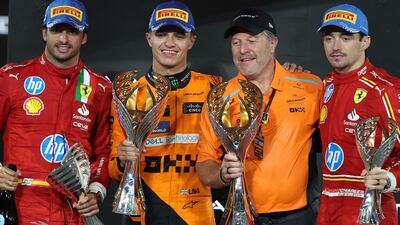
The winners' podium, from left, Ferrari driver Carlos Sainz, McLaren driver Lando Norris, McLaren CEO Zak Brown and Ferrari driver Charles Leclerc. All pictures by Chris Whiteoak / The National -
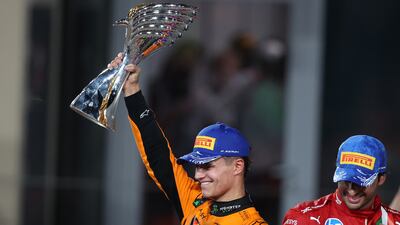
McLaren driver Lando Norris wins the Abu Dhabi Grand Prix at Yas Marina Circuit. -

McLaren CEO Zak Brown lifts the constructors' trophy in the F1 at Yas Marina Circuit after the Abu Dhabi Grand Prix. -

The drivers line up for the race at Yas Marina Circuit. -
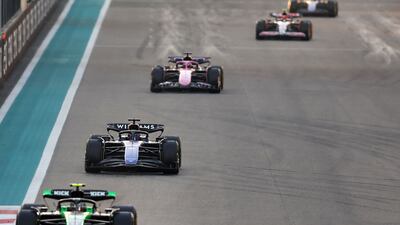
Action on the track at the Abu Dhabi GP. -

Aston Martin driver Fernando Alonso during the Abu Dhabi Grand Prix. -
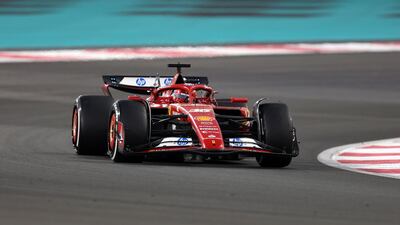
Ferrari driver Charles Leclerc during the Abu Dhabi Grand Prix. -
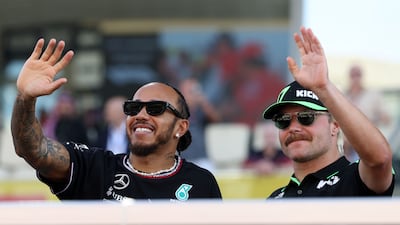
Mercedes driver Lewis Hamilton and Kick Sauber driver Valtteri Bottas during the drivers' parade. -
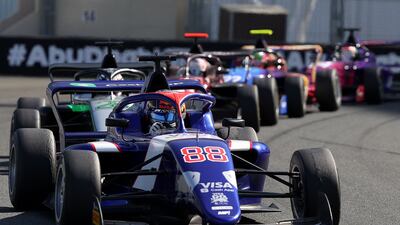
Amna Al Qubaisi competes in the F1 Academy race at Yas Marina Circuit. -

Mercedes driver George Russell arrives at the Yas Marina Circuit. -
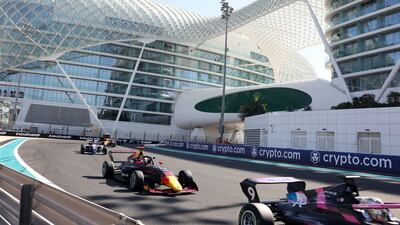
Hamda Al Qubaisi competes in the F1 Academy race. -
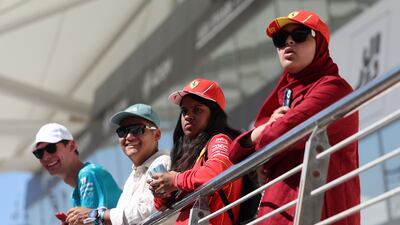
Fans watch the racing at Yas Marina Circuit. -

French-Algerian driver Isack Hadjar during the Formula 2 race at Yas Marina Circuit. -

Fans watch the racing at the Abu Dhabi Grand Prix. -

Isack Hadjar in the Formula 2 race. -

Mercedes drivers Lewis Hamilton and George Russell take part in a pre-race photo call at the Abu Dhabi Grand Prix. -
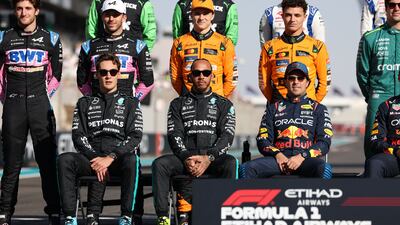
Drivers line up for a pre-race photo at the Abu Dhabi Grand Prix. -
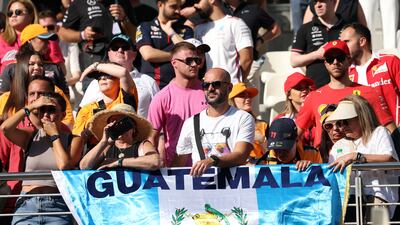
Fans watch the racing at the Abu Dhabi Grand Prix. -
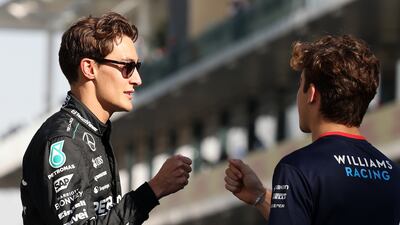
Mercedes driver George Russell fist bumps Williams driver Franco Colapinto. -
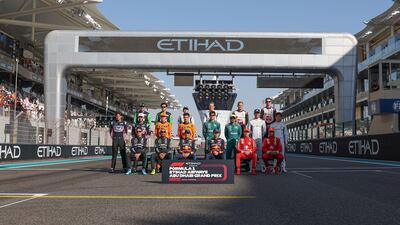
Drivers take part in a photo on the track at the Abu Dhabi Grand Prix. -
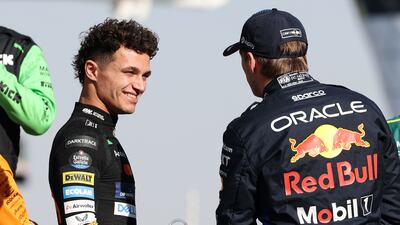
McLaren driver Lando Norris chats with Red Bull Racing driver Max Verstappen. -

Red Bull Racing driver Sergio Perez. -
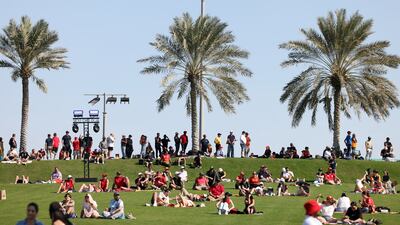
Fans watch the racing at the Abu Dhabi Grand Prix.



