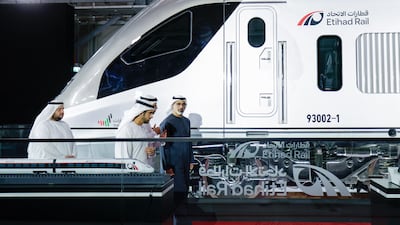
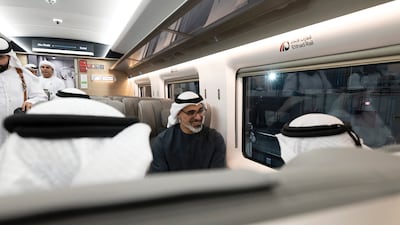
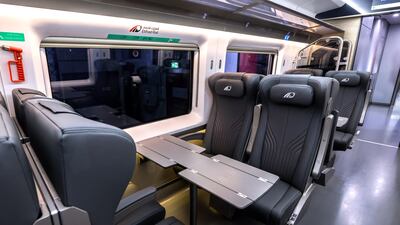
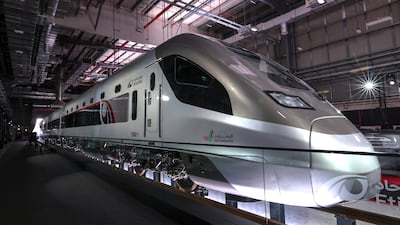
The recent trip by Sheikh Mohammed bin Rashid, Vice President and Ruler of Dubai, on an Etihad Rail service between Dubai and Fujairah represented another step forward for the UAE’s public transport infrastructure.
Services on the nationwide rail network are set to begin next year, but Etihad Rail has another, potentially more exciting, scheme in the works.
The 350kph electric high-speed line between Dubai and Abu Dhabi was announced in January. The high-speed rail service aims to cut travel times between Abu Dhabi and Dubai to 30 minutes.
While no launch date has been revealed, experts believe the project could revolutionise the UAE's economy, its environment and where its people will live. Six stations are to be built in the first phase, including Abu Dhabi’s islands, the city airports and Dubai Creek.
High-speed rail has had a chequered history in other parts of the world, with some projects suffering delays, cost overruns and cutbacks, but analysts believe the UAE is ideally placed to roll out the technology, with the geography, absence of planning bottlenecks and even climate expected to keep the project on track.
Dr Alexander Wray, a transport researcher at Western University in Canada, said the scheme meets the first prerequisite for successful high-speed rail: connecting major population centres.
“From the UAE’s perspective, it’s an ideal rail-building environment,” he explained. “It’s relatively flat, relatively stable ground, once you get below the sand, and it’s in a reliable weather environment. Yes, it’s hot, but you’re not dealing with the ice and corrosion that you typically would deal with in some of the other climates of the world.”
He believes the nature of the development that has already taken place in the area will make it easier to install high-speed rail. “The Abu Dhabi and Dubai region has been inhabited for millennia, but there’s not much urban fabric between the two that you’re having to deal with, in comparison to a lot of European cities where there’s an historical preservation issue or complex topography,” he said.
“If you look at the motorway corridors in the UAE, they’re quite wide to enable future infrastructure investment. They’re built after the American interstate model of motorway corridors that provision sufficient space to travel between cities.”
Why projects can hit the buffers
Some other high-speed rail projects have faced headwinds because the natural or built environment is less conducive to installing a long, straight railway line.
The UK’s struggles with HS2, originally due to run from London to Manchester and Leeds in the north of England, illustrate the problems.
Planning issues and the heavy cost of building tunnels and other features to reduce the environmental impact of the line have led to delays and cost spirals to the extent that the project has been cut back and will now only run between London and Birmingham. Lengthy consultations with affected residents have also caused delays.
There are high-speed rail services in fewer than 30 countries, just over half of them in Europe, where the networks in France, Germany, Italy and Spain are among the most notable. Morocco has a high-speed line between Tangier and Casablanca, while Japan, South Korea, Indonesia and Uzbekistan are among the Asian nations with high-speed rail.
All these networks are dwarfed by China, which has more than 45,000km of high-speed rail, according to the Organisation for Research on China and Asia, and is continuing to expand.
Ambitious transport vision
Algeria, Egypt, India and Thailand are among the other nations that are developing high-speed rail projects.
The Abu Dhabi–Dubai high-speed line will not be the first in the Gulf region.
Saudi Arabia opened its Haramain High-Speed Railway, which covers 450km between Makkah and Madinah, in 2018. Trains travel at speeds up to 300kph and the journey time is about two-and-a-half hours.
Many of the selling points used to market that service will also apply to the Abu Dhabi–Dubai line: a shorter journey time, no heavy traffic, a cool and comfortable experience, high safety standards and reduced carbon emissions compared to driving.
While constructing high-speed rail can have a significant carbon footprint, particularly because large amounts of concrete are used, once built it is considered a more environmentally-friendly way of travelling.
There will be stations on the electrified Abu Dhabi–Dubai line at Jaddaf, close to Dubai Creek; Al Maktoum Airport in Dubai; Zayed Airport; Saadiyat Island; Yas Island and Reem Island.
Boosting connectivity
Prof Jon Shaw, a transport researcher at the University of Plymouth in the UK, believes the high-speed service “will be reliable and won’t be subject to traffic congestion”.
“If you can go from a meeting in Dubai to a meeting in Abu Dhabi and can do that in 35 minutes, you have got the two centres effectively functioning as one space,” he said.
High-speed rail means, he said, “more journeys per day and quicker journeys”, although he cautioned that additional stops on the line could compromise the speed objective.
Having a train that is incredibly fast is not just about getting people from one place to another quickly – it can also be about showcasing a nation’s prowess. This explains why, for example, China has a maglev or magnetic levitation train from a Shanghai airport to the city capable of more than 400kph, and why Japan’s high-speed network is fabled for its high speeds and reliability.
“It becomes a source of national pride,” Dr Wray added. “I can see in the UAE this being almost a marketing piece for tourism or for global business and brand recognition. It’s those things that drive a lot of the high-speed rail conversation.”
Dr Wray said the line could spark further global investment and confidence in the UAE, with more employees able to work in one city and live in the other.
“That tends to breed corporate confidence,” he said. “If we look at the Japanese example of high-speed rail, it’s been a catalyst for new development. In the section north of Tokyo, communities have popped up. They’re almost like high-speed rail suburbs.”

Mercer, the investment consulting arm of US services company Marsh & McLennan, expects its wealth division to at least double its assets under management (AUM) in the Middle East as wealth in the region continues to grow despite economic headwinds, a company official said.
Mercer Wealth, which globally has $160 billion in AUM, plans to boost its AUM in the region to $2-$3bn in the next 2-3 years from the present $1bn, said Yasir AbuShaban, a Dubai-based principal with Mercer Wealth.
“Within the next two to three years, we are looking at reaching $2 to $3 billion as a conservative estimate and we do see an opportunity to do so,” said Mr AbuShaban.
Mercer does not directly make investments, but allocates clients’ money they have discretion to, to professional asset managers. They also provide advice to clients.
“We have buying power. We can negotiate on their (client’s) behalf with asset managers to provide them lower fees than they otherwise would have to get on their own,” he added.
Mercer Wealth’s clients include sovereign wealth funds, family offices, and insurance companies among others.
From its office in Dubai, Mercer also looks after Africa, India and Turkey, where they also see opportunity for growth.
Wealth creation in Middle East and Africa (MEA) grew 8.5 per cent to $8.1 trillion last year from $7.5tn in 2015, higher than last year’s global average of 6 per cent and the second-highest growth in a region after Asia-Pacific which grew 9.9 per cent, according to consultancy Boston Consulting Group (BCG). In the region, where wealth grew just 1.9 per cent in 2015 compared with 2014, a pickup in oil prices has helped in wealth generation.
BCG is forecasting MEA wealth will rise to $12tn by 2021, growing at an annual average of 8 per cent.
Drivers of wealth generation in the region will be split evenly between new wealth creation and growth of performance of existing assets, according to BCG.
Another general trend in the region is clients’ looking for a comprehensive approach to investing, according to Mr AbuShaban.
“Institutional investors or some of the families are seeing a slowdown in the available capital they have to invest and in that sense they are looking at optimizing the way they manage their portfolios and making sure they are not investing haphazardly and different parts of their investment are working together,” said Mr AbuShaban.
Some clients also have a higher appetite for risk, given the low interest-rate environment that does not provide enough yield for some institutional investors. These clients are keen to invest in illiquid assets, such as private equity and infrastructure.
“What we have seen is a desire for higher returns in what has been a low-return environment specifically in various fixed income or bonds,” he said.
“In this environment, we have seen a de facto increase in the risk that clients are taking in things like illiquid investments, private equity investments, infrastructure and private debt, those kind of investments were higher illiquidity results in incrementally higher returns.”
The Abu Dhabi Investment Authority, one of the largest sovereign wealth funds, said in its 2016 report that has gradually increased its exposure in direct private equity and private credit transactions, mainly in Asian markets and especially in China and India. The authority’s private equity department focused on structured equities owing to “their defensive characteristics.”
SPEC%20SHEET%3A%20APPLE%20IPHONE%2015%20PRO%20MAX
%3Cp%3E%3Cstrong%3EDisplay%3A%3C%2Fstrong%3E%206.7%22%20Super%20Retina%20XDR%20OLED%2C%202796%20x%201290%2C%20460ppi%2C%20120Hz%2C%202000%20nits%20max%2C%20HDR%2C%20True%20Tone%2C%20P3%2C%20always-on%3C%2Fp%3E%0A%3Cp%3E%3Cstrong%3EProcessor%3A%3C%2Fstrong%3E%20A17%20Pro%2C%206-core%20CPU%2C%206-core%20GPU%2C%2016-core%20Neural%20Engine%3C%2Fp%3E%0A%3Cp%3E%3Cstrong%3EMemory%3A%3C%2Fstrong%3E%208GB%3C%2Fp%3E%0A%3Cp%3E%3Cstrong%3ECapacity%3A%3C%2Fstrong%3E%20256%2F512GB%20%2F%201TB%3C%2Fp%3E%0A%3Cp%3E%3Cstrong%3EPlatform%3A%3C%2Fstrong%3E%20iOS%2017%3C%2Fp%3E%0A%3Cp%3E%3Cstrong%3EMain%20camera%3A%3C%2Fstrong%3E%20Triple%3A%2048MP%20main%20(f%2F1.78)%20%2B%2012MP%20ultra-wide%20(f%2F2.2)%20%2B%2012MP%205x%20telephoto%20(f%2F2.8)%3B%205x%20optical%20zoom%20in%2C%202x%20optical%20zoom%20out%3B%2010x%20optical%20zoom%20range%2C%20digital%20zoom%20up%20to%2025x%3B%20Photonic%20Engine%2C%20Deep%20Fusion%2C%20Smart%20HDR%204%2C%20Portrait%20Lighting%3C%2Fp%3E%0A%3Cp%3E%3Cstrong%3EMain%20camera%20video%3A%3C%2Fstrong%3E%204K%20%40%2024%2F25%2F30%2F60fps%2C%20full-HD%20%40%2025%2F30%2F60fps%2C%20HD%20%40%2030fps%2C%20slo-mo%20%40%20120%2F240fps%2C%20ProRes%20(4K)%20%40%2060fps%3B%20night%2C%20time%20lapse%2C%20cinematic%2C%20action%20modes%3B%20Dolby%20Vision%2C%204K%20HDR%3C%2Fp%3E%0A%3Cp%3E%3Cstrong%3EFront%20camera%3A%3C%2Fstrong%3E%2012MP%20TrueDepth%20(f%2F1.9)%2C%20Photonic%20Engine%2C%20Deep%20Fusion%2C%20Smart%20HDR%204%2C%20Portrait%20Lighting%3B%20Animoji%2C%20Memoji%3C%2Fp%3E%0A%3Cp%3E%3Cstrong%3EFront%20camera%20video%3A%3C%2Fstrong%3E%204K%20%40%2024%2F25%2F30%2F60fps%2C%20full-HD%20%40%2025%2F30%2F60fps%2C%20slo-mo%20%40%20120%2F240fps%2C%20ProRes%20(4K)%20%40%2030fps%3B%20night%2C%20time%20lapse%2C%20cinematic%2C%20action%20modes%3B%20Dolby%20Vision%2C%204K%20HDR%3C%2Fp%3E%0A%3Cp%3E%3Cstrong%3EBattery%3A%3C%2Fstrong%3E%204441mAh%2C%20up%20to%2029h%20video%2C%2025h%20streaming%20video%2C%2095h%20audio%3B%20fast%20charge%20to%2050%25%20in%2030min%20(with%20at%20least%2020W%20adaptor)%3B%20MagSafe%2C%20Qi%20wireless%20charging%3C%2Fp%3E%0A%3Cp%3E%3Cstrong%3EConnectivity%3A%3C%2Fstrong%3E%20Wi-Fi%2C%20Bluetooth%205.3%2C%20NFC%20(Apple%20Pay)%2C%20second-generation%20Ultra%20Wideband%20chip%3C%2Fp%3E%0A%3Cp%3E%3Cstrong%3EBiometrics%3A%3C%2Fstrong%3E%20Face%20ID%3C%2Fp%3E%0A%3Cp%3E%3Cstrong%3EI%2FO%3A%3C%2Fstrong%3E%20USB-C%3C%2Fp%3E%0A%3Cp%3E%3Cstrong%3EDurability%3A%3C%2Fstrong%3E%20IP68%2C%20water-resistant%20up%20to%206m%20up%20to%2030min%3B%20dust%2Fsplash-resistant%3C%2Fp%3E%0A%3Cp%3E%3Cstrong%3ECards%3A%3C%2Fstrong%3E%20Dual%20eSIM%20%2F%20eSIM%20%2B%20eSIM%20(US%20models%20use%20eSIMs%20only)%3C%2Fp%3E%0A%3Cp%3E%3Cstrong%3EColours%3A%3C%2Fstrong%3E%20Black%20titanium%2C%20blue%20titanium%2C%20natural%20titanium%2C%20white%20titanium%3C%2Fp%3E%0A%3Cp%3E%3Cstrong%3EIn%20the%20box%3A%20%3C%2Fstrong%3EiPhone%2015%20Pro%20Max%2C%20USB-C-to-USB-C%20woven%20cable%2C%20one%20Apple%20sticker%3C%2Fp%3E%0A%3Cp%3E%3Cstrong%3EPrice%3A%3C%2Fstrong%3E%20Dh5%2C099%20%2F%20Dh5%2C949%20%2F%20Dh6%2C799%3C%2Fp%3E%0A
Honeymoonish
%3Cp%3E%3Cstrong%3EDirector%3A%3C%2Fstrong%3E%20Elie%20El%20Samaan%3C%2Fp%3E%0A%3Cp%3E%3Cstrong%3EStarring%3A%20%3C%2Fstrong%3ENour%20Al%20Ghandour%2C%20Mahmoud%20Boushahri%3C%2Fp%3E%0A%3Cp%3E%3Cstrong%3ERating%3A%3C%2Fstrong%3E%203%2F5%3C%2Fp%3E%0A
Profile of Tamatem
Date started: March 2013
Founder: Hussam Hammo
Based: Amman, Jordan
Employees: 55
Funding: $6m
Funders: Wamda Capital, Modern Electronics (part of Al Falaisah Group) and North Base Media
WHAT IS A BLACK HOLE?
1. Black holes are objects whose gravity is so strong not even light can escape their pull
2. They can be created when massive stars collapse under their own weight
3. Large black holes can also be formed when smaller ones collide and merge
4. The biggest black holes lurk at the centre of many galaxies, including our own
5. Astronomers believe that when the universe was very young, black holes affected how galaxies formed
RESULTS
Tottenham 1
Jan Vertonghen 13'
Norwich 1
Josip Drmic 78'
2-3 on penalties
Heavily-sugared soft drinks slip through the tax net
Some popular drinks with high levels of sugar and caffeine have slipped through the fizz drink tax loophole, as they are not carbonated or classed as an energy drink.
Arizona Iced Tea with lemon is one of those beverages, with one 240 millilitre serving offering up 23 grams of sugar - about six teaspoons.
A 680ml can of Arizona Iced Tea costs just Dh6.
Most sports drinks sold in supermarkets were found to contain, on average, five teaspoons of sugar in a 500ml bottle.
Learn more about Qasr Al Hosn
In 2013, The National's History Project went beyond the walls to see what life was like living in Abu Dhabi's fabled fort:
Timeline
2012-2015
The company offers payments/bribes to win key contracts in the Middle East
May 2017
The UK SFO officially opens investigation into Petrofac’s use of agents, corruption, and potential bribery to secure contracts
September 2021
Petrofac pleads guilty to seven counts of failing to prevent bribery under the UK Bribery Act
October 2021
Court fines Petrofac £77 million for bribery. Former executive receives a two-year suspended sentence
December 2024
Petrofac enters into comprehensive restructuring to strengthen the financial position of the group
May 2025
The High Court of England and Wales approves the company’s restructuring plan
July 2025
The Court of Appeal issues a judgment challenging parts of the restructuring plan
August 2025
Petrofac issues a business update to execute the restructuring and confirms it will appeal the Court of Appeal decision
October 2025
Petrofac loses a major TenneT offshore wind contract worth €13 billion. Holding company files for administration in the UK. Petrofac delisted from the London Stock Exchange
November 2025
180 Petrofac employees laid off in the UAE
UAE currency: the story behind the money in your pockets
COMPANY PROFILE
Name: HyperSpace
Started: 2020
Founders: Alexander Heller, Rama Allen and Desi Gonzalez
Based: Dubai, UAE
Sector: Entertainment
Number of staff: 210
Investment raised: $75 million from investors including Galaxy Interactive, Riyadh Season, Sega Ventures and Apis Venture Partners