


Live updates: Follow the latest on Israel-Gaza
A leading Dubai humanitarian organisation delivering a crucial lifeline to Palestinians has sent out a call for support as it seeks to step up a global relief drive for civilians bearing the brunt of the deadly war with Israel.
Dubai Cares, established in 2007 as part of the Mohammed bin Rashid Al Maktoum Global Initiatives, has joined forces with a host of international aid groups such as UNRWA, Unicef, Save the Children and the World Food Programme over the years to provide essential food supplies and vital funding to support education and healthcare services in Gaza.
Dr Tariq Al Gurg, chief executive and vice chairman of Dubai Cares, said the organisation was eager to forge further "high-impact partnerships", with Gaza the target of a new wave of air strikes and hopes of a permanent ceasefire hanging in the balance.
At least 1,042 Palestinians have been killed and 2,542 injured in the Gaza Strip since Israel broke a ceasefire last month, the enclave's Health Ministry said on Tuesday. More than 50,300 Palestinians have been killed since the start of the war.
Dubai Cares is working closely with US-based aid group Anera – American Near East Refugee Aid – to ease the humanitarian crisis stemming from fighting that began on October 7, 2023.
“Through its partnership with Anera, the organisation is currently providing emergency food aid, safe water access and shelter for displaced families," Dr Al Gurg told The National.

"It is also distributing kitchen kits to enable families to prepare their own meals, fostering sustainability in the face of ongoing challenges. As we continue to scale our relief efforts, we welcome individuals, businesses and organisations looking to contribute to meaningful, high-impact partnerships that make a lasting difference.
“Our work has been made possible through strategic partnerships with trusted organisations, ensuring that our interventions are effective, sustainable and responsive to the urgent needs of Palestinian families."
Together in solidarity
Sean Carroll, president and chief executive of Anera, said its partnership with Dubai Cares was critical to its mission to help civilians whose lives have been upended by conflict.
“We have support from the Gulf countries but Dubai Cares is the largest partnership and longest running" he said. "Emiratis and residents can give to the Gaza relief response through Dubai Cares and it comes to Anera, who are on the ground, to do the work."
Thanks to generous donations to Dubai Cares, Mr Carroll said his aid team has been able to deliver food, water and hygiene products.
“We have saved lives in Gaza as we delivered over 64 million of meals, a lot with support from UAE," he said. "It’s a positive change for Palestinian people. We have provided more than 7,200 tents for displaced Palestinians.”
-
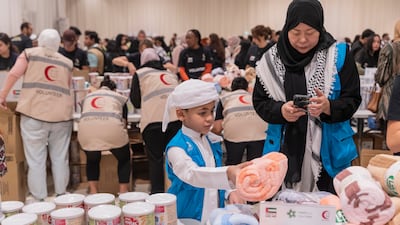
Volunteers pack aid for Palestinians in Gaza at Al Rimal Hall in Dubai on Saturday. All photos: Antonie Robertson / The National -
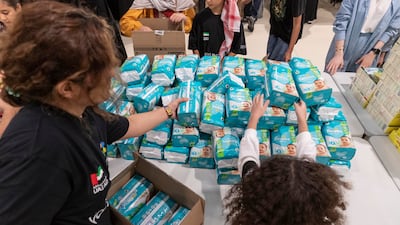
The packing operation, overseen by Dubai Cares, ran between 9am and 2pm. -
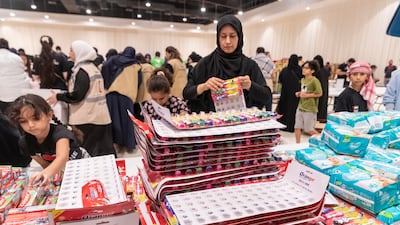
Similar events were due to take place on October 22 in Abu Dhabi and Sharjah. -
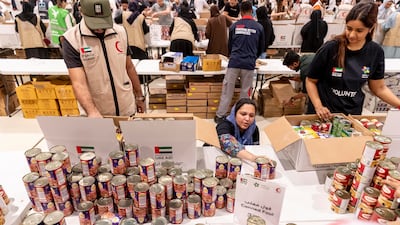
The collections have been supported by volunteers from across the UAE, as well as public and private institutions. -
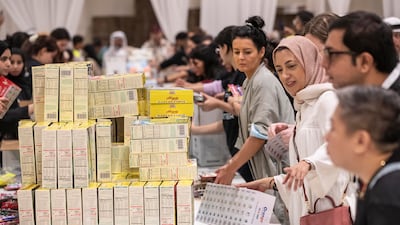
The weekend events aim to prepare 25,000 relief packages. -
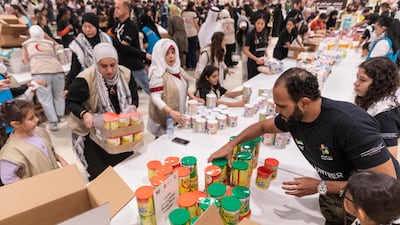
On Friday the UAE sent a plane carrying 68 tonnes of vital food supplies to the Gaza Strip as part of its continuing humanitarian support for the Palestinian people. -
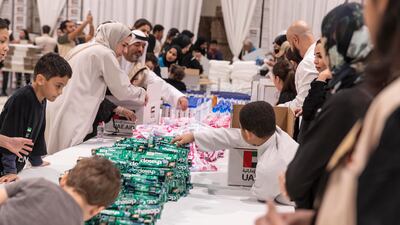
The event comes as the first lorries carrying humanitarian aid started crossing into Gaza from northern Sinai, in Egypt. -
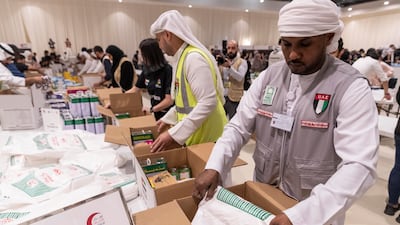
Malls across the region have been handing out donation boxes to shoppers to collect aid. -
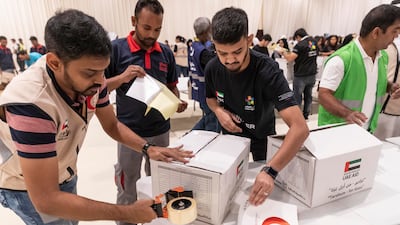
Donations have included cash, blankets, canned food, new clothes and children's supplies. -

Packed boxes of aid for Gaza are stacked up in Al Rimal Hall, in Dubai. -
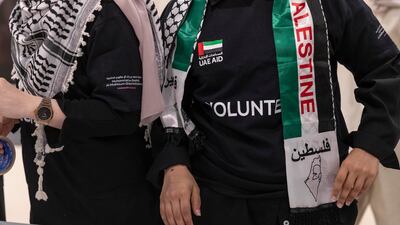
Volunteers pack aid for Palestine as part of the Dubai Cares Tarahum for Gaza Campaign. -
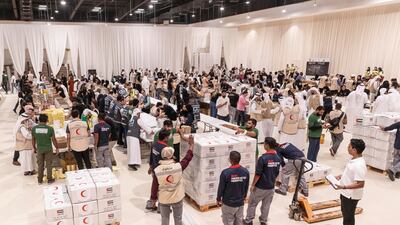
Rows of volunteers and charity workers pack and stack the boxes of aid for Gazans, at Al Rimal Hall in Dubai.


Legacy of support
Dubai Cares – with the generous help of the UAE public – has launched a number of fund-raising campaigns in support of Palestinian families.
In 2018, a joint effort with UNRWA raised Dh2.28 million ($620,000), providing 6,647 food baskets to schoolchildren and their families in Gaza.
A subsequent campaign in 2019 raised Dh3.8 million, delivering an additional 4,460 food baskets. In the same year, another scheme helped to pay for an entire academic year for 22 pupils.

After the outbreak of conflict in Gaza, Dubai Cares moved quickly to intensify its charitable work.
The Gaza in Our Hearts campaign – held in 2024 – raised Dh15.65 million and provided one million hot meals to people in the Gaza Strip.
“A key element of this campaign’s success was our commitment to transparency,” said Dr Al Gurg. "Donors received regular updates on how their contributions were making a tangible impact, strengthening engagement and maximising support."
Dubai Cares has robust measures in place to ensure the aid its fund-raising generates reaches those in need.
“We conduct field visits when possible and rely on video documentation when access is restricted, as was the case during our Gaza In Our Hearts initiative,” the Dubai Cares chief added. “The organisation also collaborates with Palestinian staff and local implementing partners to oversee school and project site visits, ensuring accountability and transparency.”
For Ramadan this year, Dubai Cares collaborated with the Palestinian Business Council in Dubai and the Northern Emirates to organise a suhoor event with donors and businessmen to raise funds to support Gaza.
More than Dh1.8 million was collected at the event to support affected people in the strip.
The charitable endeavours are integral to a wider push across the Emirates to support the Palestinian people.
A nationwide relief campaign, called Operation Gallant Knight 3, was launched by President Sheikh Mohamed after the outbreak of the war.
More than 65,000 tonnes of aid has been delivered through air, and across sea and land, to date, with close to 600 air trips, seven transport ships and nearly 3,500 lorries used to carry goods from Egypt into Gaza. Additionally, an air-drop operation has delivered more than 3,700 tonnes of humanitarian aid to inaccessible areas by parachute.
The UAE on Friday evacuated 188 Palestinians from the Gaza Strip, in co-ordination with the World Health Organisation.
They included 81 patients – half of whom are children – set to receive treatment for cancer or serious injury, joined by 107 family members. It was the 24th such aid flight conducted to provide Gazans with essential health care.

