

Two African manatees given a new life in the UAE a year ago are drawing the crowds at The National Aquarium Abu Dhabi.
Nyokoti and Sengou were relocated from South Korea by the aquarium and it led to a collaboration between it and the Mohamed bin Zayed Species Conservation Fund and the African Aquatic Conservation Fund.
The ambitious project aimed to give the two best friends a fresh start but also spearhead conservation efforts and bolster appreciation for the wonders of the marine world.
Nyokoti and Sengou, aged between 15 and 20, would not have survived in the wild. But with the right care and a specialised habitat created for them at the aquarium, they started to thrive and are now a star attraction at the facility in Al Qana.
“They are quite a magical animal,” said Paul Hamilton, general manager at the aquarium, who accompanied the mammals on their epic journey here. “They are not something that you get to lay eyes on very often.”
When The National visited on Thursday, visitors gazed at the two as they were getting fed by a diver. Both eat mostly greens and can munch through 50 kilograms a day of greens such as lettuce and spinach. They like pak choi but beetroot is their favourite snack. They have an unusual way of moving along the sea floor – almost walking along the bottom – and they can have different personalities. Sengou, for example, is more outgoing than Nyokoti.
“He would approach you right from the start,” said Mr Hamilton. “He had a certain curiosity about him,” he said. “Nyokoti just had no trust. He would prefer we were not around. He stayed closer to wild behaviour,” he said with a chuckle.
-

Two African manatees are drawing the crowds at the National Aquarium Abu Dhabi. All photos unless where stated: Victor Besa / The National -
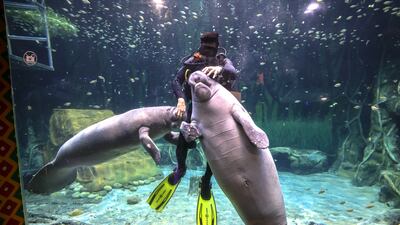
Nyokoti and Sengou have lived at the aquarium for a year, after being relocated from South Korea. -
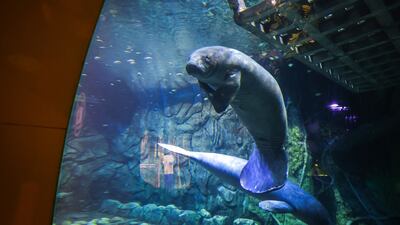
Nyokoti and Sengou, aged between 15 and 20, would not have survived in the wild. -
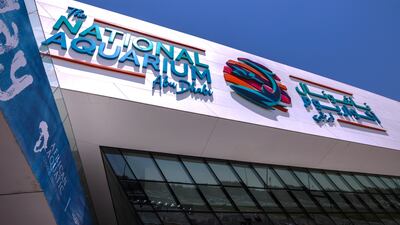
The aquarium is to host a week-long celebration to commemorate the anniversary of their arrival. -
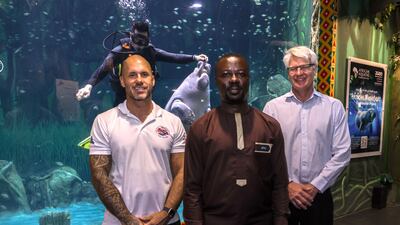
From left, Paul Hamilton, general manager at the aquarium, Clinton Factheu, a specialist in African manatee conservation, and Nicolas Heard, of the Mohamed bin Zayed Species Conservation Fund. -
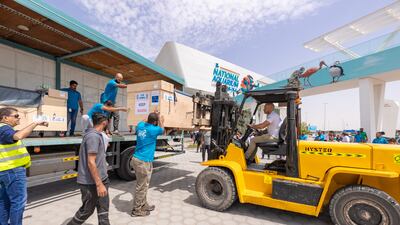
The African manatees arrived at The National Aquarium Abu Dhabi in 2024. Photo: The National Aquarium Abu Dhabi -
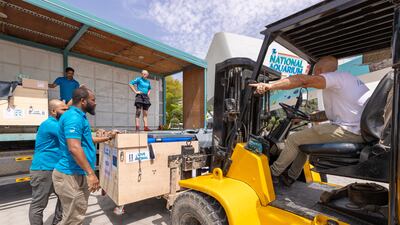
They were transported on a cargo plane. Photo: The National Aquarium Abu Dhabi -
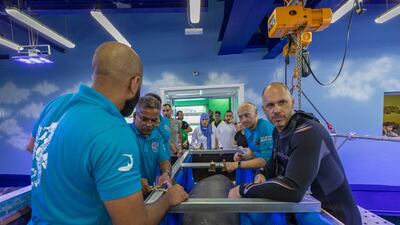
They were accompanied by a team of specialists and monitored throughout. Photo: The National Aquarium Abu Dhabi


The aquarium, one of the few worldwide to host these secretive creatures, is now hosting a week-long celebration to commemorate the occasion. The March 31 to April 6 festivities will include live feeding, talks, children’s activities and music performances.
“I think they're very memorable, these two," said Mr Mr Hamilton. "Especially when they're interacting, then they really draw a crowd.”
Manatees – relatives of the dugong, which is found in UAE waters – are shy, gentle and often solitary creatures rarely seen in the wild and will avoid human interaction. The African manatee is listed as "vulnerable" on the IUCN Red List of Threatened Species, inhabits shallow coastal waters, wetland systems and rivers from Senegal to Angola.
They can grow up to a maximum length of 450cm and weigh up to 400kg. In the wild it is practically impossible to see them, with the creatures only breaking the surface with their nostrils if the coast is clear. This means the fact they are a threatened species – chiefly from poaching but also as by-catch, entrapment in dams and habitat loss – is less known.
“We know little about them and they are very threatened,” said Clinton Factheu, a PhD student from Cameron, who has benefitted from the partnership and has travelled to the UAE to study the manatees. “I decided to dedicate my career to them.”
Mr Factheu, who has only ever seen a full manatee in real life before now, said improving the lives of local communities so they don’t have to poach fish to eat was important in protecting the manatee. They also bolster ecosystems as they feed invasive plants and clean up the banks of water systems so awareness was important.
“It is an amazing opportunity for me," said Mr Factheu, adding there were very few researchers in Africa working on them and he hoped this project would change that. "It's amazing, I'm like in heaven.”

Under the partnership, the aquarium will donate funds for the conservation of the mammals from proceeds from its retail shop. The funds are managed by Mohamed bin Zayed Species Conservation Fund in partnership with the African Aquatic Conservation Fund, an NGO that works across 19 West African countries. The project will also provide support for at least ten researchers and African graduate students.
Nicolas Heard, acting director general at the Mohamed bin Zayed Species Conservation Fund, said the presence of the manatees in Abu Dhabi will allow researchers such as Mr Factheu to study the animals and gather crucial data to bring these animals back from the brink.
“For us as an organisation to tie that back to conservation of the animals in the wild is really, really important,” he said.
“That is the crucial connection between the work that the National Aquarium here is doing and the work that conservationists are doing in Africa.”
The fund since its formation in 2008 has given more than $27m in grants to help bring 1,789 species back from the brink of extinction. This is all the more pertinent given the alarming recent report that more than 47,000 species around the world are threatened with extinction, according to the latest global Red List.
“There's such fabulously charismatic animals,” said Mr Heard. “Most people don't have the opportunity even to see just the nostril of a manatee in the wild and yet here there's an opportunity for people to engage with the animals, to view them, to observe them – to wonder at how amazing they are.”

