

Live updates: Follow the latest on Israel-Gaza
A young Gazan man who was forced to wait for months to cross the Rafah border so he could donate his kidney and save his father's life was left heart-broken when he found out he had arrived a few days too late.
Hamza Mousa, 21, was near his neighbour’s house in Tal Al Hawa, in southern Gaza, when the building was reduced to a pile of rubble by an Israeli air strike. Mr Mousa, who was injured in the blast, saw one positive in his own pain – that it gave him a chance to reach his dying father after months of waiting while the border separating Gaza from Egypt was closed, due to his need for treatment at the UAE floating hospital in Al Arish.
His father had been diagnosed with kidney failure and managed to cross the border with his wife during Ramadan last year to receive treatment in Egyptian hospitals. “He was having kidney dialysis regularly. His heart was weak, too,” Mr Mousa told The National. “I wanted to donate my kidney to him so he could stay alive but the borders were closed. He passed away last Wednesday [March 12, 2025] and I crossed the border on Sunday [March 16]. I couldn’t reach him in time.”
Surviving 'unimaginable suffering'
Since the war began in October 2023, Gaza has been under siege, with only limited supplies entering the region. Mr Mousa, who was injured on October 7, 2024, recounted the day that changed his life.
“The Israeli army hit our neighbour’s house and I was hit with shrapnel,” he said. “I woke up in Al Mamdani Hospital in Gaza and saw my leg wrapped. The doctors told me I needed surgery to insert a platinum plate." He said about 10cm of one of the bones in his leg was destroyed.

After surgery, doctors advised Mr Mousa to leave Gaza for further treatment and placed his name on a list of injured people in urgent need of treatment. When he eventually arrived, it gave him hope he would one day be able to walk again normally, but it was too late for him to save his father. “I left Gaza and crossed the Rafah border directly to the UAE floating hospital. They took X-rays and blood tests for treatment. I hope I can walk normally again.”
Mr Mousa, a construction worker, is one of seven siblings – six boys and one girl. “I left with all my brothers. Only my eldest brother stayed behind,” he added. “We have survived wars, blockades and unimaginable suffering. I don’t know what will happen to me in the future but we thank God for everything.”
Still critical need for care
The UAE's floating hospital in Al Arish, Egypt, has admitted about 30 patients from Gaza since the start of the ceasefire that came into effect on January 19. As part of Operation Chivalrous Knight 3, the medical centre receives patients through the Rafah crossing. The 100-bed floating hospital set sail from the UAE in February last year.
The hospital was established jointly between the Ministry of Defence, the Department of Health Abu Dhabi and the Abu Dhabi Ports Authority group, and involves about 100 medical and administrative staff specialising in anaesthesia, general surgery, orthopaedics and emergency services.
“With the dedication of specialised medical teams and state-of-the-art equipment, we have treated thousands of patients and performed hundreds of critical surgeries,” said Mohammed Saeed Al Shehhi, the hospital’s director. “We remain committed to providing the highest standards of medical and humanitarian care, easing the suffering of the injured and fostering hope for recovery.”
The UAE's floating hospital - in pictures
-
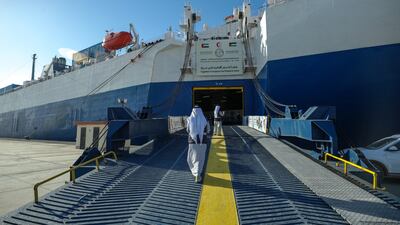
The UAE's floating hospital in Al Arish, Egypt, has provided treatment for thousands of Gazans. All photos: Victor Besa / The National -
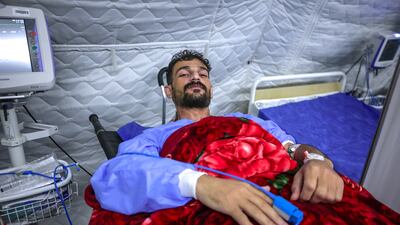
Nashaat Abdul Bari, 31, is among the patients at the hospital, which was established in February 2024. -
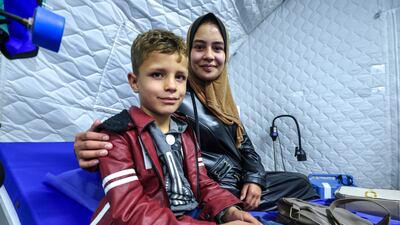
Palestinians Zain Aldery, seven, and his sister Assil, 21. The hospital was set up as part of the UAE's Operation Gallant Knight 3. -
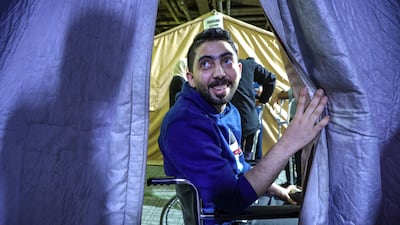
Ayman Ibrahim, a patient on the vessel, where thousands of surgical procedures have been carried out to help those injured in Israel's war on Gaza. -
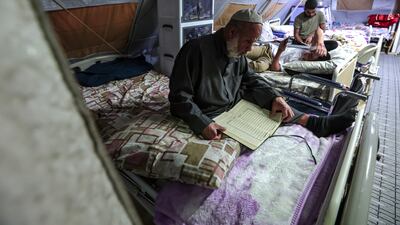
Patients read the Quran during Ramadan on the floating hospital. -
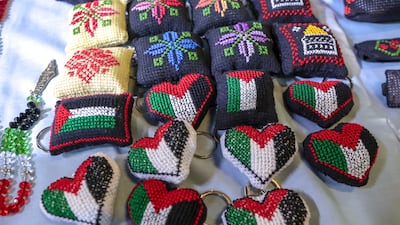
Palestinian handicrafts onboard hospital, where social and recreational activities are held, including programmes for children. -
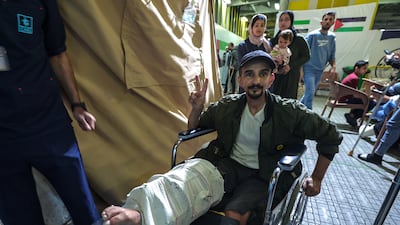
Patients receive care from an Emirati medical and administrative team, working alongside Indonesian staff. -
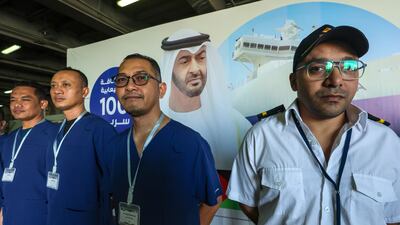
Ship staff onboard the hospital at Al Arish. Operation Gallant Knight 3 was launched by UAE President Sheikh Mohamed. -
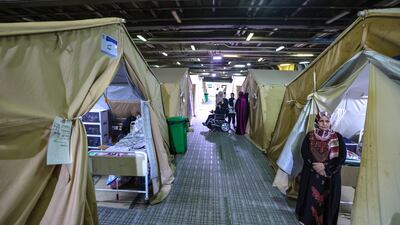
The floating hospital has 100 patient beds, with 100 more for accompanying relatives.



