

Two new Salik gates in Dubai – at the Business Bay Crossing on Al Khail Road and at Al Safa South on Sheikh Zayed Road – will be activated on Sunday, taking the number of tolls in the emirate to 10.
Announced by the Roads and Transport Authority in January, the gates will collect the standard Dh4 every time a vehicle crosses them and will aim to reduce traffic congestion by 12 to 15 per cent in the Business Bay area and by 15 per cent in Al Safa area.
In January, Salik Company – the operator of the toll gates – explained that the locations were chosen following traffic studies to reduce congestion.
“The addition of new toll gates in two increasingly busy locations marks the latest milestone in the growth plan that we set out at the time of Salik’s initial public offering," Ibrahim Al Haddad, chief executive of Salik, said at the time. Mattar Al Tayer, director general of the RTA, added that Dubai's road toll strategy was key to its efforts to reduce traffic.
Al Safa South gate will be linked to the older Safa North gate an, like the Mamzar gates, will only charge a single payment from those crossing both gates within an hour.

In an earlier interview, Mr Al Haddad said it was the first time that Salik gates would be solar-powered, supporting the authority's "sustainable growth agenda" and "commitment to green energy".
He also said that plans were under way to power all Salik gates by solar energy over the next few years.
The Salik chief executive said the toll gates had "contributed to reducing the total travel time across the emirate by approximately 6 million hours annually and increased the number of public transport users by about 9 million passengers annually”.
During its IPO announcement in 2022, Salik had hinted at plans to introduce “dynamic pricing”, which varies depending on the time of the day. “The Roads and Transport Authority could implement dynamic pricing through optimising the toll rates depending on the time of the day, for example, by charging a higher toll fee for specific lanes or during peak hours," the IPO announcement read.
It said that the system would be based on similar models used in other cities, such as Dallas and Stockholm.
In a series of social media posts, Salik said the new gates will improve accessibility to areas such as Jumeirah, Downtown Dubai, Dubai Water Canal and Al Safa, among others.
Why Dubai introduced toll gates?
The Salik system was introduced in 2007 to ease traffic congestion, raise state revenue and encourage residents to use public transport. The first two gates came up in Gharoud and Barsha, with Safa and Maktoum bridge gates added a year later. In 2013, three gates were introduced at Airport tunnel, and two at Mamzar – south and north. In 2018, the Jebel Ali gate was introduced.
Motorists are charged Dh4 to pass through each gate, with the amount deducted automatically from tags fixed to vehicle windscreens. The tags can be purchased online or at service stations, and topped up online or through recharge cards.
The toll gates:
- Al Barsha
- Al Garhoud
- Al Maktoum
- Al Mamzar South
- Al Mamzar North
- Al Safa
- Al Safa (South)
- Airport Tunnel
- Jebel Ali
- Business Bay
Penalties
-
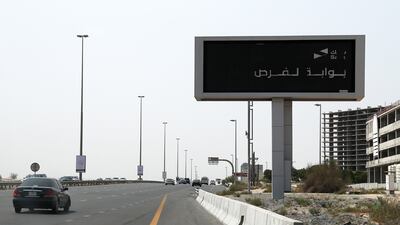
Electronic traffic signs on Umm Sequim St, which is being used to advertise the new Salik IPO scheme in Dubai. Pawan Singh / The National -

Vehicles pass under a toll gate on Sheikh Zayed Road in Dubai on Monday, September 5, 2022. Toll gate operator Salik will make an initial public offering on the emirate's stock market, becoming the latest state-linked company to list. AP -

Electronic traffic signs on Al Khail, which is being used to advertise the new Salik IPO scheme in Dubai. Pawan Singh / The National -
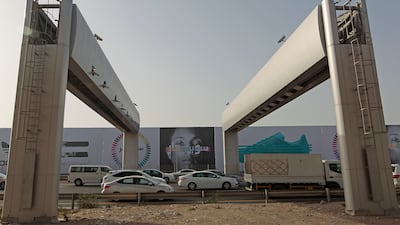
Drivers are charged Dh4 ($1.09) for each gate that they pass through. There are eight gates at present, but Salik's IPO prospectus says that more could be built. The National -
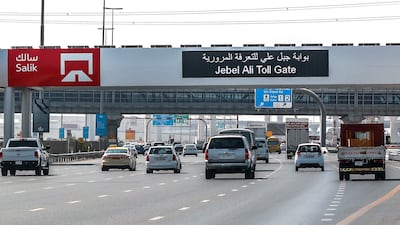
Motorists are required to have a tag on the windscreen of their car and an online account to use the high-speed motorway. Victor Besa / The National -
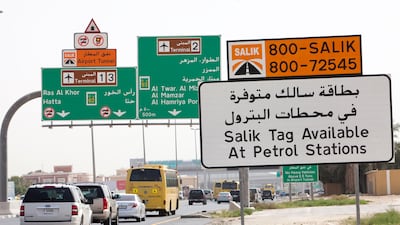
Signs warn drivers that they need a tag on their vehicle to use this road. Jaime Puebla / The National -
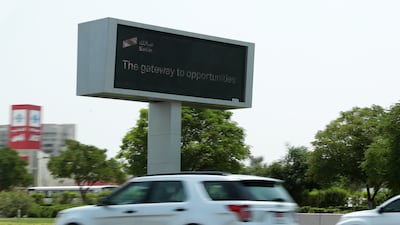
Electronic traffic signs on E311 highway, which is being used to advertise the new Salik IPO scheme in Dubai. Pawan Singh / The National


Every vehicle must have a Salik tag, with new vehicle owners given a 10-day grace period to install and activate one.
Passing through Salik gates without a tag will incur a fine of Dh100 for the first offence, Dh200 for the second offence and Dh400 every time after that.
There’s currently no daily cap on Salik, with every gate charging a fee of Dh4 every single time a vehicle passes through.
Maktoum bridge closure
Al Maktoum bridge in Dubai, where one of the 10 Salik gates is positioned, will remain closed for long durations until January 16, 2025, the RTA previously announced. It will be closed between 11pm and 5am on Monday to Saturday and all day on Sunday during this period. First opened in 1963, it connects travel between Bur Dubai and Deira.
The bridge's toll gate does not charge motorists on Sundays and is free to travel through from 10pm to 6am daily. During the partial closure for the next two months, the RTA has urged drivers to take alternative routes.
If going from Deira to Bur Dubai:
- Al Shindagha Tunnel through Baniyas Road and Al Khaleej Street
- Infinity Bridge through Baniyas Road, Al Khaleej Street and Corniche Street
- Business Bay Crossing Bridge through Baniyas Road, Sheikh Rashid Road and Rebat Street
- Al Garhoud Bridge through Baniyas Road and Sheikh Rashid Road
If travelling from Bur Dubai to Deira:
- Al Garhoud Bridge through Oud Metha Road and Sheikh Rashid Road
- Infinity Bridge or Al Shindagha Tunnel through Tariq Bin Ziyad Road, Khalid Bin Al Waleed Road and Al Khaleej Street
- Business Bay Crossing Bridge through Oud Metha Road and Al Khail Road Dubai

